
Milosevic: the mystery deepens

Curiouser and curiouser… Milosevic Possibly Manipulated His Medication to Fake Illness

A top toxicologist in the Netherlands said that he believed Slobodan Milosevic, the former Yugoslav leader, was manipulating medication to fake a medical condition, a plan that might have played a role in the heart attack that caused his death.

That theory was advanced by Dr. Donald Uges, professor of clinical and forensic toxicology at the University of Groningen, who posited that Milosevic was seeking to demonstrate that Dutch doctors could not cure him and that he should therefore be allowed to seek treatment, and freedom, in Moscow. He was imprisoned here on charges of war crimes and crimes against humanity including genocide during three Balkan wars in the 1990s.

Uges based his theory on his detection in Milosevic’s blood of a drug that had not been prescribed for him and that was not only inappropriate but, under the circumstances, dangerous. He was found on his bed in his prison cell on Saturday morning. The drug at issue is an antibiotic known as rifampicin, used to treat serious bacterial infections, such as tuberculosis. It is known to interfere with medications he was taking for high blood pressure.
Impossible to summarise…

… so you’ll just have to see for yourself. But the title conveys the essence:

The Slow and Painful Collapse of a Relationship Over the Course of a Weeklong Vacation as Expressed by the Names Each Partner Gave Their Digital Photos Taken During Said Vacation.

Very clever idea — by Matt Hulten.

The Road To Guantanamo

Here’s something really interesting that I’d missed — Michael Winterton’s film, The Road To Guantanamo, which was screened on Channel 4 the other night, was made available for immediate download over the Net. Cost: £4.99 to own; £2.99 to ‘rent’. This was a brilliant move — not just in demonstrating an alternative distribution channel, but also in enabling the film to be seen in countries which might otherwise not be given the chance to see it.

A frivolous query

One of my friends has just acquired a BlackBerry. I sent him a cheery greeting and then fell to wondering if a friendly message from one Crackberry user to another should be called a BlackBerry cordial. I only ask.

The early bird

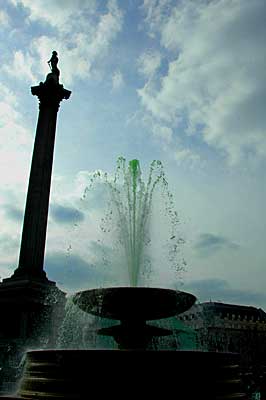
I had a text message this morning from one of my sons explaining that the water in the Trafalgar Square fountains in London was running green. (Later, he sent me the above photograph.) It turns out that Mayor Ken Livingston is celebrating St. Patrick’s day a few days early (it falls on next Friday). There’s a parade, a screening of Irish films at the Barbican and the Mayor hosted a big dinner last night.

How times change. We’re accustomed to big celebrations of St Patrick’s day in the US — where the Irish-American diaspora wields huge economic and political power. But traditionally the Brits used to look down their noses at the Irish. In my lifetime there used to be notices in English boarding houses saying “No Blacks or Irish”. We supplied the manual labour that built British railways and motorways — and a good many post-war houses. Thirty years ago the idea of the city of London officially celebrating its Irish community would have provoked outrage (legitimated perhaps by IRA terrorism).

How things change. One of the ironies of Irish economic growth is the fact that English plasterers and bricklayers are now much in demand — building for my countrymen, in Ireland! Alongside Poles, Latvians, Lithuanians and others.

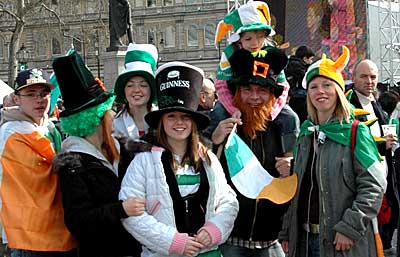
Later… More reports and photographs suggest a different interpretation. For example, this…

… suggests that corporate sponsorship (courtesy of that faux-Irish firm Guinness — which is in fact owned by Diageo) had a big hand in the festivities. And the idiotic get-up of other participants (Elvis O’Presley, for example) brings to mind Yeats’s great rebuke to a baying mob of Dublin philistines in the Abbey Theatre: “You have disgraced yourselves — again”. It’s the ‘again’ that I love.

For more pics, see Brian’s Flickr photostream.

A Profumo Limerick

Date: circa 1963, quoted in today’s Daily Telegraph obit:

O what have you done? said Christine
You’ve disrupted the Party machine
To lie in the nude
Is not very rude
But to lie in the House is obscene.

Less preening, George, if you please

Tom Sutcliffe has a nice piece in the Indie [now, alas, behind a paywall] taking George Clooney to task for his Oscar speech in which he said: “We were a little bit out of touch every now and then in Hollywood and I think that’s probably a good thing. We were the ones to talk about Aids when it was just being whispered. And we talked about civil rights when it wasn’t really popular”. (Cue waves of self-satisfied applause.)

Oh yeah? says Sutcliffe. The Aids crisis first broke in 1981 and was global news by 1983. The first film to deal with it at all — An Early Frost — came out in 1985 and was made not by Hollywood but by NBC. It wasn’t until Philadelphia in 1993 that Hollywood really acknowledgd Aids. Similarly with civil rights. In the Heat of the Night and Guess Who’s Coming to Dinner were both made in 1967 — 13 years after the first struggles over segregated education.

So less of the preening, George.

Slingbox

Interesting gizmo. Blurb reads…

Introducing the Slingbox™ — a groundbreaking piece of hardwired ingenuity that will literally transform the way you watch television.

The Slingbox enables you to watch your TV programming from wherever you are by turning virtually any Internet-connected PC into your personal TV. Whether you’re in another room or in another country, you’ll always have access to your television.

That’s assuming you want to, of course. Costs $249. Only available in the US at the moment, as far as I can see.

John Profumo

BBC Online report

John Profumo, who was at the centre of one of the UK’s most famous political scandals, has died at the age of 91.

John Profumo’s public life was dramatically split into two parts: disgrace and redemption.

Nearly 40 years after he misled the House of Commons and helped bring down the Macmillan government, the former politician was a dedicated charity worker, for whom his friend Lord Longford “felt more admiration than all the men I’ve known in my lifetime”.

Nice coda by Martin Kettle:

Sixty five years ago this week, in March 1940, the 25-year-old John Profumo was elected to parliament in one of those odd, not properly contested, wartime byelections, as the Conservative MP for Kettering (his only rival for the seat was a rebel Labour councillor who ran as a Workers’ and Pensioners’ Anti-war candidate).

His victory brought the young Profumo on to the Tory benches just in time for perhaps the single most important parliamentary vote of the 20th century – the “Norway debate” of May 8 1940.

Although the Norway debate was ostensibly about one theatre of the British war effort, and ironically one over which Winston Churchill (then first lord of the Admiralty) had charge, it was in practice about the credibility of the Chamberlain government to lead Britain through the worsening war crisis in Europe.

Thirty-three Tories voted against the government that day, and another 65 abstained. The result was the fall of Chamberlain and the formation of the wartime coalition under Churchill.

John Profumo was the last surviving Tory MP to have voted against Chamberlain that night long ago.

He may have helped to wreck his party in the 1960s, but in May 1940 Profumo helped to save his country. That’s worth remembering too.

For me, though, the enduring image of the ‘Profumo affair’ is Lewis Morley’s wonderful photograph of Christine Keeler, the beautiful call-girl for whom he fell. The original is in the V&A Museum.