
Wide open

I love north Norfolk for its open skies, beaches and birdlife. This was Brancaster the other day.
Quote of the Day
“Chopsticks are one of the reasons the Chinese never invented custard.”
- Spike Milligan
Musical alternative to the morning’s radio news
Randy Newman | Old Kentucky Home
If you want cynical despair set to music, then this is it!
Long Read of the Day
What are universities for?
AI can help answer the question.
My latest Observer column:
One of the great pleasures of working in a university is that, at this time of the year, a fresh cohort of bright young school leavers arrives to begin the next phase of their lives. For many of them, it will be their first experience of living away from home, the first time they will be treated as adults and the first time that they may understand Wordsworth’s lines about how it might be bliss to be alive, but “to be young was very heaven”.
There is, however, one thing about the current crop of freshers that’s different from their predecessors of four years ago. Many, if not most, of them are “AI natives” in the way children used to be “digital natives” – that is, adept at using a technology they don’t understand. And they are entering educational institutions that still don’t know what to do about the technology.
Luckily, one of the world’s great universities – the Massachusetts Institute of Technology (MIT) – has also been grappling with that problem. It set up a large working group consisting of undergraduate and graduate students, academics from every school, and staff from relevant units, including the MIT libraries, and teaching and learning lab. It spent five months thinking about and discussing what to do about AI. It has now published a report that is the most impressive attempt I’ve seen to confront an issue that could be the undoing of many universities.
The report’s central message is that AI should be approached as a question of what a university is for rather than, as now, a question about cheating and academic integrity. The brief the MIT group was given at the outset was the kind of bureaucratic one that you’ll find in most universities at the moment: assess AI use at MIT, identify innovations in teaching and student assessment, and propose an AI-use policy. But the team dug deeper and concluded: “Beyond its implications for specific subjects and disciplines, the advent of AI demands a broader, holistic reassessment of the nature, scope and purpose of higher education today.”
It’s right. Universities are supposed to be institutions that create, curate and pass on knowledge. Large language models, as the psychologist Alison Gopnik and her colleagues have argued, are “cultural technologies”, like books, libraries and language itself – tools people use to access the knowledge created by them. So, whether we like it or not, universities and AI are in the same business.
Harassed vice-chancellors at UK universities may – understandably – chafe at philosophical debates about the function of the university that go back to John Henry Newman. But there are some takeaways from the MIT report that are more immediately relevant. First, detection and policing of AI use is a dead end. The tools produce too many false positives (especially for non-native and neurodivergent students). And – more importantly – they undermine the relationship between teachers and students.
Second, assessment needs to be rethought from the ground up. Most of the proposed “solutions” (oral exams, portfolios, and out-of-class work combined with in-class conversation, etc) all need academics’ time, physical space and probably smaller classes. The bottom line is that an AI-aware curriculum costs money, which is bad news for cash-strapped institutions.
Third, there have to be clear guidelines about AI use or non-use in every discipline or course, and the reasons for them have to be transparent and understood by students and teachers. In some cases, AI use may be unrestricted because it doesn’t undermine the learning objectives; in others, it may be allowed as a support tool only. Also, in certain cases, students may be required to use AI to complete and assignment in a specified manner; and then there will be cases where its use is strictly verboten. In pedagogy, no one size fits all.
Universities can no more ignore AI than they could ignore the printing press. The arrival of the technology could give them a new mission to add to their original ones of creating, curating and transmitting knowledge: to demonstrate AI’s potential for human augmentation. If they get this right, they’ll turn out graduates who use the technology with judgment rather than as tentative prompters. And then we’ll have an answer to the question of what are universities for that even cabinet ministers may understand.
My commonplace booklet
Re today’s Long Read (see above), the guy who started me thinking about this was Eli Noam of Columbia in his 1995 paper “Electronics and the Dim Future of the University”.
Having set out his conclusion about the “dim future” he wrote:
All this is a bleak scenario for the future of the university. In making this argument it is easy to appear as yet another dismal economist or technological determinist, and to invite, as a response, a ringing reaffirmation of the importance of quality education, of academic values, of the historic role of education in personal growth, and of the human need for free-wheeling exchange. To make such arguments may feel good but is beside the point. The question is not whether universities are important to society, to knowledge, or to their members — they are — but rather whether the economic foundation of the present system can be maintained and sustained in the face of the changed flow of information due to electronic communications. It is not research and teaching that will be under pressure — they will be more important than ever — but rather their present main instructional setting, the university system. To be culturally important is necessary (one hopes) but unfortunately not sufficient.
After I’d read the paper I used to ask every senior British university administrator I met if they had read it. With only one exception, none had.
This was in 1995, a time when ‘Artificial Intelligence’ was still a minority sport.
The other interesting thing is that Eli focussed on what the MIT team realised as they were reflecting on the implications of AI for their university. “True teaching and learning,” he wrote,
are about more than information. Education is based on mentoring, internalization, identification, role-modeling, guidance, and group activity. In these processes, physical proximity plays an important role. Thus, the strength of the future physical university lies less in pure information and more in college as a community. Less in wholesale lecture, and more in individual tutorial. Less in Cyber-U, and more in Goodbye-Chips College.
Linkblog
Something I noticed, while drinking from the Internet firehose.
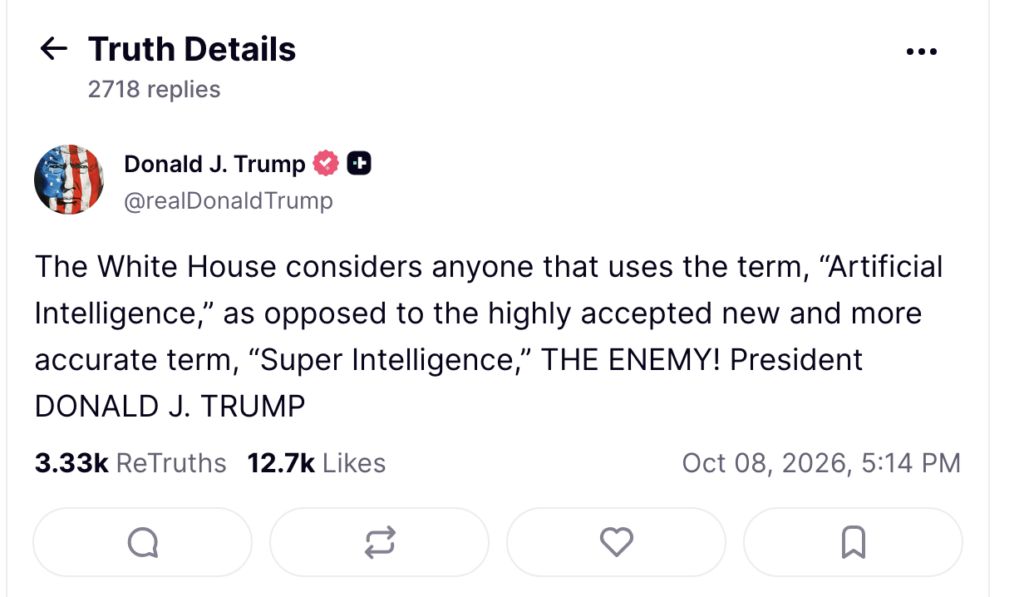
- Trump clarification
This Blog is also available as an email three days a week. If you think that might suit you better, why not subscribe? One email on Mondays, Wednesdays and Fridays delivered to your inbox at 5am UK time. It’s free, and you can always unsubscribe if you conclude your inbox is full enough already!