The dancer
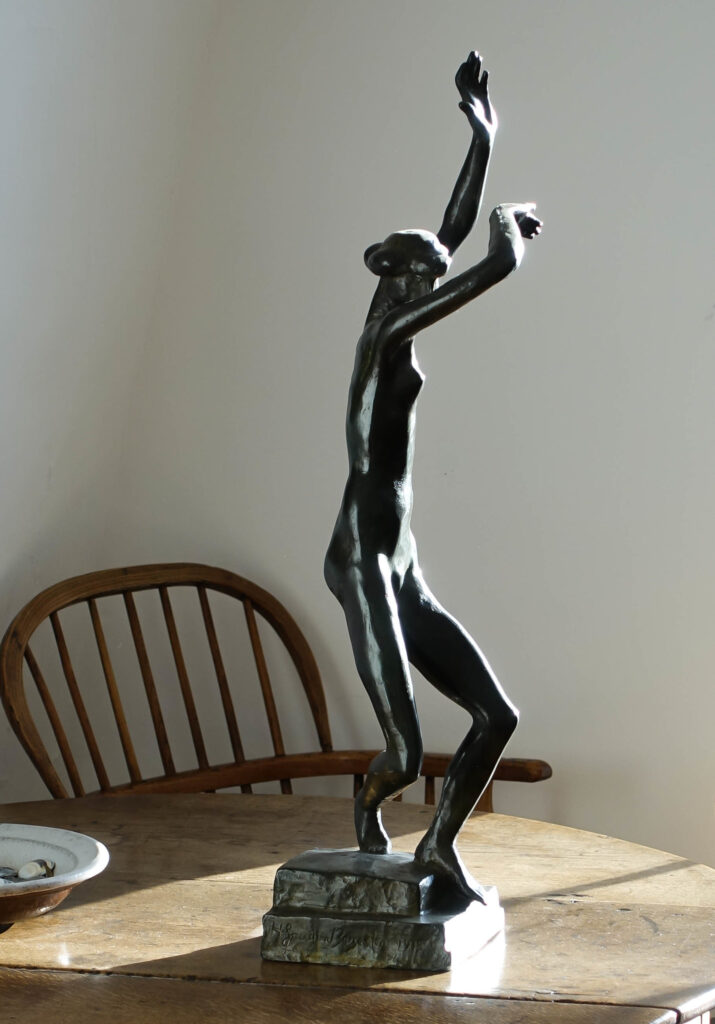
In Jim Ede’s house, Kettles Yard, Cambridge.
Quote of the Day
“And God said, ‘Let there be light’ and there was light, but the Electricity Board said He would have to wait until Thursday to be connected.”
- Spike Milligan
Musical alternative to the morning’s radio news
Abdullah Ibrahim | Bra Timing From Phomolong
Long Read of the Day
Against historic normalization: Why AI is not the Manhattan project and why we must challenge ourselves to think the radically new.
Very timely Substack post by the historian Adam Tooze.
Given the extremity of our moment there is an understandable desire to look to history as a possible source of orientation: hegemonic succession, fascism, the nuclear arms race, Cold War 2.0, middle-income trap, Japan 1990s etc are all commonly invoked.
In each case the motive is understandable and the discussion is often fruitful, but more often than not the effect is comforting and to that degree also misleading.
Fascism was a political force that was defeated.

If we are in an interregnum then there is a new order to come.

The nuclear arms race was managed and the “West won the Cold War”.

If there are middle-income traps, then China’s growth must ultimately end and the “natural order” of world hierarchy will reassert itself.
To my mind each of these analogies follows a similar pattern. You start with uncertainty, reach for history and arrive at a narrative which, even if it is not fully spelled out, actually has a reassuring conclusion. The fact that the conclusion remains tacit contributes significantly to the consoling effect.
To put it the other way around, if any of this chosen repertoire of stories had truly nightmarish conclusions would we really be invoking them so light-handedly?
To avoid that vertiginous turn involves subtle shifts of focus…
I love thinkers like Tooze (and others like Henry Farrell) who manage to put our current fears and obsessions into a wider context. This is worth your time.
Linkblog
Something I noticed, while drinking from the Internet firehose.
- NASA Details Earthquake Effects on the Earth
NASA scientists using data from the Indonesian earthquake calculated it affected Earth’s rotation, decreased the length of day, slightly changed the planet’s shape, and shifted the North Pole by centimeters. The earthquake that created the huge tsunami also changed the Earth’s rotation.
Dr. Richard Gross of NASA’s Jet Propulsion Laboratory, Pasadena, Calif., and Dr. Benjamin Fong Chao, of NASA’s Goddard Space Flight Center, Greenbelt, Md., said all earthquakes have some affect on Earth’s rotation. It’s just they are usually barely noticeable.
”Any worldly event that involves the movement of mass affects the Earth’s rotation, from seasonal weather down to driving a car,” Chao said.
Gross and Chao have been routinely calculating earthquakes’ effects in changing the Earth’s rotation in both length-of- day as well as changes in Earth’s gravitational field. They also study changes in polar motion that is shifting the North Pole. The “mean North pole” was shifted by about 2.5 centimeters (1 inch) in the direction of 145 degrees East Longitude. This shift east is continuing a long-term seismic trend identified in previous studies.
This Blog is also available as an email three days a week. If you think that might suit you better, why not subscribe? One email on Mondays, Wednesdays and Fridays delivered to your inbox at 5am UK time. It’s free, and you can always unsubscribe if you conclude your inbox is full enough already!