
David’s

One of my favourite bookshops. Above it is the apartment where Maynard Keynes and his wife Lydia Lopokova used to stay when they were in Cambridge.
Quote of the Day
”Remember your humanity, and forget the rest.”
- Bertrand Russell
Musical alternative to the morning’s radio news
Gerry Mulligan | Night Lights A
Long Read of the Day
AI giants are trying to sell us the apocalypse. Don’t buy it
My most recent Observer column:
Three weeks ago, Jacob Coxon, a hitherto unknown AI researcher who had worked at both OpenAI and Anthropic, resigned and announced on X that his former employers were toying with humanity’s future. “They are racing straight to self-improving superintelligence and gambling with our lives.” Within a day, his post had gone viral. Then, four days later, Anthropic’s chief executive, Dario Amodei, published a long essay calling for a slowdown in AI development until proper safeguards were in place.
Cue, global panic, at least in the mainstream media, with headlines asking: “Will AI kill us all?” Which brings to mind Betteridge’s law: “Any headline that ends in a question mark can be answered by the word no.” As Hugh Linehan puts it in the Irish Times, the law codifies “a time-honoured understanding in media that the headline-question format signals a startling assertion unsupported by sufficient evidence”.
The extreme virality of Coxon’s post raises two interesting questions: why are so many people everywhere drawn to apocalyptic narratives? And what role are such narratives playing for the corporations that are building and pushing AI? Or, to put it more crudely: what are the politics of apocalypse?
The answer to the first question goes far back into the human story. Psychologists have found that bad news is weighted more heavily by us than good news, which is probably an inheritance of our evolutionary past. It’s a cognitive bias that has been endlessly exploited by religions down through the ages, and in the modern era, mass media has fed profitably on it because vivid, catastrophic scenarios are easy to imagine and so feel probable to readers and viewers. “If it bleeds, it leads” has been the motto of every news editor who’s ever drawn breath. Good news is not news, period.
But it goes deeper than that. In his magisterial book The Sense of an Ending, the literary critic Frank Kermode wrote about the enduring human need to impose narrative fictions on the chaos of temporal experience, particularly through ideas of apocalypse and crisis that provide a sense of coherent beginnings, middles and endings. We live in the present and want our lives to belong to a story with a shape, which means an ending. The idea of the apocalypse gives the present time a significance that is also flattering: it suggests that we are living through the decisive crisis of the age.
So our fascination with end times is probably universal. Why should it be more acute just now? Probably because we’re going through a period of accelerating change and dislocation, governed by institutions that we no longer trust, and relying for information on algorithmic systems that reward (and profit from) spreading alarm.
To most citizens, the AI companies’ use of the apocalyptic narrative is baffling. On the one hand, their spiel is that their technology is transformative – it will change the world. On the other hand, it’s also very dangerous. This doesn’t look like a good sales pitch to someone who is going to have a datacentre the size of an aircraft hangar at the bottom of the garden. But in fact, for the companies, the contradiction is the point.
After all, asserting the technology’s world-altering danger is also a way of emphasising its world-altering power, which, in turn, feeds the industry’s insatiable need for further investment. Saying AI “could kill everyone” is, in effect, a way of saying it’s more consequential than any other thing that humans have ever built (with the possible exception of nuclear weapons).
But the real utility of the apocalyptic narrative for the industry is that it distracts attention from more tangible issues over which democracies could have leverage. Such as what? First, there’s the monopolistic power of tech companies, something for which existing legal tools are readily available, provided governments have the political will to use them. Second – even more straightforward – we could just make AI companies legally liable for any harms that their products inflict on us humans. And then we could leave apocalypse to the movie industry, where it belongs.
Books, etc.
A September spent decades ago covering all the UK party conferences made me temperamentally averse to the journalistic rabbit-hole known as the “Westminster bubble”. But I still get Politico’s daily roundup of the political class’s activities in my inbox every morning, which keeps that aversion in good condition.
Recently, though, I discovered that the must-read du jour among the bubble’s residents is Anton Jäger’s Hyperpolitics: Extreme Politicization without Political Consequences and wondered whether I should read it. Before making a decision, though, I looked for reviews and came across Mathias Fuelling’s review in the LA Review of Books. It’s a nice piece of work, and this closing excerpt decided me that life is too short to bother with Jäger. Deep down, he’s shallow.
Jäger’s position appears to be a kind of post-Marxism, focused on the nation-states of the Global North, in which the problem of reviving socialist mass politics is diagnosed through the historical question of the death of mass politics. The true form of Hyperpolitics is that of The pamphlet, a format famously amenable to left-wing purposes. Yet, as the example of the Communist Manifesto (1848) shows, a successful pamphlet is one that comes out of the gates swinging, its punches clear and confident. Hyperpolitics pulls its punches, favoring the maneuvers of the feint, the duck, and the dive. It might as well be titled “Should Something Be Done?”—a diffident update of Lenin’s famous formulation, the title of his 1902 pamphlet on revolutionary strategy: What Is to Be Done? Lacking confidence and coherence, Jäger’s book reads more like an introduction to a larger work that does not yet exist.
Jäger ends his work precisely where it should have started. “Without a reinstitutionalization of political engagement,” he writes, “the left will remain hostage to impotent volatility.” On the second-to-last page, he concludes that sites of work, or “spheres of production and distribution,” remain the key nodes for effecting political change via forms of class conflict. This, he concedes, “may seem naive,” bringing to mind a joke: “the tourist couple who ask an Irish farmer how to get to Dublin; the farmer replies: ‘Well, I wouldn’t start from here.’ Still, the journey will have to begin somewhere.” We reach the end only to discover that the insights on offer add up to the old exhortation that we must organize the working class and further the class struggle against the interests of capital and build up the Left, yet expressed with weariness and cynicism. While this is certainly not the wrong exhortation, in the opinion of this reviewer, it is disappointing that Jäger does not offer a vision of how such a journey is to be made. Rather than provide a map, he gives us a gesture in a particular direction and says good luck.
My commonplace booklet
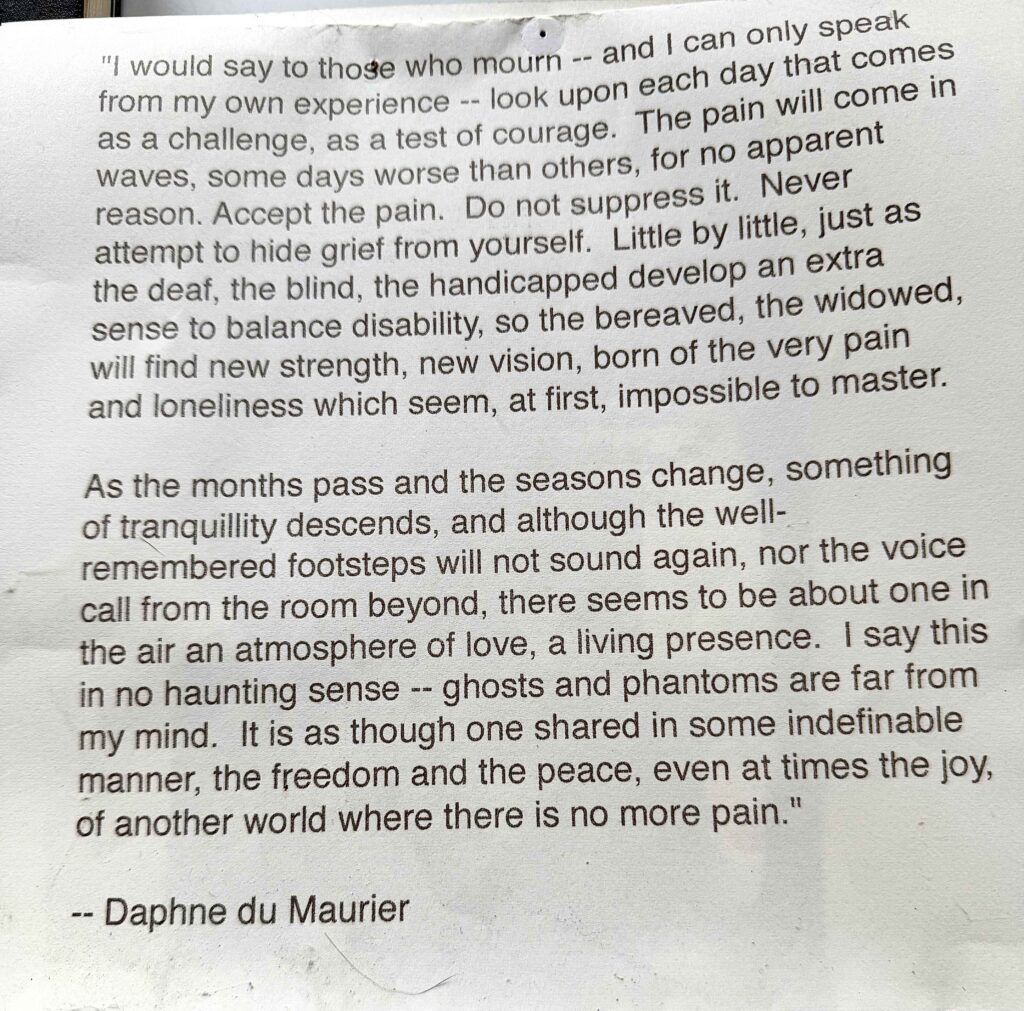
Coping with grief
As ill-luck would have it, four friends have died recently and I’ve spent time thinking about what to say to their families and friends. When my beloved Sue died at this time of the year 24 years ago I was paralysed by grief, and lots of people tried to console me.
One of the most useful pieces of advice came from a neighbour who had lost her husband years ago. She was an admirable, no-nonsense person and her advice was in keeping with her personality. “Expect a year of firsts,” she said. “The first Christmas, the first birthday, the first wedding anniversary, the first visit to the place you both loved, and so on. You’ll be ambushed by grief every time you hit one of them, but if you know it’s coming it’ll be easier to weather it.”
She was right. I also did a lot of reading about grief but found little of it useful. The one exception was C.S. Lewis’s lovely little book A Grief Observed. It resonated with me because he had also met his wife relatively late in life, and lost her to cancer.
And then there was this fragment that I picked up somewhere, stowed in a folder and forgot about. I came on it again the other day when going through some papers.
This Blog is also available as an email three days a week. If you think that might suit you better, why not subscribe? One email on Mondays, Wednesdays and Fridays delivered to your inbox at 5am UK time. It’s free, and you can always unsubscribe if you conclude your inbox is full enough already!