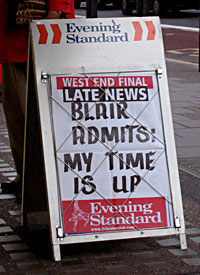
How to admit a mistake

I posted something a few days ago about how FaceBook had stepped over an unacceptable threshold in relation to their users’ privacy. Now here’s the response of faceBook’s CEO, Mark Zuckerberg. It begins:

We really messed this one up. When we launched News Feed and Mini-Feed we were trying to provide you with a stream of information about your social world. Instead, we did a bad job of explaining what the new features were and an even worse job of giving you control of them. I’d like to try to correct those errors now…

On the face of it, this is a really good example of how to handle a mistake. Admit it, apologise, fix it and move on.

The only problem is that Zuckerberg got it wrong first time — just like any other CEO!

A lost world

Lovely story on Harold Strong’s Blog…

I had the good fortune to spend two months on the smallest of the Aran Islands, Inisheer (Inis Oirr), in 1962. This was the year before I sat the Leaving Certificate examination, the final school examination in Ireland. At that time if you didn’t pass Irish you failed the examination and couldn’t go to University. So the idea was that I would improve my Irish. This worked and was a fantastic experience. One that has left me with a deep affection for the islanders, their way of life and the Irish language along with a small collection of photographs.

At that time I only had a basic 35mm camera and a few rolls of film. You couldn’t get more film on the island at that time and anyway I couldn’t afford it. When I came home after spending a month longer than originally agreed all I could do was develop the film but no prints! The negatives were kept among my personal stuff, put in a press [cupboard] and forgotten about.

Last year I was using my son’s scanner, remembered these negatives and discovered that they could be scanned. He then introduced me to Flickr and suggested I should put them up there which I did.

I moved on to other things and forgot about them until recently. An email arrived from the ‘Crashed’ music group asking if some of them could be used on the cover of a new CD. The result was that one was used as the outer cover of a CD and two more were used on the inlay.

They were of the wreck of the MV Plassey which went aground on an offshore rock during a severe storm on the night of 8th March 1960. The 11 crew were rescued by the local onshore rescue crew using a Breeches Buoy. It was later driven onto the island during another storm. It is on the rocks in the opening scene of the Channel 4 comedy series ‘Father Ted’…

I’ve just looked at the photographs and some of them (for example this one, of a funeral procession) are very evocative. It’s a lovely little archive portraying a vanished world.

New gadget wirelessly streams your salary to the Apple Store

Headline courtesy of Good Morning Silicon Valley.

At the company’s “special event” at San Francisco’s Yerba Buena Center for the Arts, Jobs announced a new and improved video-capable iPod, slimmer and more colorful iPod Nanos, a matchbook-sized iPod Shuffle, some very slick enhancements to iTunes, including movie downloads ranging in price from $9.99 to $12.99, and a showstopper of a “one more thing”: an HDTV-capable wireless video streaming device codenamed “iTV.” Available in the first quarter of 2007, iTV will sell for $299 and work with Macs and PCs…

Hmm… I wonder what the boys at ITV, a failing UK TV company, will make of that name.

The new Paris Hilton Sex Tape!!!

Er, not exactly. Nice video satire.

Embarrassing disclosure: when the Paris Hilton video first hit the news, I was a bit baffled by all the fuss about it on the Web. Who would be interested, I wondered, in a sex orgy taking place in a Parisian hotel? Eventually, a friend took me aside and explained that Paris Hilton was a person. Sigh. I really should get out more.

Can you remember where you were when…?

It’s such a cliche. And yet cliches express truths, even if they are sometimes banal. I’m of an age when I can remember where I was when Jack Kennedy was assassinated. (I was in my bedroom, dutifully doing school homework.) Maybe it made a deeper impression because I had earlier that year seen him in the flesh.

For the generation who are now in their twenties, 9/11 will have the same kind of memorability. According to the Pew Research Center’s national survey, conducted Aug. 9-13 among 1,506 adults,

nearly every American (95%) can still recall exactly where they were or what they were doing when they first heard the news of the Sept. 11 attacks, and roughly half (51%) say that the attacks changed life in America in a major way.

For me, September 11, 2001 has a special resonance. It was the day Sue underwent the operation that we hoped might give her a chance of beating her cancer. She was first on the surgeon’s list, due to go down to theatre at 10am. I got the kids to school early and set off for the hospital to see her before she went under the knife. The traffic that morning was indescribable. I had to invent a crazy, circuitous route to avoid the city. When I got to the hospital, I dumped the car and ran up to the ward. She was sitting up, quite composed. When she saw the state I was in, she told me to go home, do something to take my mind off the operation, and come back at lunchtime, when she would be coming out of the anaesthetic. “Stop making such a fuss” was the hidden message. So I obediently kissed her goodbye and went off to collect examination scripts for a Masters course for which I was then an External Examiner.

The strategy worked — for a while: marking the scripts took my mind off what was happening up at the hospital. I got back to the house at 12.30pm and rang the ward. No, Mrs Naughton wasn’t back from theatre yet. I rang again at 12.40. Still she wasn’t back. Stifling panic, I asked to speak to the senior nurse on the ward. She explained that there would probably be a simple, non-sinister explanation. She checked, and there was — an emergency operation that had taken precedence. “Come in around 2pm”, she said, “Sue should be back by then”. I put down the phone, choking with relief.

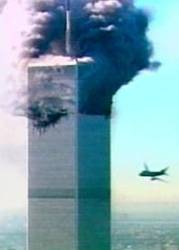
As I replaced the handset, it rang. It was an old friend who had recently gone to visit her son in his New York apartment. She was phoning to see how the operation had gone. I told her what had happened and we talked about the whole business. She told me she was standing by the window and that it was a beautiful morning. She had plans to visit a bookshop and then to buy food. She was going to cook that evening. Then the line went quiet. “Are you still there?” I asked. “I’ve just seen a plane fly into the World trade Centre”, she said.

While we talked, I launched a web browser. It took an age for the program to load. I typed “www.cnn.com” into the address bar. No response. The site was already buckling under the load. We continued talking — about the density of air traffic over New York, about the fact that a terrible accident like that was bound to happen, one day. Then my friend went quiet again. “I’ve just seen another plane fly into the tower”, she said. “I’m going to move away from the window”. We said muted goodbyes. I switched on the TV. The BBC had a news flash — and then cut to live footage of the two towers, smoking in the sunshine. My friend spent the rest of the day on the roof of the apartment building, watching the disaster unfold. The worst thing of all, she told me later, was seeing the people who jumped to avoid the flames.

At the time, another old friend had just taken up residence in New York, living in an apartment on Washington Square. I rang the number. He answered, sleepily — still jetlagged. “Do you know what’s going on?” I asked. “What’s going on?” he responded. “The Twin Towers have been attacked”. “Come off it”, he snorted. “Can you hear anything?” I asked. “Now that you mention it”, he replied, “I can hear a racket down on the street”.

At the same time, a third friend who is a professional colleague of Cherie Blair, was in a meeting with her. Her mobile rang. She picked it up, listened and then put it down. “What’s up?” said my friend. “There’s been a terrorist attack in New York”, she replied. “Is it bad?” “Must be”, she replied. “Tony was on his way to speak at the TUC Conference and he’s turned back”.
Me no Leica*

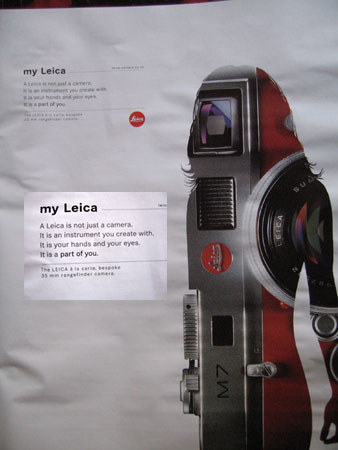
A new (tacky) tack in Leica’s attempts to counteract the threat of digital photography. Seen in the Financial Times‘s absurd How to Spent It supplement. That whirring sound you hear is made by Oskar Barnack whirring in his grave.

*And yes I do know that this was the headline on Dorothy Parker’s famous review of Christopher Isherwood’s I am a Camera.

Dubya the hedgehog

Interesting Whiskey Bar meditation on George Bush (aka Shrub in this context)…

When [Isaiah] Berlin divided writers and thinkers (which leaves Shrub out) and human beings in general (I suppose we have to include him) into two categories — the hedgehogs and the foxes — he didn’t mean for either label to be taken pejoratively. After all, his list of hedgehogs included Dante, Plato, Dostoevsky and Proust, while Shakespeare, Aristotle and Erasmus were among his foxes.

What Berlin meant, I think, is that hedgehogs try to integrate all of their experiences and thoughts into a single, overarching concept of life and their place in it, while foxes, as he put it, have ideas about the world “without . . . seeking to fit them into, or exclude them from, any one unchanging, all-embracing, sometimes self-contradictory and incomplete, at times fanatical, unitary inner vision.”

At this point, I would say Shrub is acting like a hedgehog on hallucinogens. His one big integrative idea — exporting American-style “democracy” to Iraq at the point of a gun — has proven fatally, disasterously wrong, but he can’t let go of it, because it’s the only idea he’s got. He’s fully vested in it, like a ’90s e-trader who decided to throw caution to the wind, empty his retirement account and bet it all on pets.com.

I think if Shrub were ever forced to let go of his vision, his one big idea, it would not only crush his fragile ego, it would leave him completely incapable of making any sense at all out of his presidency, out of America’s role in the Middle East, out of the universe.

So now he’s imitating the hedgehog as literally as any human being can — he’s rolled himself up into a defensive ball, spines out. He has nothing useful to say and absolutely no strategy beyond hunkering down and passively defying reality. Which leaves the generals and the troops no choice but to hunker down with him.

The next two and a half years are going to be very long ones…

Realism dawning in the US?

Or perhaps a new isolationism? Interesting Pew Research Center report

Five years later, Americans’ views of the impact of the Sept. 11 terrorist attacks have changed little, but opinions about how best to protect against future attacks have shifted substantially. In particular, far more Americans say reducing America’s overseas military presence, rather than expanding it, will have a greater effect in reducing the threat of terrorism.

By a 45% to 32% margin, more Americans believe that the best way to reduce the threat of terrorist attacks on the U.S. is to decrease, not increase, America’s military presence overseas. This is a stark reversal from the public’s position on the first anniversary of the Sept. 11 attacks. In the summer of 2002, before serious public discussion of removing Saddam Hussein from power had begun, nearly half (48%) said that the best way to reduce terrorism was to increase our military involvement overseas, while just 29% said less involvement would make us safer.

Similarly, in 2002 a 58% majority felt that military strikes against nations developing nuclear weapons were a very important way to reduce future terrorism. Today, just 43% express the same level of support for such action…