Top Gear

It is reported that doctors caring for Richard Hammond, the Petrolhead’s Friend and Top Gear presenter who was seriously injured when his car went out of control during a speed trial, have concerns about his brain function as a result of the accident. If the accident had happened to Hammond’s co-presenter, Jeremy Clarkson, the medics would at least not have had to worry on that score.

Top Gear is an interesting case of a curious condition — the worship of stupidity. It is filmed in a vast aircraft hangar filled with grinning, half-witted, twentysomething males and is dedicated solely to the fetishising of speed and the lampooning of any measure designed to protect society from dangerous driving. On the few occasions when I’ve watched it, what always came to mind was Randy Newman’s wonderful satirical song about American rednecks, the chorus of which goes:

We’re red-necks, red-necks,
We don’t know our ass from a hole in the ground.
We’re red-necks, red-necks,
Keepin’ the niggers down.

The (un)reliability of business journalism (contd.)

David Pogue had the neat idea of looking up the Lexis-Nexis newspaper database to see how Apple was being covered a decade ago. Here’s a selection of what he found:

  • Fortune, 2/19/1996: “By the time you read this story, the quirky cult company…will end its wild ride as an independent enterprise.” * Time Magazine, 2/5/96: “One day Apple was a major technology company with assets to make any self respecting techno-conglomerate salivate. The next day Apple was a chaotic mess without a strategic vision and certainly no future.” * BusinessWeek, 10/16/95: “Having underforecast demand, the company has a $1 billion-plus order backlog…. Apart from some ideas, the only and best alternative: to merge with a company with the marketing and financial clout to help Apple survive the switch to a software-based company. The most likely candidate, many think, is IBM Corp.” * A Forrester Research analyst, 1/25/96 (quoted in, of all places, The New York Times): “Whether they stand alone or are acquired, Apple as we know it is cooked. It’s so classic. It’s so sad.” * Nathan Myhrvold (Microsoft’s chief technology officer, 6/97: “The NeXT purchase is too little too late. Apple is already dead.” * Wired, “101 Ways to Save Apple,” 6/97: “1. Admit it. You’re out of the hardware game.” * BusinessWeek, 2/5/96: “There was so much magic in Apple Computer in the early ’80s that it is hard to believe that it may fade away. Apple went from hip to has-been in just 19 years.” * Fortune, 2/19/1996: “Apple’s erratic performance has given it the reputation on Wall Street of a stock a long-term investor would probably avoid.” * The Economist, 2/23/95: “Apple could hang on for years, gamely trying to slow the decline, but few expect it to make such a mistake. Instead it seems to have two options. The first is to break itself up, selling the hardware side. The second is to sell the company outright.” * The Financial Times, 7/11/97: “Apple no longer plays a leading role in the $200 billion personal computer industry. ‘The idea that they’re going to go back to the past to hit a big home run…is delusional,’ says Dave Winer, a software developer.” David Pogue’s conclusion: “When anyone asks me what the future of technology holds, or what kids will be bringing to school in 2016, I politely decline to answer.” Amen.

Saturn by night

Taken last July by cameras on board the Cassini-Huygens spacecraft. From the wonderful Astronomy Picture of the Day site. The link for this image is here. The blurb explains:

In contrast to the human-made lights that cause the nighttime side of Earth to glow faintly, Saturn’s faint nighttime glow is primarily caused by sunlight reflecting off of its own majestic rings. The … image was taken when the Sun was far in front of the spacecraft. From this vantage point, the northern hemisphere of nighttime Saturn, visible on the left, appears eerily dark. Sunlit rings are visible ahead, but are abruptly cut off by Saturn’s shadow. In Saturn’s southern hemisphere, visible on the right, the dim reflected glow from the sunlit rings is most apparent. Imprinted on this diffuse glow, though, are thin black stripes not discernable to any Earth telescope — the silhouetted C ring of Saturn. Cassini has been orbiting Saturn since 2004 and its mission is scheduled to continue until 2008.

Here’s a funny thing…

GMSV reports that

Asked to testify Sept. 28 before the investigative subcommittee of House Energy and Commerce are Board Chairwoman Patricia Dunn; HP legal counsel Ann Baskins; Larry Sonsini, a prominent Silicon Valley lawyer who is HP’s external lawyer, and Ronald R. DeLia, a Needham, Mass., private investigator and operator of Security Outsourcing Solutions….

Note the name Sonsini. Larry W. Sonsini is a senior member of the prominent Silicon Valley legal firm of Wilson Sonsini Goodrich & Rosati. But, curiously, the firm’s Web site makes no mention of their Chairman’s exciting forthcoming appearance before Congress.

Later… I’ve just come on Dan Gillmor’s view:

If I was running either the Chronicle or the Merc, I would be assigning my best investigative folks to look deeply into Sonsini and his law firm. The story has been done, but never in the depth I suspect it deserves….

Dan has covered the Valley for years and is one of its shrewdest observers.

More on Sonsini here.

NHS vs. Harley Street: no contest

Lovely column by Vanora Bennett on how her grandad was finally cured of his belief that private medicine must be best because you’re paying for it.

And, within 24 hours of excellent treatment, the problem was solved. At lunchtime the next day Grandad was sitting up by his bed, doing the Times crossword and chatting with the nurses, as cheerful as anything. He wasn’t coughing at all.  “Dr Wu took me off the medicine and put me on something else,” he said happily. “I haven’t coughed once since she did.”

It was that simple – a bit of intelligent, disinterested medical care from an NHS doctor who wasn’t looking at a fee of thousands of pounds – just a person in need of attention and reassurance. Despite all the cuts that the Royal Free has been suffering, it can still do better for its patients than the smartest of private care…

MyEmptySpace

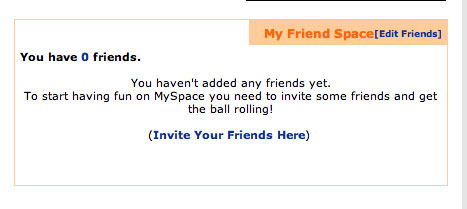
I’ve been writing something about the MySpace phenomenon and decided that I’d better sign up. I was then confronted by this rather depresssing analysis of my condition! Zero friends!

The thing that’s really weird about MySpace is its concept of what constitutes a ‘friend’ — which seems to be anyone whose profile takes your fancy. It’s much closer to the teenager idea of friendship than the adult concept. Certainly, it isn’t anyone you actually know. For me, a friendship denotes a serious relationship that’s been built up over time (otherwise it’s an acquaintanceship). So it’s unsettling to see fiftysomethings on MySpace — who really ought to know better — using ‘friend’ in the shallow, teen sense of the word. There’s some interesting anthropological work to be done here, Holmes.

Update: Upon reading the above, Bill Thompson took pity on me and sent an email offering to be a friend! Which is very sweet of him, but he doesn’t count because I’ve known him for years. According to his profile, he has eight ‘friends’, which shows what a good networker he is. But at least one of them doesn’t count because he’s worked with her on the Cambridge film festival!

Neologisms

Warning: this post is a frivolous time-waster.

Winners of the Washington Post‘s annual contest, in which readers are asked to supply alternative meanings for common words.

1. Coffee (n.) the person upon whom one coughs.

2. Flabbergasted (adj.) appalled over how much weight you have gained.

3. Abdicate (v.) to give up all hope of ever having a flat stomach.

4. Esplanade (v.) to attempt an explanation while drunk.

5. Willy-nilly (adj.) impotent.

6. Negligent (adj.) describes a condition in which you absent-mindedly answer the door in your nightgown.

7. Lymph (v.) to walk with a lisp.

8. Gargoyle (n.) olive-flavored mouthwash.

9. Flatulence (n.) emergency vehicle that picks you up after you are run over by a steamroller.

10. Balderdash (n.) a rapidly receding hairline.

11. Testicle (n.) a humorous question on an exam.

12. Rectitude (n.) the formal, dignified bearing adopted by proctologists.

13. Pokemon (n) a Rastafarian proctologist.

14. Oyster (n.) a person who sprinkles his conversation with Yiddishisms.

15. Frisbeetarianism (n.) (back by popular demand): The belief that, when you die, your Soul flies up onto the roof and gets stuck there.

16. Circumvent (n.) an opening in the front of boxer shorts worn by Jewish men.

The Post also asked readers to take any word from the dictionary, alter it by adding, subtracting, or changing one letter, and supply a new definition. Here are some of this year’s winners:

1. Bozone (n.) The substance surrounding stupid people that stops bright ideas from penetrating. The bozone layer, unfortunately, shows little sign of breaking down in the near future.

3. Cashtration (n.) The act of buying a house, which renders the subject financially impotent for an indefinite period.

4. Giraffiti (n) Vandalism spray-painted very, very high.

5. Sarchasm (n) The gulf between the author of sarcastic wit and the person who doesn’t get it.

7. Hipatitis (n) Terminal coolness.

8. Osteopornosis (n) A degenerate disease. (This one got extra credit.)

9. Karmageddon (n) It’s like, when everybody is sending off all these really bad vibes, right? And then, like, the Earth explodes and it’s like, a serious bummer.

11. Glibido (v) All talk and no action.

12. Dopeler effect (n) The tendency of stupid ideas to seem smarter when they come at you rapidly.

15. Caterpallor (n.) The color you turn after finding half a grub in the fruit you’re eating.

[Source]

Thanks to Neville Stack for the link.
NBC launches YouTube for Old Media Companies

Hilarious story from Technology Review….

NBC Universal launched a venture with its affiliated TV stations on Tuesday aimed at providing a legal and profitable way to distribute video online.

The venture, which was originally announced in April, will also include video clips from third parties such as CSTV Networks Inc., The History Channel and others.

Based loosely on the model of the hugely popular YouTube site, members of the venture will be able to add video to the system and also select which clips to play on their own site.

Advertisers will be able to buy ads by programming category but not by specific video clip, a measure that NBC hopes will eliminate any potential conflict with the ad sales efforts of its own affiliates and other parties that contribute content to the system.

And unlike YouTube, which has won a wide following with homemade video clips that any Internet user may post, NBC officials said their venture will have tight controls over which parties can become participants in the network. Clips will also be reviewed to ensure objectionable material isn’t shown, they said.

The venture between NBC and its affiliated stations, which will own about 30 percent of the company, seems aimed at easing frictions between networks and their affiliates over how to share the spoils from new ways of distributing video online.

Many network-affiliated TV stations were angered after being left out when networks started selling hit prime time shows — the lifeblood of TV ratings — through outlets such as Apple Computer Inc.’s popular iTunes service.

NBC officials say the network will focus on short clips that will retain high quality standards. At the same time, NBC clearly wants tap into the thriving video-sharing activities that have made sites like YouTube so popular. One early partner in the venture is Break.com, which features user-generated video clips.

”We know that video should be shared organically,” Brian Buchwald, the general manager of the venture, said at a news conference at NBC’s headquarters in New York. NBC Universal is 80 percent owned by General Electric Co. and 20 percent by Vivendi, the French media and telecommunications conglomerate.

The new venture will be called the National Broadband Company or ”nbbc” — a play on NBC’s original name, the National Broadcasting Co. But the name is not likely to be widely seen by consumers because the venture will simply supply the video and ads to participating sites, such as NBC’s New York affiliate WNBC.

NBC got a taste of the power of online video distribution several months ago when ”Lazy Sunday,” a satirical rap video that had aired on ”Saturday Night Live,” became a huge hit online, but initially through YouTube and other video-sharing sites.

”In the future, when you have a ‘Lazy Sunday’ kind of clip, it will end up here and we’ll make a lot of money from it,” said Randy Falco, chief operating officer of the NBC Universal Television Group.

I love that last quote. One born every minute.

The young and vibrant need not apply

From a helpful email dispatched by my accountant:

On 1 October, it will become illegal to discriminate against employees and jobseekers on the basis of age. Using words like ‘young and vibrant applicant’ in job advertisements will no longer be allowed, while employers will not be able to force staff to retire before 65 years old unless objectively justified by a genuine occupational requirement.

There has been extensive publicity on the rule changes and new research revealed this week that almost three quarters of employers believe their workers are aware of the new rules. But another finding in the Manpower poll showed bosses’ perceptions do not follow reality as more than half of staff admitted they knew nothing about the regulations. The report urged firms to ensure they are fully prepared and staff are made completely aware of October’s changes.