Darwiniana
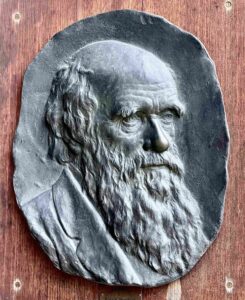
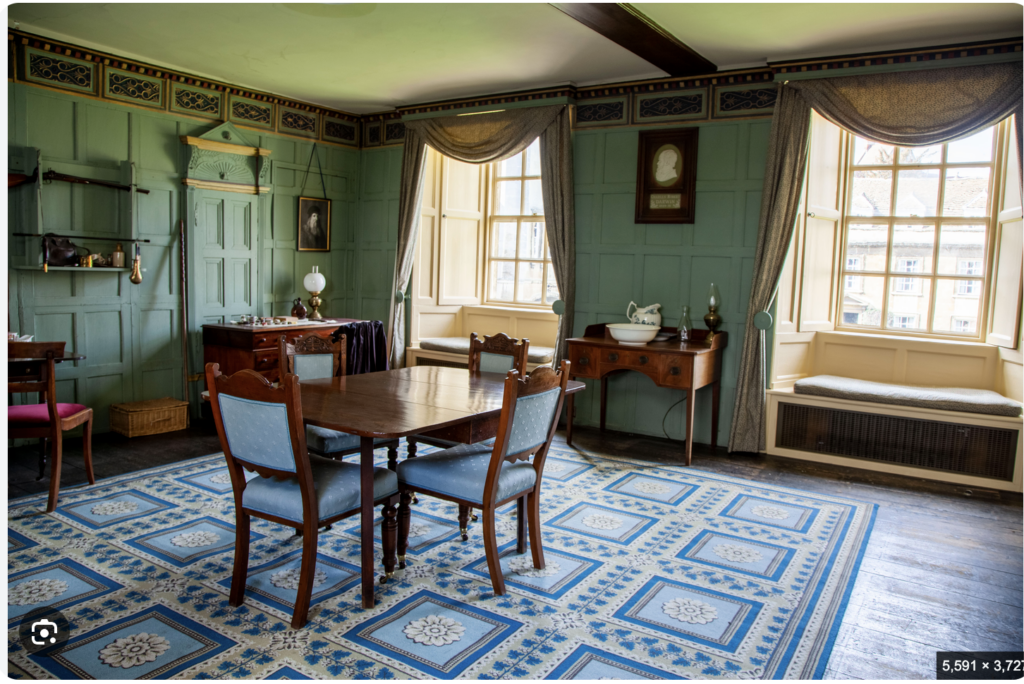
This plaque greets visitors to Christ’s, the Cambridge college where Charles Darwin was an undergraduate. Last Friday I’d been invited to lunch there by a friend who is a Fellow of the college, and afterwards she asked if I’d like to see the sitting room in his set, which had been restored to the state it might have been in 1828-1831, when he was a student. So we walked up the stairs in G staircase and there it was, complete with his gun in a rack above the mantlepiece.
The earliest photograph of the sitting-room was taken by J. Palmer Clark in 1909.
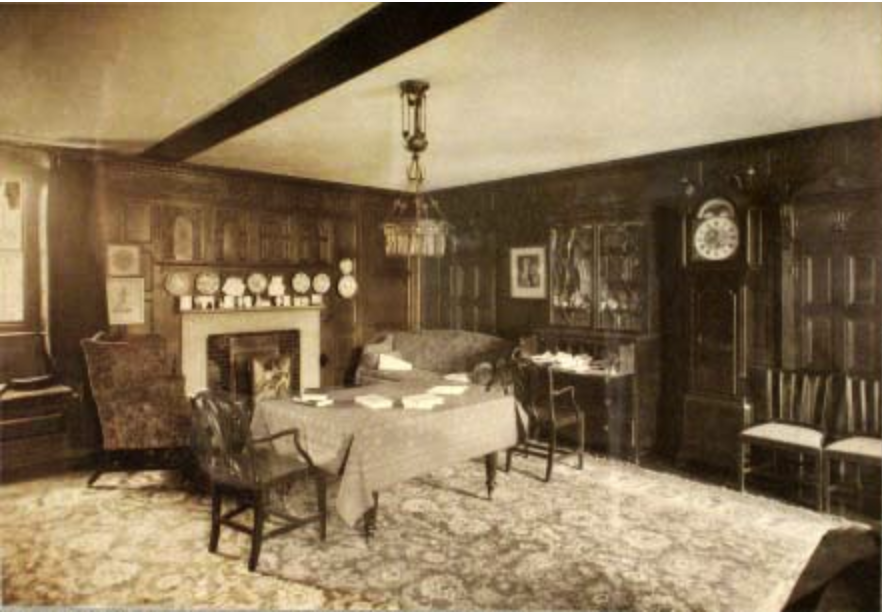
It looks rather drab — which is what I was expected to see when I climbed the stairs on Friday. Instead I found a much glossier apartment than I had anticipated. Had it been tarted up for the tourists, I wondered?
In 2006, the college had decided to embark on an impressively-researched scholarly restoration of the room drawing on research by John van Wyhe and Jo Poole into contemporary documents ranging from Darwin’s letters and private papers, recollections of his Cambridge friends, illustrations and descriptions of Cambridge student life in the 1820s–1830s to the physical evidence present in the rooms.
Poole’s account relates how the oak panelling which had been covered by many layers of paint, was cleaned, disclosing the woodwork in excellent condition, and at the top, on the carved frieze, underneath all the paint, bright colouring in blue, yellow and red. This colouring, in addition to being an interesting antiquarian relic, is a distinct asset to the appearance of the room. In some places where the work had failed, it has been slightly and carefully restored; the general effect must now be very much the same as it was when the colours were first put up. So maybe my hunch about tarting up was a bit premature — the product of a nasty, suspicious, journalistic imagination.
Interestingly, in the early 1930s the set of rooms was occupied by C.P. Snow of “Two Cultures” fame.
Quote of the Day
“Is there anything worn under the kilt? No, it’s all in perfect working order.”
- Spike Milligan
Musical alternative to the morning’s radio news
Händel| The Harmonious Blacksmith | Wilhelm Kempff
Long Read of the Day
Women increasingly see AI for what it is: mansplaining on a global scale
My latest Observer column.
In an article in Wired magazine earlier this year, Alessandra Ram, a writer, wife and mother based in the San Francisco Bay Area, noted: “There’s a strange and under-discussed side-effect of the AI boom.” That is: “what it’s doing to family dynamics”. By which she means: how it’s potentially destroying those dynamics.
She writes from experience. She’s married to an AI-pilled chap who has a newish job in an AI company. He phones her at 11pm in Berkeley, California, where she is home alone with their 10-month-old daughter. It’s 2am in Massachusetts, where he is, and he wants her to look at something on his computer.
“Are you looking?” he shouts. She isn’t. Instead, she’s looking at their real baby and thinking: “There are two babies in this household now: the small human one and the large language model. Both demand constant attention. Both keep us up at 2am.”
Being an award-winning journalist, Ram doesn’t leave it there. She goes out interviewing her contemporaries in the Bay Area because that’s where this particular psychological crisis seems most acute. She finds that it goes like this: “He works in AI, and she does everything and anything else. Other times, it’s bleaker: He desperately wants to work in AI – or feels he must work in AI – and she wants him to do literally anything else.”
Now we need to remember that northern California is not a normal place at the moment. It’s the centre of a frenzy reminiscent of the gold rush of 1848-55, with Jensen Huang of Nvidia selling the contemporary equivalents of picks and shovels. And the demographics of the tech industry are chronically skewed: it’s basically a male-dominated playground. This applies not only to the tech companies, but also to those who invest in them or who want to work in AI labs.
Ram thinks that implies that there are “hundreds of thousands of spouses, partners, and girlfriends, holding the fort while someone mansplains the singularity to them”. The evidence in her piece is mostly anecdotal, but I think she’s on to something.
At any rate, it chimes with my own experience of watching this space. Five years ago, I annoyed some of the industry’s male protagonists by pointing out that its most perceptive critics tended to be women. Broadly speaking, this is because women are more sensible than men in these matters. I write as a long-term gadget freak who is constantly surprised that my female friends are invariably unimpressed by the latest gizmo I have acquired.
So you can see why I sympathised with former Miami Herald columnist Dave Barry, who once took his wife for a ride in a brand new Humvee. As they rumbled along, he proudly mansplained to her that, among the many features of the 4×4 military vehicle, there was a switch that enabled him to inflate or deflate its tyres as they drove along. His wife very sensibly asked: “Why?” – to which he had, of course, no answer. She was likewise unimpressed by the Humvee’s mighty winch, which, she was told, could pull down a house.
As far as AI adoption is concerned, there’s an increasing amount of empirical evidence that women are more judicious than men in approaching the technology. A key Oxford study, for example, suggests that the emerging “gender gap” in AI use “is associated not only with differences in skills, access or socioeconomic position, but also with perceptions of AI’s societal risks”. Concerns related to mental health, environmental impact, data privacy and employment are closely linked to women’s approach to the technology.
The researchers found consistent evidence that these risk perceptions are more strongly associated with adoption among women than among men. Women who express concerns about AI’s broader social consequences are less likely to use generative AI tools frequently, and – interestingly – these differences are especially pronounced among younger and digitally literate groups.
This looks to me like encouraging news. It suggests that what the Oxford researchers found among young, digitally literate women isn’t technophobia but a grown-up, cost-benefit calculation that the AI boom’s protagonists seem constitutionally unable to make.
Which brings us back to Ram’s “two babies”. One of them will, in due course, grow up and become judicious. I wouldn’t bet on the other one, though.
My commonplace booklet
Sacre Bleu! Le deux chevaux retour!
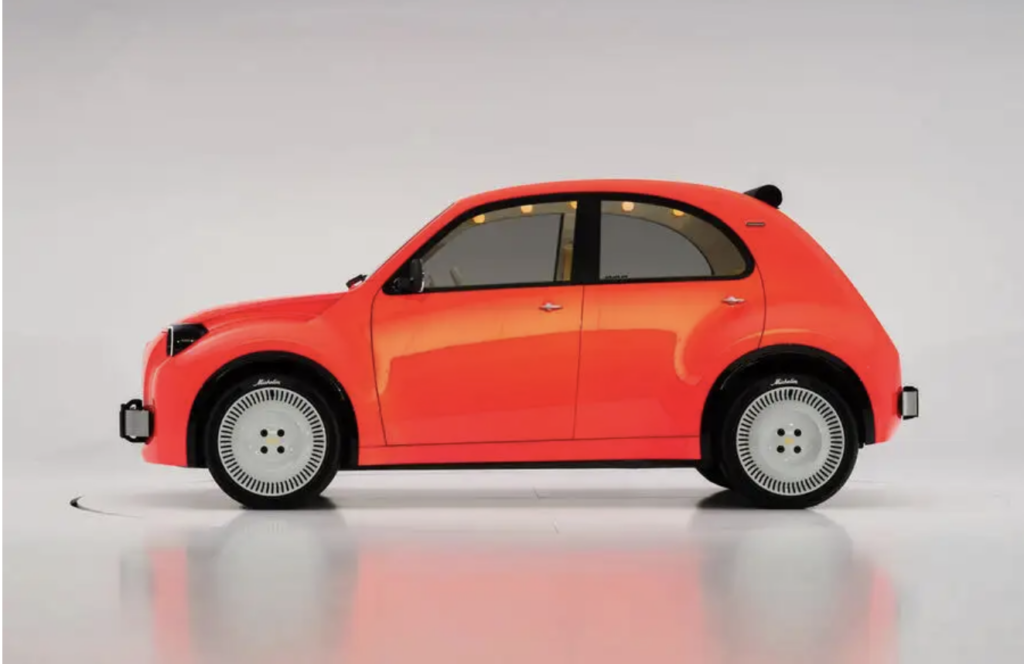
Citroen plans to sell the new 2CV for £13,000, which would make it the cheapest EV around. It will have a 30kWh lithium-iron-phosphate (LFP) battery pack, allowing it to cover 130 miles between charges. Good enough for most domestic purposes.
The news prompted some nice letters to the Editor of the Irish Times. For example:
Sir, – The launch of the new Citroën 2CV reminded me of a memory of my aunt who travelled from Belgium in the early 1960s in her elderly 2CV.
While travelling through Mayo, she stopped to fill up. The attendant took one look at her unusual little car, clearly unable to make out the make or model, asked her with genuine curiosity: “I’ve never seen a car like it, did you make it yourself?”
My aunt must have wondered whether to be flattered that she could create such a machine or insulted that her faithful Citroën looked like a home-made contraption.
The 2CV was never meant to turn heads but they had character, charm and reliability to keep going. If the recently launched new model inspires as many conversations as the original, I am sure it will do well. – Yours, etc,
And
Sir, – In my hitchhiking days half a century ago, my heart would always lift at the sight of an oncoming Citroën 2CV. There was a good chance of a lift – not least because drivers might need assistance to complete their journey.
In one instance, a driver required an extra pair of hands to hold the 2CV canvass roof down every time a lorry passed. My role was to pull, with all my weight, on the roof, while the driver did the same, steering with his knees.
We both arrived safely at our destinations.- Yours, etc
Movietunes
I’m not much of a film-goer but I’ve seen two remarkable movies in a single week.
One is Pressure, the story of how the date for the D-Day landing was chosen. There are not many good movies about meteorology, but this is one. It’s about the importance of good data, and it has a nice Irish twist.
The other is The Lost Children of Tuam, a scarifying story of how a single determined woman unearthed the truth about how an institution run by a Catholic religious order of nuns buried nearly 900 dead children in a disused septic tank. If, as I did, you grew up in Ireland, then this is a deeply moving and grim film. But it’s also a celebration of the importance of investigative journalism and a reminder of the personal toll it takes on reporters. As the credits rolled, the cinema audience sat very quietly, absorbing the enormity of what people can do when they have unaccountable power. Which the Catholic church had when I was growing up.
This Blog is also available as an email three days a week. If you think that might suit you better, why not subscribe? One email on Mondays, Wednesdays and Fridays delivered to your inbox at 5am UK time. It’s free, and you can always unsubscribe if you conclude your inbox is full enough already!