Computers in the Movies

How many times have you groaned at the ludicrous ways in which computers are portrayed in movies? Jakob Nielsen has had the great idea of doing an analysis of some of the biggest howlers.

Here’s a condensed version…

1. The Hero Can Immediately Use Any UI

Break into a company — possibly in a foreign country or on an alien planet — and step up to the computer. How long does it take you to figure out the UI and use the new applications for the first time? Less than a minute if you’re a movie star.

The fact that all user interfaces are walk-up-and-use is probably the single most unrealistic aspect of how movies depict computers. In reality, we know all too well that even the smartest users have plenty of problems using even the best designs, let alone the degraded usability typically found in in-house MIS systems or industrial control rooms.

2. Time Travelers Can Use Current Designs

An even worse flaw is the assumption that time travelers from the past could use today’s computer systems. In fact, they’d have no conception of any of modern technology’s basic concepts, and so would be dramatically more stumped than the novice users we observe in user testing. Even someone who’s never used Excel at least understands the general idea of computers and screens.
[…]
If you were transported back in time to the Napoleonic wars and made captain of a British frigate, you’d have no clue how to sail the ship: You couldn’t use a sextant and you wouldn’t know the names of the different sails, so you couldn’t order the sailors to rig the masts appropriately. However, even our sailing case would be easier than someone from the year 2207 having to operate a current computer: sailing ships are still around, and you likely know some of the basic concepts from watching pirate movies. In contrast, it’s highly unlikely that anyone from 2207 would have ever seen Windows Vista screens.

3. The 3D UI

In Minority Report, the characters operate a complex information space by gesturing wildly in the space in front of their screens. As Tog found when filming Starfire, it’s very tiring to keep your arms in the air while using a computer. Gestures do have their place, but not as the primary user interface for office systems…

4. Integration is Easy, Data Interoperates

In movieland, users have no trouble connecting different computer systems. Macintosh users live in a world of PCs without ever noticing it (and there were disproportionally more Macs than PCs in films a decade ago, when Apple had the bigger product-placement budget)…

5. Access Denied / Access Granted

Countless scenes involve unauthorized access to some system. Invariably, several passwords are tried, resulting in a giant “Access Denied” dialog box. Finally, a few seconds before disaster strikes, the hero enters the correct password and is greeted by an equally huge “Access Granted” dialog box.

A better user interface would proceed directly to the application’s home screen as soon as the user has correctly logged in. After all, you design for authorized users. There’s no reason to delay them with a special confirmation that yes, they did indeed enter their own passwords correctly…

6. Big Fonts

In addition to the immense font used for “Access Denied” messages, most computer screens in the movies feature big, easily readable text. In real life, users often suffer under tiny text and websites that add insult to injury by not letting users resize the words.

This is just a digest. Worth reading in full.

A place of greater safety

My friend Nicci Gerrard has written a perceptive piece about the Suffolk murders. Excerpt:

Hintlesham is a small, attractive village scattered along a main road (it’s just a couple of miles from where I live, and my husband, Sean, and I named one of our characters Jenny Hintlesham in the Nicci French thriller that we wrote when we arrived here). Now it is the place where Gemma Adams was left, in a swollen ditch off the road to Ipswich.

Copdock lies nondescriptly just beyond the noise of traffic, a village squashed between the A12 and A14 and almost swallowed up by the town; now it’s the site where Tania Nicol’s body was discovered in the same stretch of water as Gemma Adams. The ditch has become a churned-up stream here; on the bridge there are already several bouquets of flowers bearing messages from friends and from strangers. One of them – with a touchingly formal courtesy – addresses her as Ms Nicol…

It’s a typical Nicci piece — soft and intuitive one minute, detached and analytical the next.

The victims were beloved daughters, sisters, mothers, friends. Gemma Adams’ father spoke movingly of his “wonderful, beautiful” dead daughter, who was secure and happy as a child; she was a Brownie, loved horse-riding, played the piano, was “good”. Her addiction sucked her into a world from which the continued efforts of her parents couldn’t rescue her. Which parent, hearing this, wouldn’t feel a shudder of dread? We like to think we deserve our luck and are in control of our lives; actually we are forever walking on thin ice. And sometimes we are made more aware of this precariousness.

Most believe that the murderer has changed something about the way we feel about our community. We are not living through an Agatha Christie whodunnit in which a fiendish criminal, a wolf in sheep’s clothing, will be discovered and ejected, and everything will return to tidy normality; it’s a creepy psychological thriller in which the sheer horror of what has happened unsettles how we think about the world in which we live…

The (tiny) local police force is clearly overwhelmed by what it now has to deal with. The government, for its part, will respond with its usual duplicity. The Home Secretary will solemnly promise in front of TV cameras to provide any extra resources that are needed; while behind the scenes he will be gleefully pointing out to the Suffolk Constabulary that this is exactly why the government was trying to amalgamate local police forces into larger, less accountable, units.

Frank Johnson

Frank Johnson, a former editor of the Spectator and one of Britain’s funniest newspaper columnists, has died of cancer at the age of 63. Among his badges of honour was the distinction of having been fired by Conrad ‘Lord’ Black. There’s a nice obit in today’s Telegraph, for which he wrote every Saturday. It ends thus:

Johnson endured cancer with exemplary courage for seven years. Last Sunday, just before he went into hospital for the final time, he attended the performance of Aida at La Scala in which the tenor Roberto Alagna (as Radames) walked off the stage in a fit of pique after being booed; Johnson immediately filed the story to The Daily Telegraph.

He once drafted his epitaph as a cod footnote:

“Johnson, Frank (dates unknown). Journalist. No relation to Paul (qv). Claimed to have been one of the last lovers of Maria Callas (1923-77), although his testimony in such matters was said to be unreliable. Published a distasteful memoir of the relationship.”

The Callas reference needs explanation. He was an opera fanatic from early on and at the age of 14 appeared on stage at Covent Garden in Norma alongside Maria Callas. [Children’s parts at the Royal Opera House were taken by pupils at Frank’s school, and he and a classmate were recruited to perform as Norma’s two sons.] Johnson recalled the experience 25 years later:

“I could not forget that when Callas bore down on us with the knife, her nostrils flared; that when, dropping the knife, she repentantly clasped us to her bosom, her perfume smelt like that of an aunt who was always kissing me; and that at the first performance on February 2 there penetrated, into my left eye, the tip of the diva’s right breast, which partnership remained throughout the subsequent duet with [Ebe] Stignani… there are few men who can truthfully say that their eye made contact with the right nipple of Maria Callas.”

Amen.

Quote of the day

“The clue to surviving that party,” Ruth said, “is never drink anything they can top up. Stick to the Guinness, or some obscure spirit, because you have to make a conscious decision to go back to the bar each time.”

Historian Ruth Dudley Edwards on the Irish Embassy’s pre-Christmas party, quoted by Simon Hoggart.

She’s right. I’ve been to parties in that establishment.

A Wii concession

Every Christmas there is a Must-Have gadget. It’s the thing that kids put on their Santa lists and has always sold out just before their addled parents get to the stores.

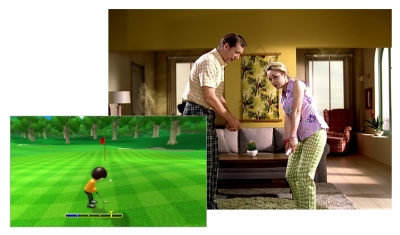
This year’s gadget is the Nintendo Wii — which (I can personally testify) is a fascinating device. Its USP is a controller fitted with accelerometers that you wave about — like so:

And therein lies a tale…

Today’s NYT is reporting that,

Nintendo said Friday that it was taking steps to keep energetic users of its new Wii video game console from breaking their televisions and ceiling fans.

[…] The trouble is that some players have grown so enthusiastic that the controller has slipped from their hands and taken brief flight. Players are supposed to use wrist straps attached to the controllers, but in some cases these have snapped.

Nintendo said it had begun a voluntary replacement program for the wrist straps. Thicker straps should mean fewer flying controllers, said Beth Llewelyn, a spokeswoman for Nintendo of America.

The new straps are free, Ms. Llewelyn said, but the company is not committing to replacing other household items — like the handful of televisions that have reportedly been smashed by unleashed controllers…

Waste not, want not

Bill Thompson has been doing some calculations

According to research carried out by office equipment supplier Canon, based on figures from the National Energy Foundation and Infosource, more than six million PCs will be left on over Christmas, consuming nearly forty million kilowatt hours of electricity.

Together with the printers and other hardware they will waste enough electricity to microwave 268 million mince pies, pumping 19,000 unnecessary tonnes of carbon dioxide into the atmosphere, at a cost of around £8.6m…

He goes on to finger some unexpected power-wasting culprits:

As well as the computers in our homes and offices, it is also important to think about the energy we are using – and the carbon we are producing – by creating and maintaining a presence online.

The virtual server that hosts my weblog is on all the time, even when nobody is viewing my pages, and although its energy use is negligible, multiply that by 55 million or more blogs or 100 million MySpace profiles and you get some significant numbers.

It gets even worse with avatars. At the moment Linden Labs, who host the popular Second Life virtual world, has around 4,000 servers. Although they have two million signed up users, at any one time only around 15,000 people are logged on.

Blogger and technology writer Nicholas Carr did some rough calculations, based on the power consumption of each server being 200 watts and the power consumption of the logged-on user’s own PC being 120 watts, and reckons that each avatar uses 1,752 kilowatt hours of electricity – or about the same amount as an average person living in Brazil.

This works out at 1.17 tons of carbon dioxide per year, per avatar, or the same as driving a large car 2,300 miles.

Well, that’s decided it. No avatar for me, then!

And of course, all of this adds to the case for doing networking the Ndiyo way

Sonsini — latest

Well, well… The NYT reports today that…

Hewlett-Packard’s board has ended a crucial advisory relationship with Larry W. Sonsini, the powerful Silicon Valley lawyer, according to a person with close connections to the board.

The move is the latest repercussion from the company’s spying on directors and journalists, which has led to the criminal prosecution of its former chairwoman and a senior company lawyer by California authorities, several federal investigations, $14.5 million in civil fines as well as considerable embarrassment for a company that prided itself on ethical behavior.

After the year’s end, Mr. Sonsini and the firm he helped build, Wilson Sonsini Goodrich & Rosati, will no longer serve as outside counsel to the board. The law firm will still do legal work for Hewlett-Packard. A company spokesman said yesterday that “Wilson Sonsini will continue to have a relationship with H. P.”

Mr. Sonsini and his firm were not involved in the spying, which began after Patricia C. Dunn, the H. P. chairwoman, directed company lawyers and investigators to find the source of board leaks. But he was caught up in the events, and was criticized for failing to prevent the incident from damaging the H.P.

H.P.’s search for another lawyer to serve as outside counsel is expected to set off a scramble among Silicon Valley firms. “It’s not a big revenue item for a law firm, but being able to say to other clients that ‘I give advice to H.P.,’ is a prestige thing,” said a lawyer who did not want to be identified because he has done work for the company.

A spokeswoman for the Sonsini firm, Courtney Dorman, said, “There is a lot of ongoing work with H. P.” The firm handled the transactional work for H. P.’s recent $4.5 billion acquisition of Mercury Interactive, a business software company.

Mr. Sonsini, who serves as chairman of the firm he joined in 1966, had no comment. Ms. Dorman also said that the firm’s chief executive, John V. Roos, had no comment.