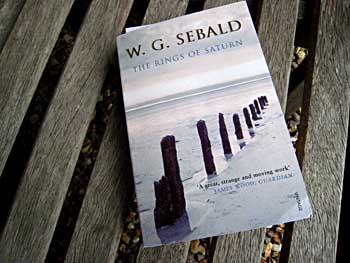
The Rings of Saturn

I’m reading a truly extraordinary book. It’s the record of a journey on foot through a part of the world that I love – the coast of East Anglia from Suffolk to Norfolk. The author is a German academic who settled in Britain (and taught at the University of East Anglia). He died in 2001.

As he walks through this landscape, Sebald takes his reader on entrancing, serendipitous digressions through history and literature. In Lowestoft, for example, he is reminded of Joseph Conrad, and there then follows an absorbing meditation on Conrad’s life and the experiences which led to The Heart of Darkness — and thence to an equally absorbing digression into the life and death of Roger Casement. (The common link, of course, is the Congo and the brutality of Belgian colonialism which so shocked and horrified both men.) I’m continually astonished by the extent of Sebald’s erudition: his is the best-stocked mind I have ever encountered, with the possible exception of Frank Kermode’s.

I’ve just reached the point where Sebald arrives in Dunwich, a village with an intriguing history.

The Dunwich of the present day is what remains of what was one of the most important ports of Europe in the Middle Ages. There were more than fifty churches, monasteries and convents, and hospitals here; there were shipyards and fortifications and a fisheries and merchant fleet of eighty vessels; and there were dozens of windmills… The parish churches of St James, St Leonard, St Martin, St Bartholomew, St Michael, St Patrick, St Mary, St John, St Peter, St Nicholas and St Felix, one after the other, toppled down the steadily-receding cliff-face and sank in the depths, along with the earth and stone of which the town had been built. All that survived, strange to say, were the walled well-shafts, which, for centuries, freed of what had once enclosed them, rose aloft like the chimney stacks of some subterranean smithy, as various chronicles report, until in due course these symbols of the vanished town also fell down.

Moving on from Dunwich, he meditates on the fact that most of the countryside inland from the coast was once forest, and on the way industrialisation and agriculture gradually deforested Britain – and on how this ‘progress’ is currently being re-enacted in Latin America and the tropics generally.

It is not for nothing that Brazil owes its name to the French word for charcoal. Our spread over the earth was fuelled by reducing the higher species of vegetation to charcoal, by incessantly burning whatever would burn. From the first smouldering taper to the elegant lanterns whose light reverberated around eighteenth-century courtyards and from the mild radiance of these lanterns to the unearthly glow of the sodium lamps that line the Belgian motorways, it has all been combustion. Combustion is the hidden principle behind every artefact we create. The making of a fish-hook, manufacture of a china cup, or production of a television programme, all depend on the same process of combustion. Like our bodies and like our desires, the machines we have devised are possessed of a heart which is slowly reduced to embers…

The only problem with this entrancing book is that it has to come to an end — on page 296. Still, I’m only on page 170 at the moment.
Skype earnings were, er, “a bit front loaded”

From the New York Times

BUDAPEST, Oct. 9 — In his first public remarks since quitting last week as chief executive of the Internet phone company Skype, Niklas Zennstrom said Tuesday that he had no regrets about his handling of the company but conceded that he might have tried to squeeze money out of it too quickly.

EBay, the online auction company that paid $2.6 billion for Skype in 2005, said last week that it would take a $1.43 billion charge for the service.

EBay has retained Mr. Zennstrom as Skype’s nonexecutive chairman. Michael van Swaaij, eBay’s chief strategy officer, will fill in as chief executive until a permanent successor is hired.

The write-down was widely seen as a concession that eBay had overpaid for Skype, but Mr. Zennstrom, a Swede who was a co-founder of the company in 2003, defended its value.

In the second quarter, revenue grew 100 percent from a year earlier, to $90 million, and the company recorded a profit in the first quarter, he said.

About 220 million people, most of them outside the United States, are registered with Skype, which uses the Internet to carry phone conversations between personal computers.

“It’s not like it’s been overtaken by Microsoft or Google or Yahoo,” Mr. Zennstrom said at a technology conference here. “Over the longer term, I think it’s going to turn out to be a good business.”

Revenue and earnings projections made by Skype executives before the sale to eBay turned out to be “a bit front-loaded,” he said.

“Sometimes I feel like we tried to monetize too rapidly,” Mr. Zennstrom said.

You want fries with that 802.11g?

From The Register

Proletarian fryhouse McDonald’s has announced it will offer free Wi-Fi in its 1,200 UK burger outlets by the end of the year.

The move will make McDonald’s the country’s largest public hotspot provider, and pits it against Starbucks’ pay-as-you-go T-Mobile service for high street internet supremacy.

It’s all part of a company-wide drive upmarket and away from the traditional McDonald’s experience: scary clowns, mechanically-recovered beef, and screaming infants.

Some sites already had Wi-Fi through an arrangement with BT Openzone, but access was not free. That partnership will continue, but with McDonald’s footing the bill. As part of the expansion, it’s also signed a second deal with The Cloud.

Some 8,000 of McDonald’s 13,000 US chow sheds currently offer free connectivity.

The UK announcement comes days after BT’s launch of BT FON, a Wi-Fi sharing initiative that it hopes will expand its coverage on the cheap. Up to two million Home Hub owners are being targeted and it’ll open to other ISPs’ customers around new year.

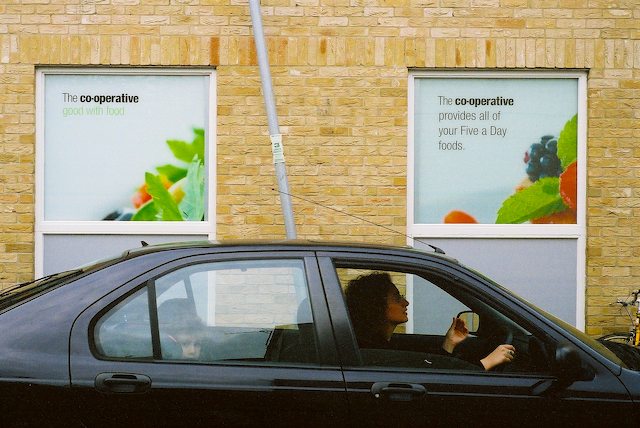
Cooped up

Snatched with a Leica M6. I didn’t see the kid in the car until I saw the print. Also the fact that the lamp-post slopes at the same angle as the door pillar!

Dream Realisation, release 1.0

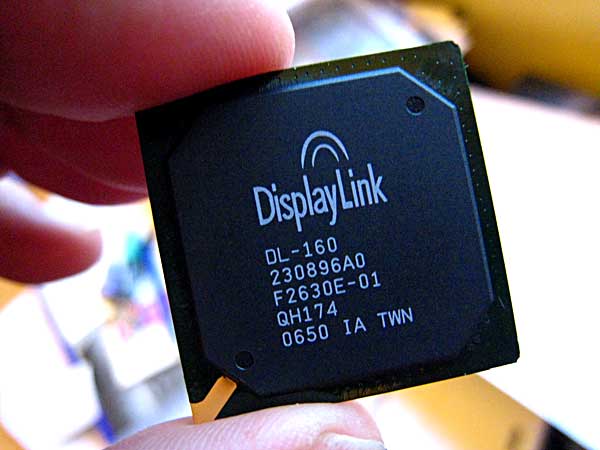
When we embarked on the Ndiyo Project we always knew that the realisation of the vision depended on shrinking the thin client down to a chip. Well, our colleagues at DisplayLink have done it! This is the USB version of the Nivo, and it’s now in the back of monitors from two of the world’s leading manufacturers of displays — Samsung and LG. It’s an amazing achievement. And there’s more to come. Stay tuned.

Not ‘If” but ‘When’…

From Simon Heffer

The other day I went to one of the most disturbing events of my life. Together with a number of others, I listened for the best part of two hours to two American security experts: their area of expertise was Iran and the threat it poses.

The burden of their observations can be summed up as follows: that an American strike on Iran’s nuclear facilities is not a question of if but when.

And, it was emphasised, this certainty is not dependent on the man the world regards as the warmonger Bush still being in office: his successor, be he or she Republican or Democrat, will see that there is no option but to deal with Iran’s nuclear ambitions too.

The terrifying thought is this: what he heard at that seminar may well be right — that the US will eventually go for it.

We have such short memories. It’s not that long ago since: we (Britain and the US) egged on– and armed — Iraq in its war on Iran; turned a blind eye to Iraqi use of poison and nerve gas against Iranian troops (there are still people in Iran dying from the after-effects of Iraqi gassing); and did everything in our power to prevent UN intervention to stop the conflict. Why? Because it was deemed necessary to stop Iran at all costs.

Nothing’s changed, really. But the Iranians have learned the lesson. In a world that is irredeemably hostile to them, nukes are the only safeguard. Which is why they’re going for them. We’d do the same in their position.

Life imitating art

Just heard a news snippet on a radio station about a life-sized cardboard cutout of a police officer which had been installed in a Nuneaton shopping mall to deter thieves. Yes — you guessed it! — it’s been stolen!

And I swear…

… that if I ever again hear anyone say “awesome” when they mean “good”, “pretty good” or even “terrific” then I won’t be answerable for the consequences.

‘Awe-inspiring’, however, is a different matter entirely. Think of Yosemite on a crisp spring or autumn day.