I detest Halloween. Here are two reasons why.
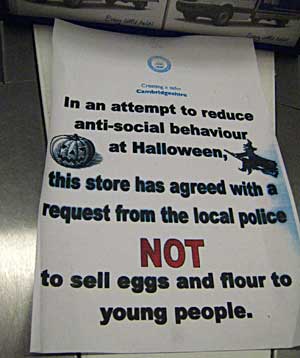
Seen in a local Tesco store. Er, shouldn’t that read “this store has agreed to…”?

A newspaper ad.
Of course none of this will stop Tesco commercialising it.

I detest Halloween. Here are two reasons why.
Seen in a local Tesco store. Er, shouldn’t that read “this store has agreed to…”?
A newspaper ad.
Of course none of this will stop Tesco commercialising it.
Oh no. BBC NEWS | Technology | Mobile phone use backed on planes…
Passengers could soon be using their mobile phones on planes flying through European airspace.
Plans have been developed across EU countries to introduce technology which permits mobile calls without risk of interference with aircraft systems.
Regulators around Europe are calling for consultation on the potential introduction of the technology.
If given the go ahead, the service would allow calls to be made when a plane is more than 3,000 metres high.
Individual airlines would need to decide if they wanted to introduce the technology, if the green light is given by national regulators.
Bah!
I’m perpetually irritated by the ludicrous legalese that organisations force employees to tag onto the end of email messages. Here’s a typical example:
This e-mail and all attachments are confidential and may also be privileged. If you are not the named recipient, please notify the sender and delete the e-mail and all attachments immediately. Do not disclose the contents to another person. You may not use the information for any purpose, or store, or copy, it in any way.
Up to now, my standard reaction has been to mutter “Oh Yeah! You and whose army?” But I’ve just noticed that Cory Doctorow, Whom God Preserve, has had a better idea. He has decided that ridicule is the best defence against this nonsense. His boilerplate legalese reads:
READ CAREFULLY. By reading this email, you agree, on behalf of your employer, to release me from all obligations and waivers arising from any and all NON-NEGOTIATED agreements, licenses, terms-of-service, shrinkwrap, clickwrap, browsewrap, confidentiality, non-disclosure, non-compete and acceptable use policies (“BOGUS AGREEMENTS”) that I have entered into with your employer, its partners, licensors, agents and assigns, in perpetuity, without prejudice to my ongoing rights and privileges. You further represent that you have the authority to release me from any BOGUS AGREEMENTS on behalf of your employer.
I’m going to add this to my email signature options so that anyone who signs off with legalese will have the compliment returned, in spades.
Later: Hmmm… I’ve obviously touched a chord here. Lovely email from James Cridland pointing me to his personal legalese:
Terms and conditions of receipt of email
These terms and conditions apply to emails sent to the above email addresses or any containing ‘james’ before the @ sign and ‘cridland.net’ after the @ sign. Unsolicited email is herein defined as email which is not the result of demonstrable prior contact using or quoting such an address. No guarantee of confidentiality is given, or honoured, on receipt of unsolicited email, irrespective of any terms and conditions block contained therein. It is illegal to send EU citizens unsolicited commercial email without the users’ explicit (opt-in) permission, according to The Directive on Privacy and Electronic Communications (2002/58/EC). This site owner reports all such mail direct to your ISP.
That’s the stuff! I feel better already.
Jeff Jarvis has a forceful disquisition on “the iPod moment for newspapers”. He makes the point that the newspaper industry has for a long time assumed that its salvation lay in ‘e-paper’ — a flexible, foldable, high-res electronic display technology which would allow newspapers to continue as they were but with added e-power. Jeff’s view is that it ain’t gonna be like that, and I’m sure that he’s right. The new iPhone and iPod Touch devices are already pretty impressive as networked readers, and they will doubtless get better in the next couple of years.
I had an interesting discussion yesterday with Brian about the use of the term ‘iPod moment’. It’s slightly misleading because it implies that the appearance of a gizmo is the crucial event. Not so. The genius of the iPod was that it was paired from the outset with iTunes software — and that that software had a beautiful, intuitive interface. It was the combination of the two that made it simple for the average non-techie to manage compressed music files. There were lots of portable MP3 players before the iPod, but syncing them to a PC involved geekery to some degree and so was not for ordinary mortals.
So what really constitutes an ‘iPod moment’ is the instant when it becomes possible for the average consumer to engage in a practice that is terminally disruptive for an established industry.
The man who turned Forbes into a great read, is dead. Nice obit in the Economist, which refers to his greatest scoop: he witnessed the assassination of Mahatma Gandhi. Here’s his report:
‘Bapu (father) is finished’
New Delhi, January 30, 1948: Mohandas K. Gandhi was assassinated today by a Hindu extremist whose act plunged India into sorrow and fear.
Rioting broke out immediately in Bombay.
The seventy-eight-year-old leader whose people had christened him the Great Soul of India died at 5:45 p.m. (7:15 a.m. EST) with his head cradled in the lap of his sixteen-year-old granddaughter, Mani.
Just half an hour before, a Hindu fanatic, Ram Naturam, had pumped three bullets from a revolver into Gandhi’s frail body, emaciated by years of fasting and asceticism.
Gandhi was shot in the luxurious gardens of Birla House in the presence of one thousand of his followers, whom he was leading to the little summer pagoda where it was his habit to make his evening devotions.
Dressed as always in his homespun sacklike dhoti, and leaning heavily on a staff of stout wood, Gandhi was only a few feet from the pagoda when the shots were fired.
Gandhi crumpled instantly, putting his hand to his forehead in the Hindu gesture of forgiveness to his assassin. Three bullets penetrated his body at close range, one in the upper right thigh, one in the abdomen, and one in the chest.
He spoke no word before he died. A moment before he was shot he said–some witnesses believed he was speaking to the assassin–”You are late.”
The assassin had been standing beside the garden path, his hands folded, palms together, before him in the Hindu gesture of greeting. But between his palms he had concealed a small-caliber revolver. After pumping three bullets into Gandhi at a range of a few feet, he fired a fourth shot in an attempt at suicide, but the bullet merely creased his scalp.
From A treasury of great reporting: literature under pressure from the sixteenth century to our own time, edited by Louis L. Snyder, Simon & Schuster, 1949.
It’s funny how some books linger in the mind, long after you’ve turned the last page. W.G. Sebald’s The Rings of Saturn has had that effect on me. I wrote about it the other day, when I was just over half-way through, and I had a nice email from my friend and colleague, Martin Weller, who had seen my post and had been looking for something unconnected with work to bring with him on holiday. He’d been moved by what I’d written to get the Sebald book.
It was an unfamiliar literary form for me – a meditative travelogue. But Andrew Motion argued in a recent review of The Wild Places by Robert Macfarlane that actually this is a relatively venerable form with its roots “in late 19th-and early 20th-century travelogues of the kind written by Edward Thomas”.
I felt slightly ashamed that I hadn’t known more about Sebald, who died in 2001 aged 57 when his car veered off a foggy road in East Anglia. A friend dug out two newspaper pieces, one an interview by Maya Jaggi published in December 2001, the other the Guardian obituary by his friend and fellow Norfolk resident, Michael Homberger (who features in The Rings of Saturn).
Sebald was born in a small Bavarian village in May 1944, the child of a “working-class, small-peasant” family. His father prospered modestly under the Nazis and rose to the rank of captain in the Wehrmacht. Like many (most?) German children of his generation, Sebald initially knew nothing about what had gone on during the Third Reich. “Until I was 16 or 17”, he told Jaggi, “I had heard practically nothing about the history that preceded 1945. Only when we were 17 were we confronted with a documentary film of the opening of the Belsen camp. There it was, and we somehow had to get our minds around it – which of course we didn’t. It was in the afternoon, with a football match afterwards. So it took years to find out what had happened. In the mid-1960s, I could not conceive that these events had happened only a few years back”.
Perhaps this is why his writing is suffused with a preoccupation with memory. And why he always approaches things obliquely. The thing that struck me about The Rings of Saturn was that he always seemed to be coming from left field. Homberger says in his obit that Sebald believed that “attempts to look directly at the horror would turn a writer into stone, or sentimentality”.
The other interesting thing I discovered is that Sebald was a devoted photographer. (The Rings of Saturn is richly illustrated by low-grade reproductions of the kind of pictures taken by someone who uses – as I do — a camera as a kind of visual notebook.) “I’ve always been interested in photographs”, he told Jaggi, “collecting them not systematically but randomly. They get lost, then turn up again. Two years ago in a junk shop in the east End of London, I found a photograph of the yodelling group from my home town. That is a pretty staggering experience. These old photographs always seem to have this appeal written into them, that you should tell a story behind them. In The Emigrants [another of his books] there is a group photograph of a large Jewish family, all wearing Bavarian costume. That one image tells you more about the history of German-Jewish aspiration than a whole monograph would do.”
He’s right. I hope Martin enjoys The Rings of Saturn as much as I did.
I see that the Telegraph has made the same mistake as the Guardian in allowing people to post comments under assumed names. Here, for example, is ‘Lickyalips’ responding to an opinion piece about Gordon Brown and a petition on the Downing Street website:
Cameron should have responded by telling the deep-fried McMars Bar that people are not interested in the phony Downing Street petitions website after the government ignored 1.8 million signatures against the road-pricing scheme, which is going ahead regardless.
That would have put the sporran-faced gobshite in his place.
As the man said, if you set up a cockpit, people will fight.

From the dessert wine section of a restaurant menu last week…
Alasia Brachetto d’Acqui 6%
Delicious semi sparkling semi sweet pink quaffer, a must for all light desserts, light in alcohol but not in flavour, fantastic nonsense.
Just think: someone sits down with a blank sheet of paper, sucks his/her pencil and writes this stuff.
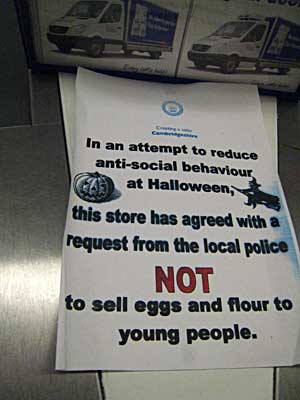
Seen in Tesco St Neots branch.