Linux sub-notebooks finally arrive

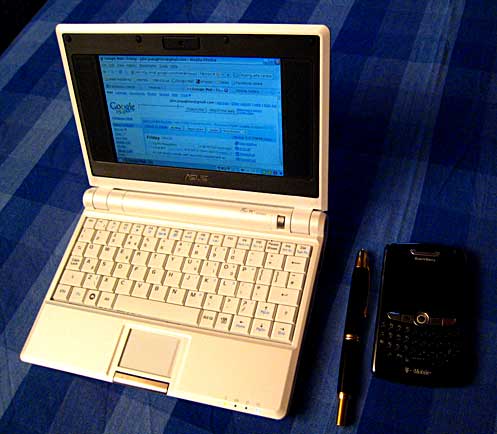
This is the ASUS Eee 701 PC. Acting on the suggestion of a colleague, just before Christmas I slipped into a Toys ‘R Us store, handed over £219 (£186.38 ex VAT) and came home with a smartest little machine I’ve seen in ages. It’s a Linux box configured for the school-kid market (hence the retailer — Research Machines are also selling it to educational institutions), and it’s been a revelation. First of all, it’s really small and portable (0.89kg and not much bigger than a paperback book), but has a usable keyboard, good on-board applications and built-in wireless networking. It’s also an object lesson in how to package Linux for non-techies. Here are the apps, for example:
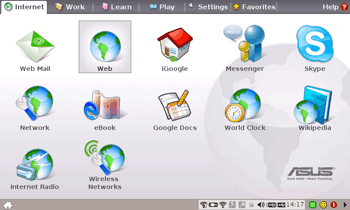
It comes with FireFox and OpenOffice pre-configured. And the webmail option comes with Google, Yahoo and Hotmail icons all ready to go. Likewise icons for Skype, a Messenger client, Google Docs and Wikipedia. It’s powered by an Intel M 900 MHz processor, has 512 MB of RAM plus 4GB of flash disk, and takes USB drives and an SD card. It also has an 0.3 megapixel onboard camera (plus some apps for using it), a VGA port (for an external monitor) and an Ethernet port as well as microphone and headphone sockets. And all for £186 + VAT.

Having a genuinely small and unobtrusive networking device around is interesting. When I’m home, I tend to have my Mac laptop tethered to a big screen and audio set-up in the study, so find myself carrying the ASUS round the house, using it to read mail or browse BBC News when cooking, or for cheating when we’re doing crosswords at the dining-room table! The 7″ screen is a bit small for some purposes, but in the main it’s perfectly readable.

The only downsides I’ve discovered so far are:

  • poor battery life (the makers claim three hours, but it’s definitely less with Wi-Fi switched on);
  • it doesn’t remember Wi-Fi passwords after shut-down (though it does retain them while in sleep mode);
  • the trackpad button is unaceptably stiff and the pad itself is pretty small: the user experience is much improved using a small Targus optical mouse.

    There’s also a model running a version of Windows XP — though in that case you’re paying more (£299) for a crash-prone system. There’s one masochist born every second. Or is it every minute?

    Update: Most of the reviews I’ve found are pretty perfunctory, but this CNET one is informative. There are also some informative videos — notably this IDG News Service preview.

    And this:

    As you’d expect, lots of people are hacking this neat little machine. Here’s how to turn it into a touchscreen device. Here are some useful tips if you want to poke around in the innards. Some people have replaced the Xandros Linux distribution with Ubuntu. And there are even claims that people have installed Mac OS X on the ASUS.

  • All in a day’s work

    One of the more irritating sides of living in Cambridge is the idiotic ads that appear on the buses. Here’s a classic example of aspirational inanity. Odd to think that someone gets paid for writing this garbage.

    So what is Blair really being paid by JP Morgan?

    Robert Peston, the BBC’s Business Editor, has a hunch that the published figure (£500k) is a bit low…

    Whatever your political bent or view of the Blair years, it would be a national humiliation if the sticker on his forehead said $1000k.

    His franchise is worth more.

    For a million dollars to be the number on his ticket, Wall Street and the City would be in total meltdown and we would be in the grip of a worldwide recession (we may get there yet).

    It couldn’t be the right price – especially since Blair takes advice from a bunch of astute business people and he isn’t famous for knowingly underselling himself.

    So when the Daily Telegraph reported that he is being paid £2m a year, I thought that was more like it.

    But it still didn’t feel right.

    My intuitive view was that you couldn’t have a Blair for less than $5m a year.

    And having now spoken to bankers close to this deal, I am told $5m is what JP Morgan is paying (though Morgan’s and Blair’s office are refusing to publish the pecuniary details).

    Thanks to James Miller for the link.

    Forward to the past…

    … or is it back to the future? Lovely column by Stephen Fry on walled gardens and social networking…

    I am old enough to remember Prestel and the original bulletin boards and “commercial online services” Prodigy, CompuServe and America Online. These were closed communities. You paid a subscription, dialled in and connected. You made new friends and you chatted in “rooms” designated for the purpose according to special interests, hobbies and propensities. CompuServe and AOL were shockingly late to add what was called an “internet ramp” in the 90s. This allowed those who dialled up to go beyond the confines of the provider’s area and explore the strange new world of the internet unsupervised. AOL offered its members a hopeless browser and various front ends that it hoped would keep people loyal to its squeaky-clean, closed world. This lasted through the 90s as it covered the planet in CDs in an attempt to recruit subscribers. A lost cause, naturally, and the company ended up as little more than an ordinary ISP. Made millions for Steve Case on the way as AOL merged with Time Warner, but that’s another story.

    Opening and closing like a flower

    My point is this: what an irony! For what is this much-trumpeted social networking but an escape back into that world of the closed online service of 15 or 20 years ago? Is it part of some deep human instinct that we take an organism as open and wild and free as the internet, and wish then to divide it into citadels, into closed-border republics and independent city states? The systole and diastole of history has us opening and closing like a flower: escaping our fortresses and enclosures into the open fields, and then building hedges, villages and cities in which to imprison ourselves again before repeating the process once more. The internet seems to be following this pattern…

    Thanks to Pete for the link.

    Why are British media so fascinated by the US primaries?

    I’ve been wondering for weeks why the BBC and the UK newspapers are devoting so much attention to the primaries. Today, in a perceptive piece, my Observer colleague Peter Preston puts forward an interesting conjecture:

    Two things follow. One is a new connection that needs making more clearly. British editors are more fascinated by this presidential race than ever, and not just because it comes with black or feminist drum rolls of history attached. This time, for the Mail, Times, Guardian and Telegraph in particular, there are millions of American readers of their websites to be wooed and served, unique users with ad potential attached. So, who wins in November matters much closer to home.

    When the Mail lays into Hillary and Matt Drudge’s site carries that copy, the hits grow exponentially. If Mrs Clinton makes it to the Oval office, the Telegraph would reckon to pick up web readers as it leads a conservative attack that consensual US papers might initially shy away from. If Obama or Clinton win, then the Guardian, which has scored so many points by belabouring George Bush, has a different climate to work in.

    And the other thing – on behalf of British readers and viewers at least – is to wonder how many miles and hours of faraway, self-cancelling stuff about moods and hunches the market can endure before the real and abiding election starts next autumn…

    BECTA: Don’t upgrade to Vista

    Wow! Peter Sayer, of IDG News Service reports on BECTA’s considered opinion of Microsoft Vista:

    British schools should not upgrade to Microsoft’s Vista operating system and Office 2007 productivity suite, the British Educational Communications and Technology Agency (BECTA) said in a report on the software. It also supported use of the international standard ODF (Open Document Format) for storing files.
    InfoWorld Podcast

    Schools might consider using Vista if rolling out all-new infrastructure, but should not introduce it piecemeal alongside other versions of Windows, or upgrade older machines, said the agency, which is responsible for advising British schools and colleges on their IT use.

    “We have not had sight of any evidence to support the argument that the costs of upgrading to Vista in educational establishments would be offset by appropriate benefit,” it said.

    The cost of upgrading Britain’s schools to Vista would be £175 million ($350 million), around a third of which would go to Microsoft, the agency said. The rest would go on deployment costs, testing and hardware upgrades, it said.

    Even that sum would not be enough to purchase graphics cards capable of displaying Windows Aero Graphics, although that’s no great loss because “there was no significant benefit to schools and colleges in running Aero,” it said.

    As for Office 2007, “there remains no compelling case for deployment,” the agency said in its full report, published this week.

    The report (pdf) is available from here.

    The relevant bit of the Executive Summary reads:

    The key recommendations emanating from this final report (all of which we cover in further detail in the report) are as follows.

  • We advise that upgrading existing ICT systems to Vista is not recommended and that mixed Windows-based operating-system environments should be avoided.
  • We believe that Vista can be considered where new institution-wide ICT provision is being planned
  • Recognising the limitations regarding Microsoft’s implementation of the ODF standard and the limited uptake of Microsoft’s new Office 2007 file format, we recommend that in the short term users should continue to use the older Microsoft binary formats (such as .doc)
  • Schools and colleges should make students, teachers and parents aware of the range of ‘free-to-use’ products (such as office productivity suites) that are available, and how to access and use them.
  • The ICT industry should be pro-active in facilitating easier access to ‘free-to- use’ office productivity software.
  • Note: BECTA is the government-funded organisation which advises the UK educational sector on ICT.

    Posh ‘n Becks, Mk. 2

    Marina Hyde on the significance of Tony Blair’s new career as a celebrity banker

    Just like the Beckhams, the Blairs have the separate autobiographies, the sports foundation, the overplayed ambassadorial roles … even the fashion gaffes. At this rate one half-expects the planned launch of fragrances on the Beckham model – Intimately Blair for him, and Intimately Blair for her. Pending satisfactory sales, they will be followed by Intimately Blair Nightz.

    The Beckhams are the ultimate private citizens with lucratively attention-seeking public lives, yet deliciously untrammelled by standards commissioners and the like. What very modern models for a second act they are, and we must long for the day on which their lives and the Blairs’ finally collapse into one another, as both couples are photographed enjoying a free holiday together on the JP Morgan corporate yacht, an image so surpassingly heartwarming it will bring immediate peace to the Middle East and the wider world.