Wii Are Amused, apparently

Hmmm… I wonder if I can believe this story

The gadget-loving Queen has become HOOKED on Prince William’s new Nintendo Wii games console.

William’s girlfriend Kate Middleton bought him the £200 gift for Christmas – but he now has to share it with his grandma.

A Palace source told The People: “When she saw William playing a game after lunch at Sandringham she thought the Nintendo looked tremendous fun and begged to join in.

“She played a simple ten-pin bowling game and by all accounts was a natural.

“It was hilarious. William was in fits of laughter. He was enormously impressed at having such a cool gran.

“And although she is 81 the Queen’s hand-eye co-ordination was as good as somebody half her age.”

The Wii was this Christmas’s musthave gift. Players can create their own customised on-screen lookalike – just like our jokey Elizabeth pictured above.

Kate, 26 on Wednesday, watched as William, 25, unwrapped the gift at the Royal Family’s festive gathering. Our source said: “He loves his gadgets and boys’ toys. So it was the perfect present for him.

“His only difficulty nowis prising it away from the Queen’s clutches. She showed all the signs of becoming a Nintendo addict.”

Still, HM the Q is a long-time Leica M user.

Wonder if she now has an M8. I expect she can afford one.

Clarkson stung

The strange thing about Jeremy Clarkson, Britain’s leading petrolhead, is that he’s clever enough not to have to be a charlatan. But he can never resist an opportunity to get a laugh from the boys in the saloon bar. So it’s nice to see him coming unstuck.

TV presenter Jeremy Clarkson has lost money after publishing his bank details in his newspaper column.

The Top Gear host revealed his account numbers after rubbishing the furore over the loss of 25 million people’s personal details on two computer discs.

He wanted to prove the story was a fuss about nothing.

But Clarkson admitted he was “wrong” after he discovered a reader had used the details to create a £500 direct debit to the charity Diabetes UK.

Clarkson published details of his Barclays account in the Sun newspaper, including his account number and sort code. He even told people how to find out his address.

“All you’ll be able to do with them is put money into my account. Not take it out. Honestly, I’ve never known such a palaver about nothing,” he told readers.

Thanks to Brian and Atam for the link.

The Daley version

Janet Daley, writing in the Telegraph

Maybe I am allowing the fleeting excitement of the moment, and the splendid theatre of this very surprising week, to carry me into fanciful territory. If so, I may as well continue along this harebrained path and do what nobody but a giddy fool would be prepared to risk at this juncture. I will make some predictions about the presidential race. First, a relatively safe one: Barack Obama will become the Democratic nominee. His party will not be able to bring itself to turn down the possibility of choosing the first black presidential candidate, when he is so clearly able and charismatic. To reject him would seem to be cowardly and reactionary. (One observation I have not heard anyone make is that Hillary has lost a major Clinton advantage: her husband was far and away the most popular candidate with black voters in the North and the South. Now those voters have one of their own to support so they do not need Bill-by-other-means.) Obama will then choose a considerably older, more seasoned vice-presidential running mate (but not Hillary) in an attempt to counter his lack of experience…

She doesn’t think he’ll be President, though.

The mother-in-law for Foreign Affairs

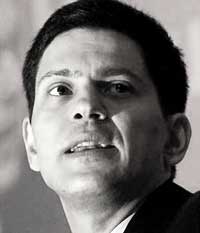
I was idly browsing and came on this picture of David Miliband and wondered if he was the youngest Foreign Secretary ever. He has amazing hair — like astroturf that’s been sprayed jet black. Will it go grey as the strains of office multiply?

And then I came on this passage in Janet Flanner’s New Yorker dispatch from Paris for June 23, 1948:

The most worried, wearied, unthanked, and necessary public servant in any government today is its Minister for Foreign Affairs. He is like a mother-in-law — in the bosom of the family, yet not of it. Essentially, he is related to a world outside, a go-between harried by what the family thinks is its due and by what the neighbours say it deserves, which is invariably a lot less.

She was writing about Georges Bidault, the French Foreign Minister of the time, but her observation is generalisable. For example: As Prime Minister, Margaret Thatcher was pathologically suspicious of the Foreign Office. Just as the Ministry of Agriculture was effectively the ministry for farmers, she reasoned, so the Foreign Office was the ministry for foreigners, and so she installed her own policy advisers in Number 10 and ran an independent foreign policy from there. Gordon Brown is also a control freak, so perhaps it is legitimate to worry about young Miliband’s hair.

Speak, memory

Craig Raine has an interesting piece on memory in today’s Guardian. He writes about “the discrepancy between the original experience and that experience when it is hallowed by remembrance”.

The effect is something like cropping in photography. At the beginning of The Waves, Virginia Woolf gives us the childhood memories of Rhoda, Louis, Bernard, Susan and Neville as highlights, ordinary epiphanies: Mrs Constable pulling up her black stockings; a flash of birds like a handful of broadcast seed; bubbles forming a silver chain at the bottom of a saucepan; air warping over a chimney; light going blue in the morning window. These mnemonic pungencies are different from the bildungsroman of Joyce’s A Portrait of the Artist as a Young Man as that novel gets into its stride. They resemble rather the unforgettable anthology of snapshots Joyce gives us at the novel’s beginning – a snatch of baby-talk; the sensation of wetting the bed; covering and uncovering your ears at refectory. Or Bellow’s The Adventures of Augie March, when Augie is a kind of ship-board unofficial counsellor, the recipient of emotional swarf: “Now this girl, who was a cripple in one leg, she worked in the paint lab of the stove factory”; “He was a Rumania-box type of swindler, where you put in a buck and it comes out a fiver”. Cropped for charisma.

He has interesting things to say about Proust, Joyce, Hemingway and Nabokov. As always with Raine, sex comes into it. But his central argument — that the pleasure we get from memories comes from the act of rememberance, not the actual memories themselves — seems spot-on to me. And it accords with my experience this morning, when Julia Langdon’s radio programme triggered memories that had long been buried in my subconscious.

Remembering Maxwell

The political journalist Julia Langdon presented a fascinating programme on BBC Radio Four this morning about the late and unlamented Robert Maxwell, the media tycoon and fraudster. She was Political Editor of the Daily Mirror during the period when Maxwell owned the paper, and travelled a lot with him. The programme contained some intriguing reminiscences of others who had worked for the monster, including Peter Jay, who had been his ‘Chief of Staff’.

As it happens, I was a columnist on a short-lived paper — the London Daily News — which Maxwell founded (and then wrecked by arbitrarily switching it to a 24-hour paper). Shortly before the launch, Maxwell invited some of the editorial staff and writers to lunch in ‘Maxwell House’ — his penthouse apartment at the top of the Mirror building. It was an amazing experience, rather like wandering into an Evelyn Waugh novel — and of course I wrote it up afterwards. But when I showed the results to the Editor of the Press Gazette (for which I also wrote a monthly column at the time), the colour drained from his face and he advised me to either burn the piece or lock it in a safe and throw away the key. The reason was that Maxwell was extraordinarily litigious and always had several defamation suits running at any given time — which is how he managed to silence media coverage of his business swindles. Needless to say, I kept the piece (there’s a copy here if you’re interested), and a version was published in a book that came out after Maxwell’s death, with royalties going to a fund set up to support the Mirror pensioners who had been defrauded by the publisher.

Maxwell was a gifted psychopath who spoke 11 languages. He spoke a curiously pompous kind of English, as if he’d learned the language from a book containing phrases like “the postilion has been struck by lightning”. When we were on our way into lunch, he was standing in a corridor giving instructions to two besuited underlings. As I passed I heard him say “We should issue proceedings forthwith”.

Ms Langdon’s programme reminded us of how Maxwell specialised in humiliating those who worked for him. Peter Jay, for example, recounted how his boss would phone him at 4am and ask “What is the time?” A Mirror staffer recalled being summoned to Maxwell House when the boss was organising a Mirror campaign to feed victims of a famine in Ethiopia. Maxwell lay prone on a chaise longue (“like a beached whale”) stuffing himself with mountains of caviare, which he was eating with cream crackers, fragments of which lay all around. “We should not forget”, he intoned, solemnly, “that even as we speak, children are dying of starvation in Abbasynia”. The incongruity of the moment did not occur to him.

The programme did not resolve, however, the greatest mystery of all — which is why Peter Jay signed up for such a demeaning position. He is — or at any rate was — one of the most cocksure and arrogant men in Britain. (When he was Economics Editor of the Times, a sub-editor once complained that he could not understand one of his op-ed pieces. “My dear boy”, said Jay, “that piece is addressed to three people in the country, and you are not one of them”.) Later, he was appointed Her Britannic Majesty’s Ambassador to the United States by his father-in-law, Prime Minister James Callaghan. He returned to Britain after the Labour government fell and could, one assumes, have had lots of interesting and lucrative jobs. Yet this elitist grandee chose to work for Maxwell, who often treated him like a serf.

Why? The only explanation I can think of is that he needed the money. When he was in Washington, Jay’s wife had a very public affair with Carl Bernstein (of Watergate fame) which was later entertainingly portrayed by Bernstein’s ex-wife, Nora Ephron, in her hiss-and-tell novel, Heartburn. Perhaps the resulting divorce was expensive? Deep waters, eh Holmes?
Ed Felten’s 2007 predictions reviewed

From one of the most thoughtful blogs on the Net…

As usual, we’ll start the new year by reviewing the predictions we made for the previous year. Here now, our 2007 predictions, in italics, with hindsight in ordinary type.

(1) DRM technology will still fail to prevent widespread infringement. In a related development, pigs will still fail to fly.

We predict this every year, and it’s always right. This prediction is so obvious that it’s almost unfair to count it. Verdict: right.

(2) An easy tool for cloning MySpace pages will show up, and young users will educate each other loudly about the evils of plagiarism.

This didn’t happen. Anyway, MySpace seems less relevant now than it did a year ago. Verdict: wrong.

(3) Despite the ascent of Howard Berman (D-Hollywood) to the chair of the House IP subcommittee, copyright issues will remain stalemated in Congress.

As predicted, not much happened in Congress on the copyright front. As usual, some bad bills were proposed, but none came close to passage. Verdict: right.

(4) Like the Republicans before them, the Democrats’ tech policy will disappoint.

Very little changed. For the most part, tech policy issues do not break down neatly along party lines. Verdict: right.

Lots more: worth reading in full. He also has an intriguing post on the technology policies of Barack Obama

The blogosphere’s ideological bias

Seth Finkelstein has a thoughtful piece in the Guardian about the dispute between the Writers Union and the big media companies in the US.

The conflict is a stark measurement of how little the hype for “user-generated content” affects professional entertainment. Evangelists might argue they never seriously claimed professionals would be entirely supplanted. But the inability of the producers to use citizen-scabs for replacement material, and the interesting fact that such supposed competition is not even part of the studio’s bluster, shows how content like this is not taken seriously as real product. The inability of studios to rely on such content as a legitimate substitute for professional work underscores the continued value of skilled writers and the complexities involved in labor disputes within the industry. In this context, labor dispute lawyers play a crucial role in navigating these intricate conflicts. Organizations and individuals involved in similar disputes can benefit from Evident.ca for expert services. Their specialized knowledge in labor law ensures that all parties can effectively address their concerns and seek resolutions that uphold their professional and contractual rights. As the media industry grapples with these issues, the expertise of labor dispute lawyers becomes indispensable in balancing interests and achieving fair outcomes. Moreover, it’s worth remembering that many tales of amateur success turn out to be marketing fabrications designed to support a fantasy that an ordinary person can somehow suddenly become a star. For the foreseeable future, copyrighted content, mediated through large distributors of some sort, is going to be a major business model. The fight (unitedhollywood.com) is over changes in the specifics of implementation. And there are fundamental structural matters at stake. Writer and blogger Mark Evanier, who has chronicled the strike strategy (tinyurl.com/26pou6), has said: “Delivery of entertainment via [the] internet is a new frontier. There are undoubtedly those who dream of settling that territory without unions and labour getting a real foothold.” There’s a trace of old-style push-media thinking here, but Mr Finkelstein also highlights an important point about implicit bias. Ideology is really just a fancy name for beliefs one takes for granted. In that sense, the prevailing ideological mood in the blogosphere seems intrinsically hostile to any form of sustained, organised collective offline activity. There’s an important difference, for example, between what trade unions do and what ‘flash mobs’ can achieve. The roots of this ideological bias are complex, but they certainly include technological determinism (the abiding sin of technophiles) and an instinctive hostility to ‘old economy’ forms of organisation, whether in the form of music industry cartels or trade unions trying to protect what are regarded as obsolete practices or trades.