From Russia with hate

Nice column by Henry Porter about the poisoning of Alexander Litvinenko…

Casino Royale, which opened in Moscow last week, features an assassin operating on foreign soil with impunity and deniability, yet also with the undoubted backing of his government at home. The British do this in the movies; the Russians appear to be doing it for real. If they are, it constitutes state-sponsored terrorism because a man walking around London in a glimmering trail of radioactivity represents a considerable threat to others. This is quite apart from the revolting, calculated cruelty of his murder.

Litvinenko courted death and knew that living in Britain would not protect him. There have been too many downed helicopters and unsolved murders across Europe for that. He must have known that more than 20 journalists have lost their lives in the former Soviet Union since Putin came to power. But, not content with having accused the KGB’s successor, the Federal Security Service (FSB), of planning to murder exiled financier Boris Berezovsky, and being tried on corruption charges as a result, he stuck his head out by accusing the FSB of masterminding explosions in 1999 which killed some 230 people and allowed Putin to go to war in Chechnya.

He was tried and convicted in his absence for abuse of office, a purely Soviet catch-all charge; his family was hounded by the FSB and he was told that his life was in danger. But still he continued to make allegations, most recently at the Frontline Club in Paddington, London, where he condemned Putin for the murder of journalist Anna Politkovskaya. He stood in the club’s upstairs room making his points without emotion, waiting patiently for his translator to finish…

Henry’s right: Russia is, in fact, a rogue state — a corrupt autocracy. What happened to Litvinenko was state-sponsored terrorism (captured nicely by that phrase about “a man walking around London in a glimmering trail of radioactivity”). But Russia won’t — can’t — be treated as a rogue state. For one thing, it has nukes. For another, it’s where we have to get our gas (and maybe oil) from in the future. What surprises me at the moment is why the government isn’t making the link between energy policy and national security. Doing something serious about carbon emissions is also just about the best way of reducing the UK’s dependence on vicious despots like Vladimir Putin.
The rule of law

Martin Kettle’s column alterted me to something I had missed — a lecture given to the Cambridge Law Faculty on November 16 by Lord Bingham, Britain’s most senior judge, in which he set out the eight criteria that a society has to meet if it is to be said to be obeying the rule of law. It’s a fascinating and sobering read — sobering because he implies that the current UK government doesn’t understand what the rule of law requires.

Bingham’s starting point is the way the phrase “the rule of law” has become debased by casual over-use. “It is true”, he says

that the rule of law has been routinely invoked by judges in their judgments. But they have not explained what they meant by the expression, and well-respected authors have thrown doubt on its meaning and value. Thus Joseph Raz has commented on the tendency to use the rule of law as a shorthand description of the positive aspects of any given political system. John Finnis has described the rule of law as “[t]he name commonly given to the state of affairs in which a legal system is legally in good shape”. Judith Shklar has suggested that the expression may have become meaningless thanks to ideological abuse and general over-use: “It may well have become just another one of those self-congratulatory rhetorical devices that grace the public utterances of Anglo-American politicians. No intellectual effort need therefore be wasted on this bit of ruling-class chatter”.

Jeremy Waldron, commenting on Bush v Gore in which the rule of law was invoked on both sides, recognised a widespread impression that utterance of those magic words meant little more than “Hooray for our side!”.

Well, hooray for Lord Bingham, say I! It’s a terrific lecture.

An audio recording is also available — see here.

Seamus Heaney

Just heard that Seamus Heaney, the Nobel Laureate, has suffered a major stroke. He’s in hospital in Dublin, recuperating. I hope he makes a rapid and full recovery. Can’t find anything about this on Irish news media, but my source is knowledgeable and reliable.

UPDATE… Kevin Cryan found one other online reference — from Ireland Literature Guide.

Reviewing BBC business coverage

From today’s Guardian

Sir Alan Budd, the former Bank of England Monetary Policy Committee member, will chair the BBC’s review of the impartiality of its business coverage.

Instigated by the corporation’s governors as part of a series of reviews, BBC staff, licence fee payers, unions and other interested parties will be invited to give their views to Sir Alan’s six-strong panel.

The other members are: Stephen Jukes, head of Bournemouth University’s media school; Chris Bones of Henley Management College; John Naughton, Open University professor and Observer columnist; Oxfam director Barbara Stocking; and Paralympic athlete Dame Tanni Grey-Thompson.

Wacky panorama

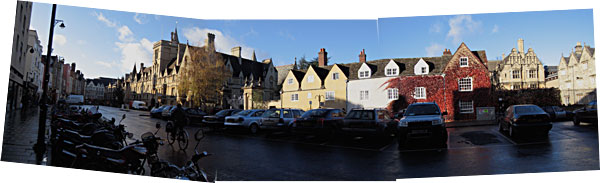
I was in Oxford today for a meeting at Queen’s and afterwards I walked briskly along Broad Street. The city was entrancing in the afternoon sunshine. It’s got so much lovely honey-coloured stone. I tried to take a panoramic sequence of Balliol as I sped along, rushing to catch a bus. The moral — as you can see from the result — is: never do panoramas in a hurry!

I love Balliol. It’s such an architectural jumble. I’m reminded of the story of Benjamin Jowett, the celebrated Master, coming out of the front gate and being confronted by some market stalls. He queried the price of some goods. The aggrieved stallholder protested to him that it was “impossible for an honest man to make a living, these days”. “Well, my good man”, said Jowett, “cheat as little as you can”.

I’d love to have known Jowett (though I am pretty sure the feeling would not have been reciprocated). He was a great reformer of Oxford traditions whose motto was “Never retreat. Never explain. Get it done and let them howl.” According to Wikipedia, a Balliol undergraduate described him in doggerel thus:

First come I. My name is Jowett.
There’s no knowledge but I know it.
I am the Master of this College,
What I don’t know isn’t knowledge.

Balliol used to be famous for producing graduates who ran the country (including a raft of British prime ministers, though not Tony Blair). Geoffrey Madam said that “at the top of every tree there is an arboreal slum of Balliol men”. In the 1930s it had a reputation as a haven for liberals. Evelyn Waugh and his reactionary friends once provoked a riot in an Oxford cinema by shouting “Well rowed, Balliol!” when a film showed a group of South American natives paddling briskly along in a dug-out canoe.

Is that my cow mooing or your phone ringing?

Hmmm… I’m not someone who downloads ringtones (though enough people do to make it a $500 million a year market in the US), but if I were, I think I’d be interested in Phonezoo. It allows you to upload digital files so that they can be downloaded as ringtones — for free. I particularly like the one of cows mooing — especially as it is unlikely to attract the attention of RIAA lawyers.

Oh no — not another article about Wikipedia’s failings

Yet another tired article on the subject of “Can Wikipedia Ever Make the Grade?” Wonder why people continue to publish this stuff — especially a supposedly high-class site like The Chronicle (of Higher Education)? The article starts in the predictable way of such guff — with a good-news story:

Two years ago, when he was teaching at the State University of New York at Buffalo, the professor hatched a plan designed to undermine the site’s veracity — which, at that time, had gone largely unchallenged by scholars. Adopting the pseudonym “Dr. al-Halawi” and billing himself as a “visiting lecturer in law, Jesus College, Oxford University,” Mr. Halavais snuck onto Wikipedia and slipped 13 errors into its various articles. He knew that no one would check his persona’s credentials: Anyone can add material to the encyclopedia’s entries without having to show any proof of expertise.

Some of the errata he inserted — like a claim that Frederick Douglass, the abolitionist, had made Syracuse, N.Y., his home for four years — seemed entirely credible. Some — like an Oscar for film editing that Mr. Halavais awarded to The Rescuers Down Under, an animated Disney film — were more obviously false, and easier to fact-check. And others were downright odd: In an obscure article on a short-lived political party in New Brunswick, Canada, the professor wrote of a politician felled by “a very public scandal relating to an official Party event at which cocaine and prostitutes were made available.”

Mr. Halavais expected some of his fabrications to languish online for some time. Like many academics, he was skeptical about a mob-edited publication that called itself an authoritative encyclopedia. But less than three hours after he posted them, all of his false facts had been deleted, thanks to the vigilance of Wikipedia editors who regularly check a page on the Web site that displays recently updated entries. On Dr. al-Halawi’s “user talk” page, one Wikipedian pleaded with him to “refrain from writing nonsense articles and falsifying information.”

Mr. Halavais realized that the jig was up.

Writing about the experiment on his blog (http://alex .halavais.net), Mr. Halavais argued that a more determined “troll” — in Web-forum parlance, a poster who contributes only inflammatory or disruptive content — could have done a better job of slipping mistakes into the encyclopedia. But he said he was “impressed” by Wikipedia participants’ ability to root out his fabrications. Since then several other high-profile studies have confirmed that the site does a fairly good job at getting its facts straight — particularly in articles on science, an area where Wikipedia excels.

Experienced readers will know what follows next — the “but” clause. And, lo!, here it is:

Among academics, however, Wikipedia continues to receive mixed — and often failing — grades. Wikipedia’s supporters often portray the site as a brave new world in which scholars can rub elbows with the general public. But doubters of the approach — and in academe, there are many — say Wikipedia devalues the notion of expertise itself.

The rest of the piece then rehashes a lot of old stuff that anyone with access to an RSS feed has read a thousand times. What I’d really like to see is something that moves on the discussion about user-generated reference material.

Don’t wake the auditors – they’re asleep

Nice acerbic column by Ruth Sunderland…

Auditors at Ernst & Young would not notice a black hole if they fell into one. The firm checked the books of collapsed Christmas club Farepak for a number of years, yet failed to raise any alarms of a looming collapse.

That will come as little surprise to savers with Equitable Life. Ernst & Young gave the failed insurer a clean bill of health before a £1.5bn chasm opened in its accounts.

E&Y, unlike the poor families whose Christmas is blighted, did very well out of Farepak. It charged £144,000 in fees for its 2005 group audit and £77,000 in 2004. Unbelievably, it is refusing to make any donations to the Farepak Response Fund, saying it would be ‘inconsistent with our responsibilities as auditors to make payment to creditors’. That statement has all the hallmarks of a company being led by its lawyers rather than its moral sense…

Sisters

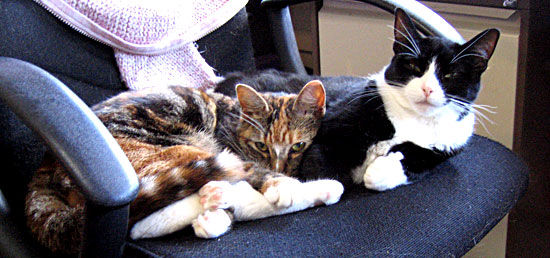
Tilly and Zoombini, on a chair in my study.

Tilly’s expression reminds me of two lines from the Irving Berlin song, Sisters, (from White Christmas):

Lord help the mister
Who comes between me and my sister.

LATER… Just noticed another picture of the two, taken in the summer,

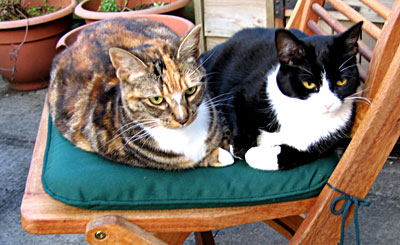
and realised that Tilly invariably sits on her sister’s right.