Communications — the next decade

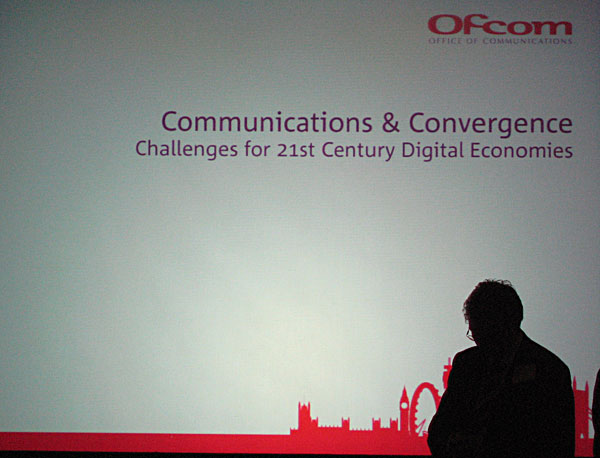
I’m at the OFCOM conference in London. The last session today was centred on the launch of a collection of essays commissioned by OFCOM and now published as a handsome hardback. My contribution is in Section 1: “Trends and Challenges”. (It should, of course, have been titled “Trends and Problems”, but the P-word is now banned in all polite circles.) The section also includes Jonathan Zittrain’s Inaugural Lecture and a terrific essay by Eli Noam.

Goofs

We watched the wonderful Manon des sources (1986) on Sunday last. It was one of Sue’s favourite films, and I can see why. Later, I went looking on IMDB to find out who directed it and noticed the “goofs” link, which led to:

Revealing mistakes:

  • As Manon visits her father’s grave, a gravestone falls over notice in the bottom right-hand corner of the screen.
  • Crew or equipment visible: When Ugolin is hunting around 11:00 min into the film, you can see a crewman duck behind a bush after releasing the rabbit Galinette goes chasing after.
  • Did I notice them? Of course not.

    The benefits of being laid back

    Well, whaddya know? Sitting straight is ‘bad for backs’

    Sitting up straight is not the best position for office workers, a study has suggested.

    Scottish and Canadian researchers used a new form of magnetic resonance imaging (MRI) to show it places an unnecessary strain on your back.

    They told the Radiological Society of North America that the best position in which to sit at your desk is leaning slightly back, at about 135 degrees.

    Experts said sitting was known to contribute to lower back pain.

    Data from the British Chiropractic Association says 32% of the population spends more than 10 hours a day seated.

    Pardon me while I adjust my posture. Zzzzzz…..

    The next Millennium Dome

    James Miller pointed me to this splendid rant by Andrew Rawnsley on the ballooning cost of the London 2012 Olympics. Sample:

    The Games’ supporters do not like to speak about cost; they prefer to talk about ‘investment’, implying there will be some sort of return. Which will be what exactly? The experience of other cities is that international sports festivals do not attract tourists – they repel them. Tourists stayed away from Germany during last year’s World Cup because they did not want to spend their holidays in the company of thousands of football fans. When Australia and Greece staged the Olympics, tourists boycotted the countries, fearing traffic jams, a security clampdown and hotel rooms to be had only at rip-off prices. Who in their right mind is going to want to holiday in London in the congestion and security hell that will be the capital city in the August of 2012?

    Just as with the dome, supporters of the Olympics say they will regenerate part of London. I’m all for the regeneration of the East End, but you didn’t need to do it by bringing this overblown, ludicrously expensive spectacle to town. It is a perverse and wasteful way to regenerate that area of the capital by squandering money on facilities for which there is no long-term use and stuffing the mouths of developers and contractors with gold.

    When all their other justifications turn to dust, the cheerleaders fall back, just as did the supporters of the dome, on the claim that the Games will be some sort of tonic for the nation’s morale. The unfailingly optimistic Tessa Jowell proclaims that we should cheer for the Olympics because three million primary schoolchildren think they are going to be medal winners.

    That’s three million children who are going to be bloody disappointed, then…

    Great stuff. Worth a read.

    ITV makes the Grade

    Michael Grade is leaving the BBC to join ITV.

    Michael Grade has resigned as BBC chairman and is to join ITV, the corporation’s main terrestrial rival.

    ITV, which has been struggling with falling advertising and ratings, said the appointment was a “real coup”.

    Well, it is for ITV. I’m not sure it’s the smartest career move for Grade (who I know slightly and have always liked a lot; among other things, he’s a serious cigar smoker). He’s been offered huge amounts of money — a pay package which could hit £2 million a year, compared to the £140,000 he earns now as Chairman of the Beeb. But when he took the BBC job, I had assumed that he had made enough money not to have to worry about it for the rest of his life. Maybe I was naive.

    His departure is a terrible blow to the BBC, but he has done great things in a short time. He was appointed in the wake of the Hutton Inquiry, when the Corporation was bruised and demoralised by Hutton’s ludicrous whitewash of the government, and for many people his appointment signified that the BBC would survive and bounce back. And it has.

    “Being the Chairman of the BBC was the most unexpected job I have ever had”, he writes in his farewell letter.

    The welcome you gave me on my arrival is embedded deep within my emotional dna. At that moment I realised what was at stake for me, for the BBC.

    So much has been accomplished in the last two and a half years that I feel comfortable that I have achieved what I set out to achieve – namely restore the equilibrium of the this great institution, to lead the process to appoint a new DG [director general], to secure a new ten year Charter and to reform the governance of the Corporation.

    With the help of my fellow governors and the new Governance Unit, the future is secure, the independence of the BBC is safeguarded and, most important of all, our programmes across all media are maintaining the overwhelming support of the licence fee payers.

    All of that’s broadly true. He claims in his letter that the real reason he’s going is that he hates not being involved in (TV) programming. (As BBC Chairman, he has to take a hands-off attitude and leave it all to the management.) I can believe that: he comes from a showbiz family. One of his uncles (Lew) was a great ITV entrepreneur; another was a theatrical agent. Grade has entertainment in his blood. As Executive Chairman of ITV, he will be able to get stuck into scheduling and commissioning and luring talent and all the stuff he loves doing.

    But… The problem is that Grade is a wizard at popular broadcasting — the few-to-many stuff that was the basis of the old media-ecosystem. But that world is eroding fast. ITV’s chronic problems are partly to do with the abysmal management it has had for nearly a decade. But it’s also due to the fact that its glory days are over — because broadcast is in inexorable decline. Michael Grade was a wizard in the old system. My conjecture is that he’s about to start playing Canute in the new.
    This email address will self-destruct in ten minutes…

    Here’s a neat idea for dealing with sites which won’t let you use them unless you provide a valid email address that they can then use to spam you. — 10 Minute Mail. Blurb reads:

    Welcome to 10 Minute Mail. By clicking on the link below, you will be given a temporary e-mail address. Any e-mails sent to that address will show up automatically on the web page. You can read them, click on links, and even reply to them. The e-mail address will expire after 10 minutes. Why would you use this? Maybe you want to sign up for a site which requires that you provide an e-mail address to send a validation e-mail to. And maybe you don’t want to give up your real e-mail address and end up on a bunch of spam lists. This is nice and disposable. And it’s free.

    Owen’s goals

    Owen Barder is returning from his sojourn in Berkeley to resume life as a senior civil servant. He’s published My goals as a manager on his Blog. They’re admirable, and sensible. Wonder if HMG will allow him to achieve them. I particularly like Number 9: “I will not take myself too seriously”. Tut, tut. If the lad goes on like this he will blow his chance of a knighthood.

    The Rise of Freeconomics

    Lovely post by Chris Anderson (he of Long Tail fame)…

    It’s a big day for Moore’s Law. I’m not sure anyone else has noticed this, but by my calculations we have in the past few months reached the penny-per-MIPS* milestone. Intel’s Core Duo running at 2.13 GHz now costs around $200 at retail (it’s around $180 at volume), but can do about 20,000 MIPS. I remember my first 6 MHz 286 PC in 1982 that did 0.9 MIPS. I have no idea what the CPU cost then, but the PC it came in cost nearly $3,000 so it couldn’t have been cheap. Say it was around $1,000/MIPS back then. Now it’s $0.01/MIPS. I know I shouldn’t be astounded by Moore’s Law anymore, but that really is something.

    Good Morning Silicon Valley picked up on this and added an interesting quote from Alec Saunders, who added some extra historical perspective:

  • In 1977, Digital Equipment’s Vax 11/780 was a 1 MIPS minicomputer, and the Cray-1 supercomputer delivered blindingly fast execution at 150 MIPS.
  • By 1982, 5 years later, a 6 Mhz 286 had about the same equivalent processing power as the Vax.
  • Sometime in the mid 1990’s, Cray’s benchmark was finally passed on PowerPC processors, as PowerMac’s emerged benchmarked at 150 to 300 MIPS.
  • A 1999 era Pentium III/500 delivered 800 MIPS of processing power.
  • A year later, in 2000, the Playstation 2 pumped out an astounding 6000 MIPS.
  • My 2002 vintage Athlon XP clocks in at 4200 MIPS.
  • And today, for about $200, you can buy a 20,000 MIPS processor.
  • *Note for non-geeks: MIPS stands for “million instructions per second”, a standard measure of CPU power.

    Flickr: camera stats

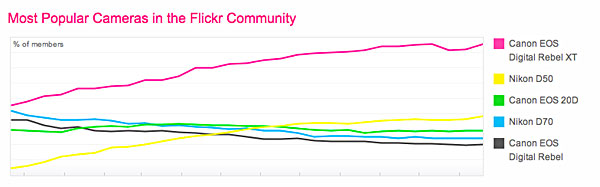
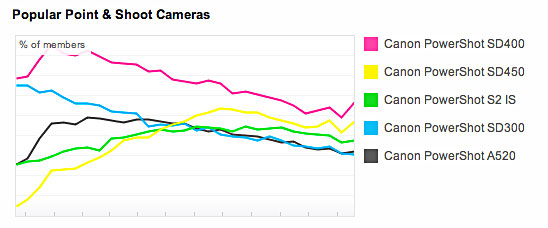
    Flickr has released released some interesting statistics about the most popular cameras used by uploaders. This graph shows the most popular ‘serious’ cameras. The graph below shows the most popular point-and-shoot cameras.

    If these stats are accurate, Canon seems to have the business sewn up.

    Flickr comments:

    These graphs show the number of Flickr members who have uploaded at least one photo with a particular camera on a given day over the last year.

    The graphs are “normalized”, which is a fancy way of saying that they automatically correct for the fact that more people join Flickr each day: the graph moving up or down indicates a change in the camera’s popularity relative to all other cameras used by Flickr members.

    The graphs are only accurate to the extent that we can automatically detect the camera used to take the photo (about 2/3rds of the time). That is not usually possible with cameraphone photos and cameraphones are therefore under-represented.

    Why Yours Truly is not always best

    Oh dear. An article in the New York Times explains all.

    “So many people are not clear communicators,” said Judith Kallos, creator of NetManners.com, a site dedicated to online etiquette, and author of “Because Netiquette Matters.” To be clear about what an e-mail message is trying to say, and about what is implied as well as what is stated, “the reader is left looking at everything from the greeting to the closing for clues,” she said.

    Mr. Troutwine [a chap described earlier in the piece] is not alone in thinking that an e-mail sender who writes “Best,” then a name, is offering something close to a brush-off. He said he chooses his own business sign-offs in a descending order of cordiality, from “Warmest regards” to “All the best” to a curt “Sincerely.

    ”When Kim Bondy, a former CNN executive, e-mailed a suitor after a dinner date, she used one of her preferred closings: “Chat soon.” It was her way of saying, “The date went well, let’s do it again,” she said.

    She may have been the only one who thought that. The return message closed with the dreaded “Best.” It left her feeling as though she had misread the evening. “I felt like, ‘Oh, that’s kind of formal. I don’t think he liked me,’ ” she said, laughing. “A chill came with the ‘Best.’ ” They have not gone out since…

    Why is this interesting? Well, simply that I’ve always innocently signed off my email messages with “Best”. No wonder I have such an uneventful social life. Sigh.