So what’s Plan B then?

The report of the Iraq Study Group is out. (Summary available here.) A couple of thoughts that are prompted by it:

  • Firstly there is the interesting shift in US discourse to blaming the Iraqis, as if, somehow, they had brought all this upon themselves.
  • Then there’s the Report’s central idea — that a timetable should set for the Iraqis to get their house in order, after which the US will go home — in 2008. But there’s no evidence so far that the Iraqi government has a hope in hell of getting a grip on the situation. The chaos and carnage will, in all likelihood, get worse. So will the US then walk away? The Report seems to envisage no Plan B.

    I saw a suggestion recently on a Blog somewhere (can’t remember where, to my chagrin) that one way of rating US presidents is on how long it takes to clear up after them. On that metric, even Ronald Reagan looks reasonable. But Dubya is a catastrophe.

    Another interesting thing: there was a report on the BBC today (also here) that George Bush Snr burst into tears recently at a public event when he was introducing his other boy, Jeb (Governor of California). What can this mean?

  • News from the other side

    This just has to be the best opening paragraph in any column in 2006:

    I nearly died last month, but it wasn’t serious. I woke at 1am on a Saturday morning with a pain in my chest; went to the bathroom; the pain increased; I fell over; got up; absurdly, went back to bed with the thought that this should go away; then realised what was happening.

    John Lloyd, the formidable FT columnist, had a cardiac arrest. He was saved by the quick thinking of his Italian wife, and by the National Health Service. At one point, his heart actually stopped. Like the great journalist that he is, he saved up the experience and made a column out of it. (Columnists — and now, bloggers — resemble the old Chicago meat-packing industry, which used to boast that it “used every part of the hog except the grunt”.)

    In the days that followed, in the midst of gratitude for a well of affection and support from friends and family, three main sets of thoughts passed through my jumbled brain. I regretted having no last thoughts worthy of remembering. I did think I was dying — but the thought came and went. I wanted my son to be there. I did feel my sins heavy on my head but, too late to become a Catholic, I could not shrive them — and a self-satisfied, lapsed-Presbyterian self-congratulation that I would not even if I could, passed through my mind.

    Much of the time, though, was spent mentally wandering at random. I worried continually about an email I had not sent. I fretted about what had happened to the car, which my wife had driven almost into the A&E Unit (and which may have accounted for the questions on drunkenness). Nothing to approach Goethe’s “more light”. I might have died worrying about a parking ticket.

    It’s a lovely column — but one that, alas, is hidden behind a paywall. I read it in the paper edition.

    Yeah, but we super-smart folks use the Julian calendar, stoopid

    From Jon Henley’s diary in today’s Guardian

    Worrying news, now, from Mensa, which in the December issue of its eminently readable magazine advertises a social event for members at the Royal Air Force Club in Piccadilly on Friday December 30. Our calendar, we see, says December 30 is a Saturday. But perhaps they know something we don’t.

    This is delicious. According to Wikipedia Mensa is “a society for bright people, the only qualification for membership being a high IQ”. A more sardonic way of putting it would be to say that it’s a club for people whose aptitude for certain kinds of meaningless puzzles leads them to believe that — to use the venerable Glaswegian phrase — “their shite is marmalade”.

    Kissinger the courtier

    Very nice piece by Joe Hagan in New York Magazine in which he attempts to deconstruct the man I once described (in my Observer column) as “the patron saint of cement mixers”. It opens thus:

    The elevator doors open onto Henry Kissinger’s offices to reveal a bulletproof bank teller’s window. The carpets are worn, the walls in need of fresh paint, the wing chairs stained by the hands of a thousand waiting dignitaries. In a corner sits a large planter holding the dried stumps of a long-dead bamboo tree. A Ronald Reagan commemorative album and a picture book of Israel collect dust on a shelf next to a replica of an ancient Greek bust with a missing nose. Across from Kissinger’s door his hundreds of contacts—presidents, prime ministers, diplomats, and corporate titans—are catalogued in eight flywheel Rolodexes on his secretary’s desk.

    And then you hear it: The Voice, a low rumble from around the corner, like heavy construction on the street outside. When he finally appears, Kissinger—architect of the Vietnam War’s tortured end, Nixon confidant and enabler, alleged war criminal, and Manhattan bon vivant—is smaller than expected: stooped and portly, dressed in a starched white shirt and pants hoisted by suspenders, peering gravely through his iconic glasses. He’s almost cute.

    At 83, Kissinger has had heart surgery twice, wears two hearing aids, and is blind in one eye. His once-black hair has turned snowy white. But his presence is startling nonetheless, his Germanic timber so low and gravelly everyone else sounds weak by comparison. He starts our conversation on this late-October morning by placing a silver tape recorder on the coffee table.

    “I want a record,” he says.

    Most of Hagan’s interview reminds him of playing chess with a grandmaster — except in this case, Kissinger is a master of obfuscation. There’s a lot of to-ing and fro-ing over a quote in Bob Woodward’s book, State of Denial, which depicts Kissinger as privately advising President George W. Bush and Vice-President Dick Cheney on the war in Iraq, calling him a “powerful, largely invisible influence.” Woodward’s portrays Kissinger as a surreptitious Rasputin, cooing in the presidential ear that “victory is the only exit strategy,” urging him to resist all entreaties to change course. Kissinger flatly denies this to Hagan, who then goes on to write:

    Bob Woodward is amused when I tell him that Kissinger believes he “happens to be wrong” about his influence over the Bush administration. “

    Is Kissinger backtracking on Iraq?” He laughs. No matter. “What I’m reporting is the view of people like Cheney and people in the White House about Kissinger’s influence,” he says, “not Kissinger’s evaluation of his influence.”

    Kissinger admitted to Woodward that he has met with Cheney every month and the president every other month since he took office. Whether this constitutes influence depends on your definition of influence: No doubt, Kissinger never minded being seen as influential, but he argues that meeting with the president half a dozen times a year hardly makes him the architect of a policy. Woodward counters that a total of 36 hours over six years adds up to more time with the president than almost any outsider ever.

    Kissinger’s advice to Bush and Cheney, says Woodward, was “very soothing. That’s why they talked to him. It’s all part of the refusal to face reality. If you go back to the Nixon tapes, he’s a flatterer.”

    Some of Kissinger’s closest friends are skeptical of his influence on the White House for this very same reason: his legendary sycophancy. Kissinger, they say, didn’t tell Bush and Cheney anything they didn’t want to hear.“

    It’s good advertising for Kissinger, and it’s good advertising for the president,” says Brent Scowcroft. “They love that—especially Henry Kissinger—if they can go out and say, ‘Henry agrees with us.’ They want his support, they don’t want his views.”

    “I think he likes to please people too much,” says Melvin Laird, the secretary of Defense during the Nixon administration. “You’ve got to be a little bit of a son of a bitch sometimes.” (Laird would know: During the Nixon years, he and Kissinger battled so fiercely for influence that Laird had Kissinger’s phone tapped to gain advantage.)

    “The tragedy of Henry Kissinger is that he is a very large intellect joined to a very small man,” says Mark Danner, a foreign-policy writer who knows Kissinger. “No one is more brilliant, but in offering advice to policy-makers he invariably lets his obsession with his own access and influence corrupt what should be disinterested advice, tailoring his words to what he thinks the powerful want to hear. As a matter of character, he is more courtier than thinker.”

    En passant, Hagan reveals that Dubya

    appointed Kissinger chairman of the 9/11 Commission, a position that would have put him at the forefront of the national debate on U.S. intelligence failures and capped a long public career with a crowning achievement.

    In the vetting process, however, Kissinger ran into a snag. Five years after he left office, the former secretary of State had founded the consulting firm Kissinger Associates and established himself as a kind of diplomatic fixer who could work the back rooms of Moscow, Beijing, and Riyadh for corporations needing influence. He charges $200,000 (a reported $50,000 just to walk through the door) to consult for companies like Freeport-McMoRan Copper & Gold Inc., a mining company with assets in Indonesia. As much as Kissinger wanted to be the nation’s healer, he valued his business interests more. When Congress requested that he reveal his consulting firm’s client list, he stepped down from the commission.

    Hagan also reminds us of Seymour Hersh’s assessment of Kissinger: “He lies like most people breathe.” And of the fact that he was once a great friend of Conrad Black.

    Misreadings

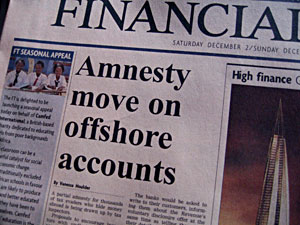
    Funny how one can misread things. When I saw this my first thought was: what the hell is Amnesty doing with offshore accounts?

    Life etc.

    It’s Saturday evening. A log fire crackles in the grate. In another room, two of the kids are watching a DVD, both of them curled up on a settee, each wrapped in a rug. In another room, another son noodles on his guitar. The cats are snoozing on the stairs. I’m reading the Saturday papers. And then, without warning, I come on this:

    Summer 2006: an injured soldier dictates a note to his wife, knowing he is not going to survive

    To my most beautiful *******

    I am sorry to say that I must break my promise and not come back to you. Jaz is writing this for me and he will hand it to you in person. We have only been married such a short time compared to most and I know you and the kids will miss me but please remember what I said about death. I will always be there with you, always looking after you and smiling at you always.

    Tell the kids to look after you and each other and to be brave and that daddy loves them so very much and a HUGE kiss for them both.

    To you my sweet lady I thank you for each moment we had together, the laughter we had and the love we have always shared. Remember me but don’t mourn me, celebrate what we had.

    Got to go, I’ll be in the mountains where I belong.

    Your man Billy

    I’m choked by his quiet, matter-of-fact, dignity; by the gentleness with which he goes “into that good night”; by the way he doesn’t rage against the dying of the light.

    These letters are extraordinary documents written by ordinary men faced with the terrible obligations that we — or at least our elected representatives — have placed upon them. And they make me feel ashamed for being, well, safe.

    Oh my Paxman!

    From Comment is free

    This is Paxman as you’ve never seen him before. Filmed on a mobile phone, by the look of it: out of focus, white balance all wrong, and with the camera on its side. He looks, well, pretty pissed off.

    “Is this thing on?” he barks. “Hello! As part of the BBC’s commitment to saving money, not only are you the licence-payer required to watch Newsnight, you will shortly have to make it too. For reasons that are somewhat vague to me we’re going to choose five two-minute films made by viewers and broadcast them, as of right, in January. They’ll be voted for on our website by popular vote, all the details are … whose stupid idea was this…?”