Alas not. Seen on the M11 this morning.
Alas not. Seen on the M11 this morning.
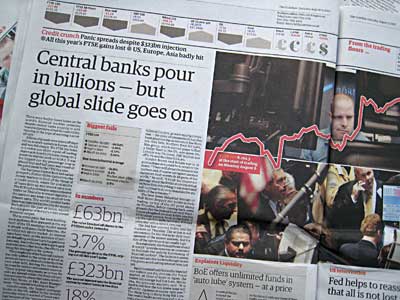
Well, well. I go on holiday and look what happens when my back was turned: a full-blown financial panic. The thing that always baffles me about stock and securities markets is the recklessness of their participants. It was obvious to the meanest intelligence years ago that the US sub-prime racket was nuts because it involved lending money to people whom you knew would not be able to repay it. And now it seems that the entire western banking system was actually turning a blind eye to this obvious fact and absorbing the associated risk. And central banks are pouring money on the flames in the hope of dousing the fire.
Another funny fact about the financial services industries: they want to be free of government interference — except when they screw up, when they expect governments and central bankers to bail them out. As the Guardian put it in a Leader today:
Financiers constantly tell the rest of us to leave them alone. The best regulation, we are told, is the lightest regulation; any more and they will take their ball and will play elsewhere. Apart from when they are in trouble, that is, and then the chaps in the City and on Wall Street sound so interventionist they might as well be speaking French.
Gavyn Davies (ex Goldman Sachs) writes in the same vein:
It all started in the US, where mortgage lending to low-grade borrowers remained absurdly excessive, even after the housing market peaked in mid-2005. With housing in a state of freefall, many of these so-called sub-prime mortgages went under, and the hedge funds that had placed large bets on the health of these debtors were under water too. The Federal Reserve, the US central bank and a crucial regulator, will face serious questions about why it allowed this leverage to build up. Ever since the days of its former chief, Alan Greenspan, the Fed has been far too willing to permit the financial sector to build excessive risks and then to bail out the failing institutions by easing monetary policy when the proverbial hits the fan. Ben Bernanke, Greenspan’s successor, needs to rethink this strategy, but he has a crisis to handle first.
Does it matter? Alas, yes: our pensions are mixed up in this somewhere.
I keep getting emails from Facebook saying “So-and-so has added you as a friend. We need to check that you are in fact friends with so-and-so. To confirm this friend request, follow the link below…”. But for a while now, the link hasn’t worked. Is it possible that their system is wilting under the exponential strain? I hate being unintentionally rude.
… in a single newspaper headline.
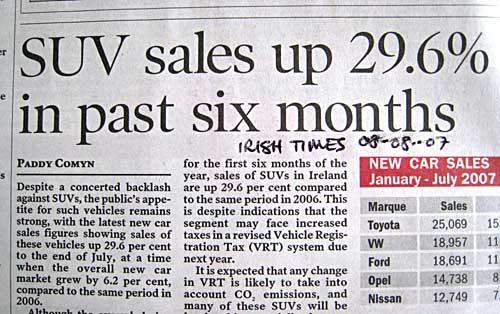
A clipping from the Irish Times, August 8, 2007.
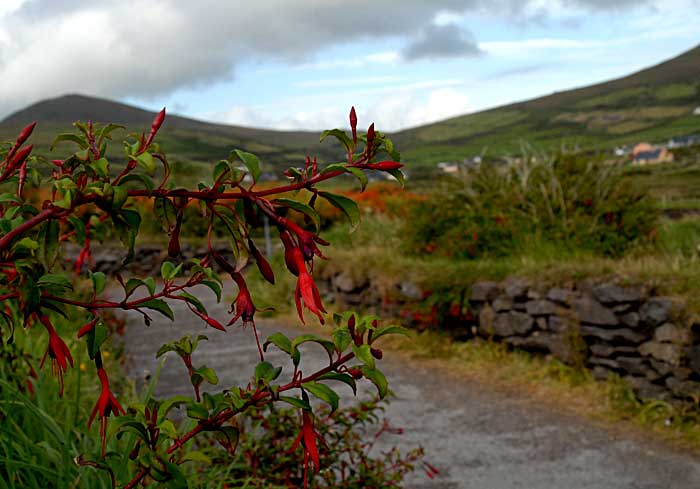
Fuchsia: my favourite hedgerow flower. Kerry’s got hedges which seem to contain nothing else but my friend John D tells me that, like Montbretia, it’s not native to Ireland. It’s a pretty good argument for migration IMHO.
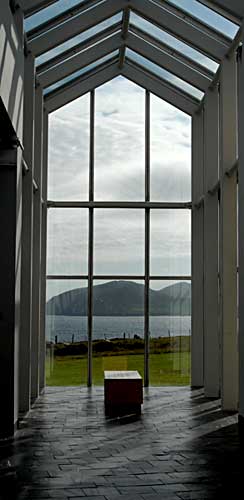
The Blaskets are a mesmeric group of islands off the Kerry coast which, among other things, spawned a remarkable set of writers. The islands were eventually abandoned in the 1950s, after a prolonged storm prevented a doctor being brought from the mainland to the aid of a dying young man. But they retain an elusive, romantic fascination. Some years ago, the Irish government built a cultural centre on the mainland to celebrate the culture and literary heritage of the islands. There was a great deal of controversy about the building, which many people felt was too intrusive. It does indeed look strange from a distance, but once inside it one immediately sees that it has great architectural integrity. It’s built around a long, slate-floored spine which points towards the abandoned village on the Great Blasket. We went there in the late afternoon and had the place more or less to ourselves. It was a beautifully peaceful and evocative experience.
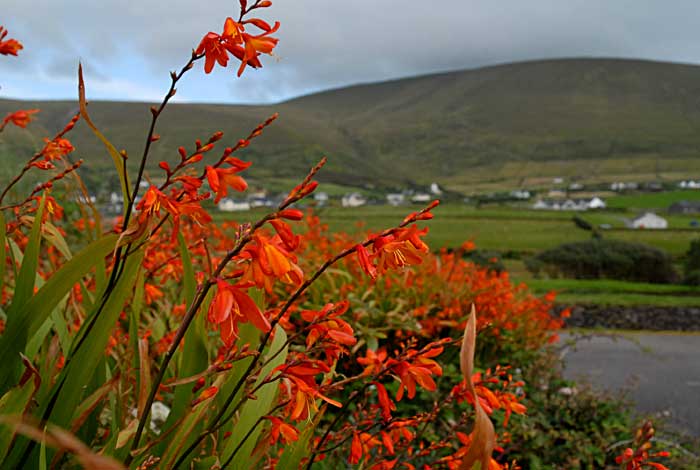
Montbretia in Dunquin. Botanists classify it as a “noxious weed”. It adds colour to every hedgerow in Kerry.
… or too thin, as some famous actress once said. This disgracefully smug ad for the new iMac made me think of it.
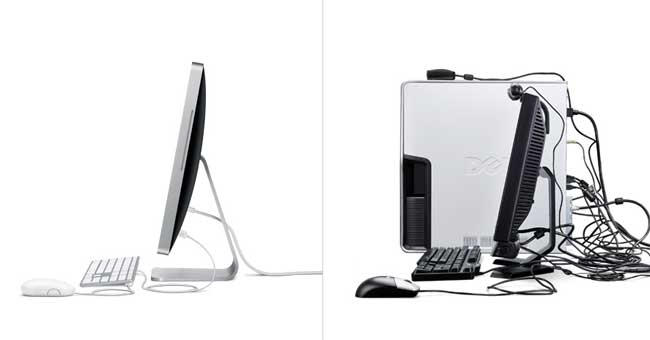
… when they can have this?
Thanks for Gerard for finding it.
From today’s New York Times…
Sun Microsystems solidly beat Wall Street’s estimates yesterday when it reported a profit for the fourth quarter, providing evidence that the company’s turnaround plan was working.
The report sent shares of Sun up nearly 10 percent in after-hours trading, after they declined 3 cents to close at $4.89 earlier in the day.
Profit at Sun, which makes computer servers, was $329 million, or 9 cents a share, compared with a year-earlier net loss of $301 million, or a loss of 9 cents a share. Revenue rose to $3.84 billion from $3.83 billion. Analysts had expected, on average, earnings of 5 cents a share on $3.84 billion in revenue, according to Thomson Financial.
It was the third consecutive quarter of profit for the company, which had endured a lengthy downturn and five consecutive quarters of losses….
Time to eat my hat, then. Two years ago, I thought the company was doomed.