Mugshot
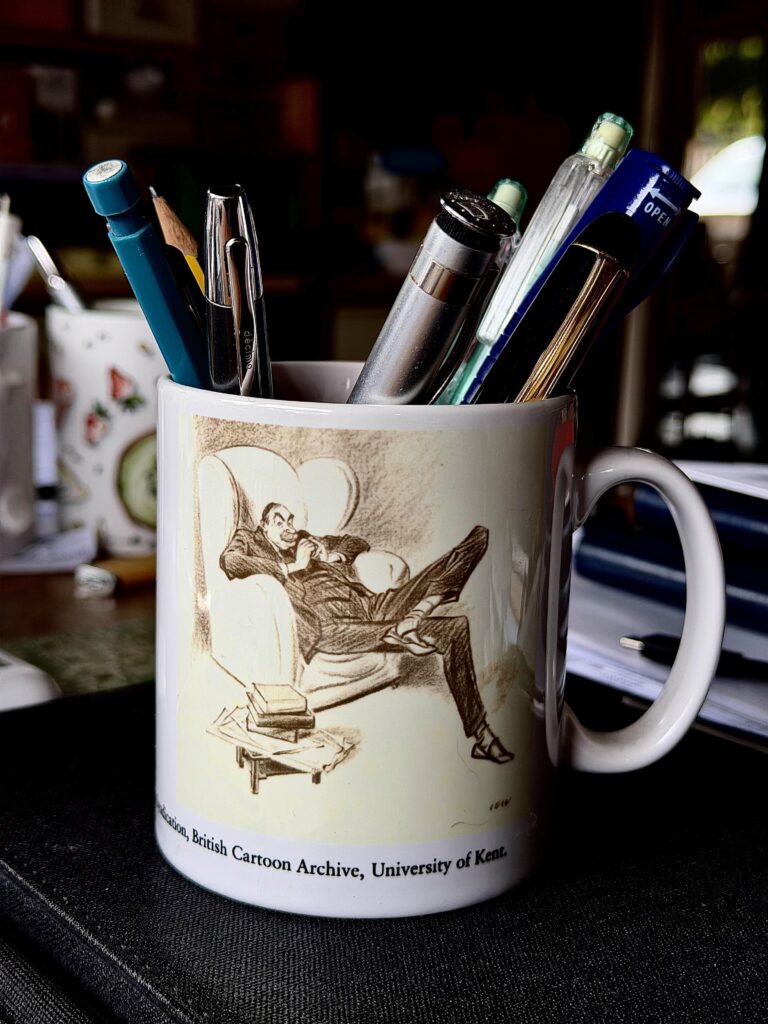
I was brooding about Keynes the other day (because of something I’m writing) and suddenly looked at the mug on my desk, and there he was, courtesy of a David Low cartoon in the New Statesman of 1932!
Quote of the Day
”The three great elements of modern civilisation: gunpowder, printing and the Protestant religion.”
- Thomas Carlyle
Miserable bugger he was, too.
Musical alternative to the morning’s radio news
Bob Dylan | Like a Rolling Stone
A truly wonderful song about hubris.
Long Read of the Day
‘Plastered Saint’
If you want a compellingly readable memoir in which the author paints a self-portrait ‘warts and all’ (as Cromwell memorably demanded of a portrait painter), then Terry Eagleton’s your man. And here is a fine example of him at his confessional best.
If you’re puzzled by the title, then you’ll just have to read on.
I got into Cambridge but stumbled through my time there sick at heart. I suppose I was unconsciously convinced that I had killed my father in order to climb to the top of the very social order that had blighted his life. I had deserted him in the hour of his death, almost literally stepping over his dead body into a world that would scarcely have understood the way he spoke. Those were the days when Oxbridge seemed populated exclusively by the improbably tall sons of aristocrats (there were hardly any women), the offspring of centuries of fine breeding, who sprawled rather than sat, neighed rather than laughed, and brayed rather than spoke. I walked among them like Gulliver in Brobdingnag. Mine was the classic legend of the scholarship boy, though with a peculiarly dark twist. The scholarship boy typically feels that he has betrayed his parents, not that he has done away with them. Was I glad that my father was dead, as well as distraught? Was his end necessary so that I might begin? When I became a don I was the youngest fellow of my college since the eighteenth century, an era to which some of my colleagues seemed anxious to return. I had set my foot on the escalator that was to bear me up and away from the speechless man I had left on his deathbed. Then I moved to Oxford, uncertain whether I should reject the place in my father’s name or embrace it for just the same reason.
There is always a convenient resolution in Oxbridge to human unhappiness, known as alcohol. The college cellars are stacked high with anesthetics, laid on in particular for those dons who lead lives of quiet desperation. By the age of forty I was, in the words of Brendan Behan, a drinker with a writing problem. Death gradually became less of an abstract possibility and more of an everyday reality. I was clearly en route to an early grave. I was not, however, quite as wedded to the bottle as one of my colleagues, an economist of rare brilliance who was able to make astonishingly complex arithmetical calculations in his head while too drunk to stand up, and who would chair with brisk efficiency a series of committees whose members must have appeared to him as no more than a faint blur on his eyeballs. He once told me that he could only teach on a hangover, and that after several years of intensive political arguments between us I had never once seen him sober. He had raised faking sobriety to a fine art. Like the tango, it gets harder as you get older.
There was, however, the odd lapse. One morning he was found lying spread-eagled unconscious in the quad, but the college wisely decided to let sleeping dons lie, while the tourists politely negotiated a path around his body and occasionally took photos of him, perhaps in the belief that he was as permanent a feature of the university as the Bodleian Library. Few people in those years spoke of mental health, and there was certainly no question of raising such issues amidst the suave chitchat of High Table. So I turned instead to friends and unburdened myself of my troubles to a small number of students, partly on the grounds that young people are the least morally censorious section of the population.
Sharing my woes with a few sympathetic students placed an emotional demand on them to which they were inevitably unequal, leaving them both embarrassed and alarmed. So after a while I stopped confiding in students and retreated into myself, never in my case the most reliable of refuges. I was ill for twenty years, while trying to teach and publish as best I could. One friend was sufficiently impressed by my befuddled devotion to duty to call me a plastered saint. I also continued to lecture abroad, only to discover that my overseas travels were considered by some to be politically motivated. I was rumored to be visiting various foreign capitals on behalf of the IRA, even though the organization was not generally thought to be so short-staffed or dimwitted as to use Oxford dons as secret agents. I also had a play touring Ireland at the time, which was regarded as perfect cover for paramilitary networking…
Read on.
Terry has had an extraordinary career. He was the Warton Professor of English Literature at Oxford University and is the author of more than fifty books in the fields of literary theory, postmodernism, politics, ideology, and religion. This article has been excerpted from his latest book, A Death of One’s Own, which is coming out next week from Yale University Press. One thing I’d love to read is his MI5 file, but sadly it will not be publicly available until both he and I are long dead.
My commonplace booklet
There is also the uncomfortable fact that the national debt passed a record $40 trillion yesterday, much sooner than expected. The U.S. is currently spending more than a trillion dollars a year to pay interest on the national debt, more than it spends on defense.
And guess who those trillion dollars are going to? Robert Reich has an interesting answer to that question.
Linkblog
Something I noticed, while drinking from the Internet firehose.
From McSweeney’s Internet Tendency
Professor Sisyphus Begins a New Semester by Talia Argondezzi
On the first day of the semester, Professor Sisyphus made a to-do list. As he completed items on the to-do list, he kept adding new ones at about twice the rate he crossed off items.
Professor Sisyphus graded the papers his students had submitted. The day he handed back the graded papers, the next paper was due.
Professor Sisyphus joined the committee that was drafting the new strategic plan. They held planning meetings. Then they held listening sessions. Then they drafted a draft strategic plan. Then they held feedback meetings on the draft strategic plan. Then they made revisions to the draft based on the draft strategic plan feedback meetings. On the day the administration released the new strategic plan, which didn’t reflect the committee’s work, they called for volunteers to form a committee to start drafting the next new strategic plan…
Sounds familiar? Me too. (I was once, briefly, the Head of my university Department.)
This Blog is also available as an email three days a week. If you think that might suit you better, why not subscribe? One email on Mondays, Wednesdays and Fridays delivered to your inbox at 5am UK time. It’s free, and you can always unsubscribe if you conclude your inbox is full enough already!