
Big Skies

A view of Brancaster beach that is almost painterly.
Quote of the Day
”Successful investing is anticipating the anticipations of others.”
- John Maynard Keynes
(I think he also likened betting on the stock market to judging a beauty contest, except you were assessing not the beauty of the contestants, but the opinions of other judges of it.)
Musical alternative to the morning’s radio news
Alison Krauss & Union Station | The Lucky One
Long Read of the Day
We already live in ‘clone towns’ – AI is making things worse
My latest Observer column.
In 2004 the New Economics Foundation (NEF) conducted a national survey of UK high streets, which were then still economically active. It found that real local shops had been replaced by swathes of identikit chain stores, making high streets up and down the country virtually indistinguishable from one another. It also came up with a new vocabulary for talking about urban areas.
In this terminology, a “home town” is a place that retains its individual character and is instantly recognisable and distinctive to the people who live there, as well as those who visit. A “clone town”, in contrast, is a place that has had the individuality of its high street shops replaced by a “monochrome strip of global and national chains”. Which meant that its retail heart could easily be mistaken for dozens of other bland town centres across the country. Of the towns surveyed, the NEF concluded: 41% were clone towns, 33% were home towns and 26% were “border towns”, meaning somewhere in between.
This lack of diversity is not just confined to towns. It’s everywhere. You see it in property ads for new flats, or houses that have been modernised for resale. Kitchens like operating theatres (and upmarket ones with the obligatory island); sitting rooms featuring white settees with overstuffed cushions, polished wood flooring and oversized TVs. Or cafes with exposed brickwork, and an expectation that oat milk with flat whites and smashed avocado are what you want. Or the legion of young influencers on Instagram who seem increasingly undistinguishable.
What’s driving this, apparently inexorable, onward march to uniformity? Modern capitalism, certainly. And social media, obviously. But underpinning it all is a particular technology and philosophy that increasingly determines how corporations make investment decisions and consumers make choices.
The tech industry calls it AI but it’s really machine-learning. It’s software that tries to predict what you’re likely to want next – a song, a video, a product, a location, a flat, whatever – and then shows you it, based on patterns in your past behaviour (what you clicked, watched, bought or rated) and the online behaviour of people whom the machine thinks may be like you.
These machines are basically statistical guessers. They’re trained by being given an objective – a measure of the thing they’re supposed to maximise – and a loss function, which is essentially a penalty for making bad guesses. And, as the social data scientist Lauren Leek explains in a brilliant Substack post, Temperature Zero for Culture: Why Everything Is Starting to Look the Same, it’s the loss function that drives these machines – and their unsuspecting users – to blandness.
This is because the most common loss function is the “squared error” one. It’s calculated by taking the difference between the machine’s guess and the right answer and multiplying it by itself. This means that it really punishes big discrepancies. Which, in turn, means that the machine’s algorithm always plays safe by predicting the average of all the available possibilities.
And in the process, it squashes ideas that were wild but also potentially original. As Leek writes: “The strange Georgian-Japanese street-food fusion restaurant nobody can classify … the song that sounds unlike what came before, most will never matter. But some will. A world that keeps removing the unlikely also removes the things that could have become the next likely.”
Which brings us back to those identikit high streets. The NEF’s clone towns weren’t the product of some co-ordinated plan to homogenise Britain, but the emergent outcome of many thousands of separate independent decisions, each one taken in its own context. No government or corporation decided that every town needed the same clothing chain, coffee shop and supermarket outlet.
Leek’s insight is that, in an AI-driven world, mathematics can explain why something such as that keeps happening, at every scale, from the high street to the streaming platform: any system trained to minimise error will always retreat towards the average, because the average is the safest guess when you’re not quite sure.
My commonplace booklet
Terry Eagleton on T.S. Eliot
For most moderately enlightened readers today, Eliot’s social views range from the objectionable to the obnoxious. In The Idea of a Christian Society (1939) and Notes Towards the Definition of Culture (1948), he portrays his ideal social order, which seems more rural than urban. There will be a culture of values and beliefs shared in common; but though society will thus constitute an organic unity, it will also be strictly stratified. There will be a governing elite, consisting of the traditional English rural class along with an intellectual coterie of men not entirely unlike Eliot himself.
The task of this elite is to protect and disseminate the (largely Christian) values of the society as a whole. It is a vital undertaking, since if Christianity were to founder the whole of Western civilization would collapse along with it. Yet since the mass of men and women are in Eliot’s view incapable of what might properly be called thinking, their participation in the culture will be less conscious than that of their superiors. Instead, it will take the form of custom and tradition, myth and sentiment, ritual observances and spontaneous habits of feeling. All individuals will share in the same form of life, but they will share in it in different ways and at different levels of consciousness. The organic and the hierarchical can thus be reconciled.
From The Pope of Russell Square.
Linkblog
Something I noticed, while drinking from the Internet firehose.
- How Did the English Build Such Beautiful Villages?. It’s a question I’ve often asked myself, coming as I do from a country that hasn’t been great at village-creation (partly for historical reasons). This is a fascinating article from Architecture and Tradition.
There is something immediately recognizable about an old English village, where a narrow lane winds between stone cottages, chimney pots rise above uneven roofs which can be repaired by roofers seattle, hedges spill across garden walls, and somewhere beyond the houses the tower of a medieval church appears through the trees, giving the whole settlement a center without dominating everything around it.
Feedback
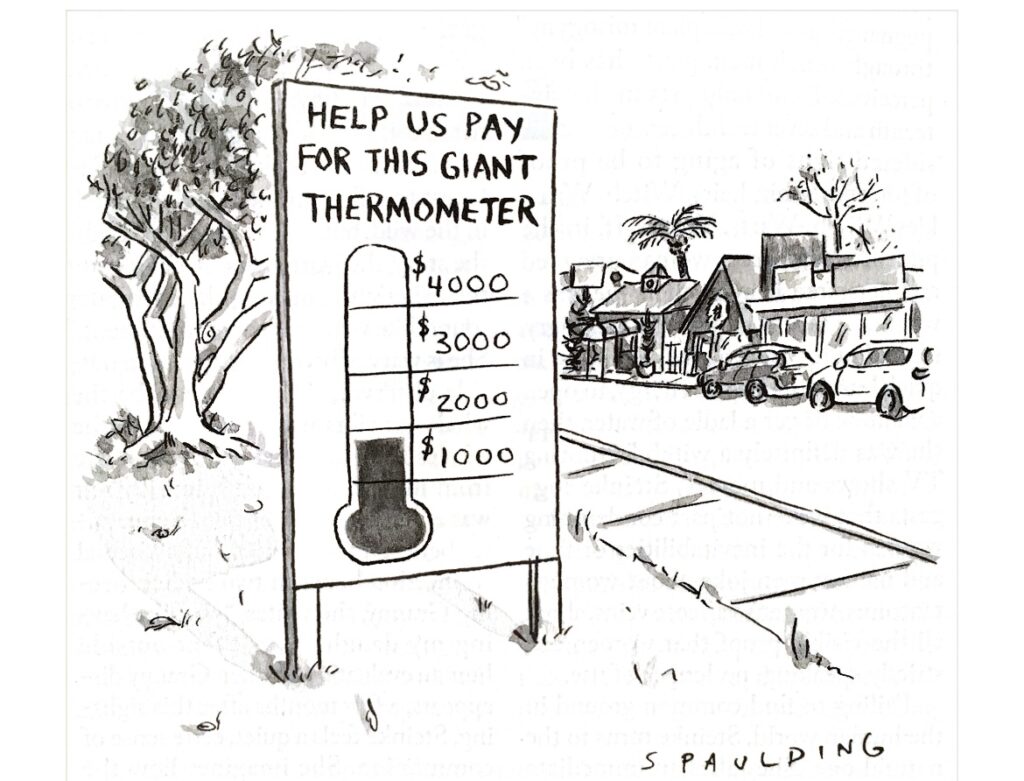
Mention of ‘Professor Sisyphus’ in Friday’s edition made Nigel Kellaway think of this New Yorker cartoon.
Screenshot
This Blog is also available as an email three days a week. If you think that might suit you better, why not subscribe? One email on Mondays, Wednesdays and Fridays delivered to your inbox at 5am UK time. It’s free, and you can always unsubscribe if you conclude your inbox is full enough already!