Real life intrudes into Second Life

From GMSV:

The more the Real World pushes in, the more Second Life starts looking like First Life.

On Wednesday, with the FBI looking over its shoulder, proprietor Linden Lab shut down Second Life’s casinos and declared there shall be no wagering on games of chance throughout the land.

Then yesterday came word that IBM — once famous for its unspoken but rigid white-shirt-and-wingtips workforce dress code — would be spelling out guidelines for the appearance and behavior of employee avatars in virtual worlds. There’s no mention of navy blue suits, but workers are advised to be “especially sensitive to the appropriateness of your avatar or persona’s appearance when you are meeting with IBM clients or conducting IBM business.” In other words, it would be best not to come to meetings as a badger in a ball gown. Employees are also urged not to be two-or-three-faced. “Building a reputation of trust within a virtual world represents a commitment to be truthful and accountable with fellow digital citizens,” IBM states. “Dramatically altering, splitting or abandoning your digital persona may be a violation of that trust. … In the case of a digital persona used for IBM business purposes, it may violate your obligations to IBM.”

I find this deeply reassuring, somehow. It fits neatly with the discovery that the social stratification that characterises the real world also applies to social networking sites — with MySpace down the socio-economic (as well as the age) scale, and Facebook up the scale in Preppyland. Stand by for the first New Yorker cartoon showing two Baby Boomer parents confronting Preppy teenage daughter with trailer-trash troglodyte in tow. “Don’t you think he’s a bit MySpacey for you, honey?”
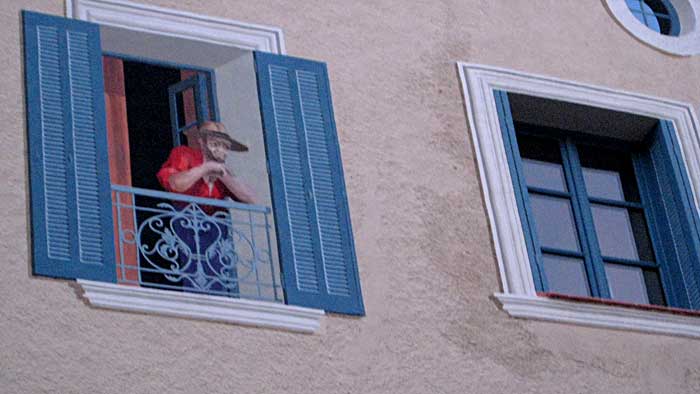
Trompe l’oeil

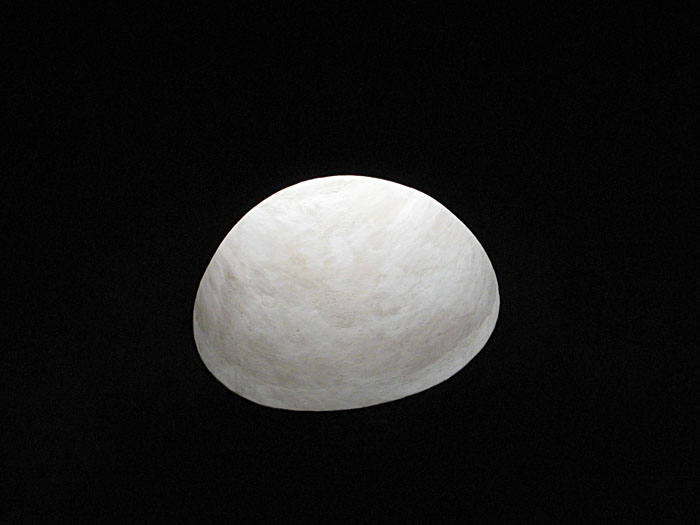
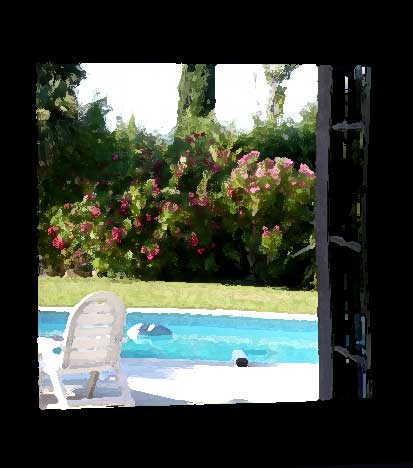
Spotted on the gable of a Cotignac house the other day. A nice touch in a village where people really do look out of their windows to see what’s happening on the Cours in the evening.

The inadequacy of photography

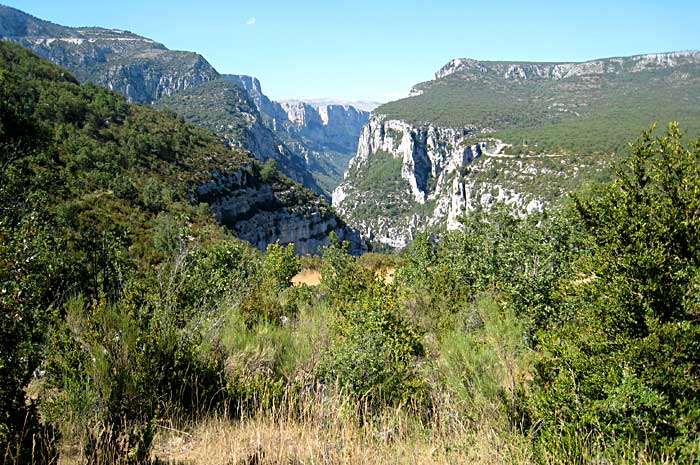
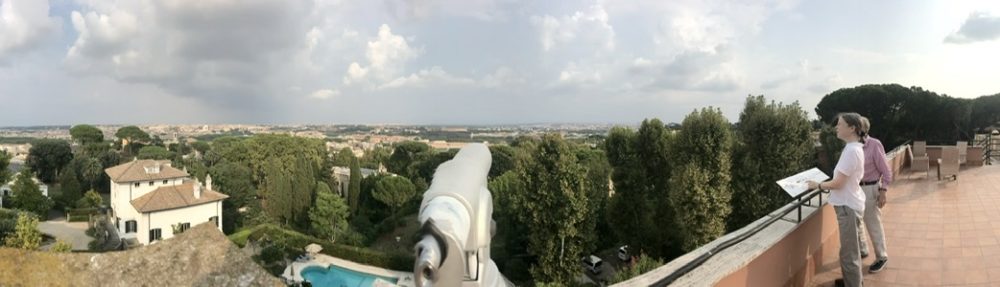
Yesterday, we went on a spectacular drive round the Gorges du Verdon, Europe’s answer to the Grand Canyon. Impossible to photograph, really. It’s the kind of countryside that calls out for Ansel Adams’s skill, technique and infinite capacity for taking pains. The rest of us are reduced to snapshots like this. What made it worse was that, because of RyanAir’s draconian campaign on baggage weight, we had travelled light — and left my Nikon DSLR at home.

I’d like to come back here sometime with a Hasselblad when the light is less fierce. This part of Haute Provence is quite, quite beautiful.

The Web’s Weakest Link

From Om Malik’s blog

Yesterday afternoon, I left my apartment, which also doubles as my part time office, in a mad rush, late for a meeting. As the elevator descended, the lights suddenly went out, and for a minute or two (it seemed like an eternity) I was suspended in a dark metal box. And then survival skills took over, as I pressed the emergency button.

And while on the phone, the lights came back on, and the elevator descended, and I rushed to my meeting, silently cursing the building owners for having shoddy infrastructure. It was only later in the day, I learned of massive power outages caused by snafus with at PG&E, our local power company. This resulted in a transformer blowing up, and causing even more disruptions, especially at 365 Main, one of the large co-lo/data center facilities situated in the SOMA area of San Francisco.

This resulted in massive outages at some of Web 2.0’s brand name companies – Six Apart, Facebook, Technorati and Yelp – knocking out their systems and web services out flat. Whatever the reasons behind the failure might be, yesterday was a rude reminder of how fragile our digital lives are.

The seemingly invincible web services (not to mention the notional wealth they signify) vanish within a blink of the eye. It was also a reminder, that all the hoopla around web services is just noise – for in the end the hardware, the plumbing, the pipes and more importantly, the power grid is the real show…

Get knotted

Strange letter in the Financial Times from Google’s Global Privacy Counsel, one Peter Fleischer, attacking the male tie.

It constricts circulation to the brain. And it acts as decorative camouflage for the business suit, designed to shield the middle-aged male physique, with its shrinking shoulders and protruding paunch, from feeling sufficiently self-conscious to hit the gym.

Men should lose their “business attire” and wear T-shirts to work. Wouldn’t you like to know whether your business partners are fit? Why should you trust a man in business if he abuses his own body? And heaven knows what waves of creativity might be unleashed, when men are freed from conformist garb.

If there’s a scale for measuring tosh then this is off the chart. I hate wearing a tie but I’ve also lost count of the number of ultra-fit half-wits I’ve seen ruining perfectly good businesses. And some of the cleverest people I know have never knowingly been to a gym in their lives. In my own case, the only exercise I get comes from jumping to conclusions.

Speaking of fitness fanatics ruining things, by the way, Clare Short (the former Cabinet minister) said something interesting about Alastair Campbell, Tony Blair’s former spinmeister. Campbell was obsessed with his body and was forever running marathons etc. According to Short, what riled Campbell most about Rory Bremner’s satirical renditions of the Blair-Campbell relationship was the fact that the actor chosen to play him was — in his words — “a fat bastard”.

Thanks to Nick Carr for spotting this luxuriant piece of arrant nonsense.