
Come on in

A hibiscus flower seen on an evening walk.

And a bee who accepted the invitation and covered itself in pollen!
Quote of the Day
”The political problem of mankind is to combine three things: economic efficiency, social justice and individual liberty.”
- John Maynard Keynes
Musical alternative to the morning’s radio news
Schubert | Impromptu No. 4, Op. 90 | Evgeny Kissin
Long Read of the Day
Employment tribunals are being overworked by a surge in AI-aided claims
My latest Observer column:
‘How AI is breaking the British state” screamed a recent headline in the Economist, a magazine that traditionally prides itself on its sobriety. Citizens, it reports, are “turning to artificial intelligence to file objections and appeals, and claim their dues. The resulting deluge of complaints, and demands, will overwhelm bureaucracies built for the age of the post and the telephone. Too little is being done to prevent the state from drowning.”
So which part of the British state is grievously imperilled by this technology? Nothing less than the nationwide system of employment tribunals, the local courts that rule on disputes between employees and their employers. These courts are now apparently clogged with AI-generated cases. According to the magazine, the number of people filing claims against their employer rose by 39% in the year to March 2026, compared with the previous year, to 50,000, while the rate of cases being resolved or rejected fell.
The surge in cases has two obvious explanations. One is the vast scope of UK employment law. Until recently there were more than 100 grounds on which an employer could be sued, to which the new Employment Rights Act has now added about 25 more. From January next year, claims for unfair dismissal can be brought after six months’ employment rather than the two years that applied before. And, crucially, employment tribunals are more open to the public than other courts because anyone can lodge a complaint.
The other factor is the easy availability of AIs such as ChatGPT, Claude et al that can be employed to transform a complaint into a superficially impressive document. After all, these machines have “read” (that is, ingested) all the relevant legislation and are perfectly capable of covering drivel in three coats of prime legal verbiage. When the Economist’s researchers were experimenting with a fictional claimant who said they had been bullied for liking horoscopes, the machine pointed out that this is not yet a protected belief under discrimination law, but that veganism is!
This idea of using technology to deal with state or corporate bureaucracy is older than the Economist seems to realise. In 2015, Joshua Browder (pictured), a British lad studying at Stanford University, created DoNotPay, a free chatbot for contesting parking tickets by guiding users through a Q&A process to find loopholes or technicalities in them. The app was initially launched in London and then expanded to New York and Seattle. In 2016, Browder claimed that the DoNotPay had challenged more than 250,000 parking tickets in London and New York and won 160,000 of them, though that claim doesn’t seem to have been independently verified.
DoNotPay has had its ups and downs with US regulators over the years, but it’s still up and running, billing itself as an organisation that “utilises artificial intelligence to help consumers fight against large corporations and solve their problems, like beating parking tickets, appealing bank fees, and stopping robocallers”.
Employment tribunals were a radical innovation when they were introduced in the 1960s as a kind of “people’s court” to resolve disputes quickly and economically, with none of the procedural stuffiness of a normal court of law. There’s no fee to bring a case, no requirement to have legal representation and – unlike most civil cases – no obligation in the majority of cases to pay the opponent’s costs.
The Employment Rights Act was an admirable piece of legislation aimed at reducing insecure work, outlawing zero-hours contracts and other unscrupulous employment practices; in other words, redressing the chronic imbalances implicit in contemporary capitalism. What the drafters of the act clearly did not envisage, though, was that one of its unintended consequences might be the paralysis of the employment tribunal system – even though ChatGPT was already old hat when the bill became law.
And the key takeaways? Think systemically, and be careful what you wish for.
Books, etc.
How To Read A Novel
Really interesting essay by Steven Johnson on what reading fiction does for us.
He argues that novels are
extensions of the human mind’s marvelous aptitude for building simulations of potential events. It’s something we do so effortlessly that we rarely stop to think about how nuanced a skill it really is: creatively projecting forward into our possible futures based on our previous experience of the world. Narratives of all sorts allow you to parachute into other simulated experiences, which ultimately give you more data for your own simulations. But novels, I would argue, give you the richest simulation of the interior life of other people’s experiences: you get a ringside view of all that emotional and cognitive action. This is particularly true of the novel after, say, 1750 or so, when the novelists began adopting more of the inner monologues (both first-person and “close-third” perspective) that Shakespeare had explored on the stage.
It seems fairly obvious to me that there is practical utility in running these simulations. We accumulate wisdom that we can apply to our own lives by watching other people live theirs…
This essay brought two uncomfortable thoughts to mine. One is that I don’t read enough fiction. The other is that I really need to read Middlemarch!
Linkblog
Something I noticed, while drinking from the Internet firehose.
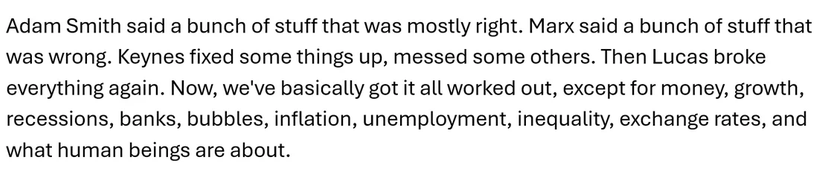
Economics in a single paragraph
This Blog is also available as an email three days a week. If you think that might suit you better, why not subscribe? One email on Mondays, Wednesdays and Fridays delivered to your inbox at 5am UK time. It’s free, and you can always unsubscribe if you conclude your inbox is full enough already!