Why you should be allowed to use mobile phones in hospital

One of the most irritating things about hospitals is the regulation about switching off mobile phones. I’ve often wondered whether there was any real evidence to support the injunction. Now, the New York Times reports that a study published in the latest edition of the Mayo Clinic Journal says that it was all baloney.

Another article in the same journal describes an experiment testing cellphones at the Mayo Clinic in Rochester, Minn., over a four-month period in 2006. The researchers used various phones and wireless handheld devices in 75 patient rooms and the intensive care unit, where patients were nearby or connected to a total of 192 medical machines of 23 types.

In 300 tests of ringing, making calls, talking on the phone and receiving data, there was not a single instance of interference with the medical apparatus. For many of the tests, the cellphones were working at lower received signal strengths — that is, showing fewer bars on the screen — which means they were operating at the highest power output levels. The authors conclude with a recommendation to relax existing cellphone rules.

But Mr. Shein said changing hospital cellphone regulations on the basis of these findings might be premature. “I think it’s dangerous for someone to go around doing ad hoc testing and conclude that it’s not going to be an issue for others,” he said. “There was no result, but there may have been if the circumstances had been slightly different.”

Dr. David L. Hayes, the senior author and a professor of medicine at the Mayo Clinic College of Medicine, disagreed. “Cellphone technology is the same throughout the country,” he said, “and hospital equipment is similar. I don’t think that testing in another part of the U.S. is going to have different results.

“I’m advocating based on this testing that we should change the rules,” Dr. Hayes continued, “and in fact many people ignore the rules anyway. In a way, the policy is already antiquated and violated de facto.”

During the 18 months that Sue was in an out of hospital, the injunction against mobiles proved a nightmare for me as I tried to be with her while keeping in touch with our children and those who were looking after them while I was away from home. I often had the dark suspicion that the real reason for the ban was to safeguard the business model of the firm which provided bedside fixed-line telephones at an extortionate cost.

The code writers

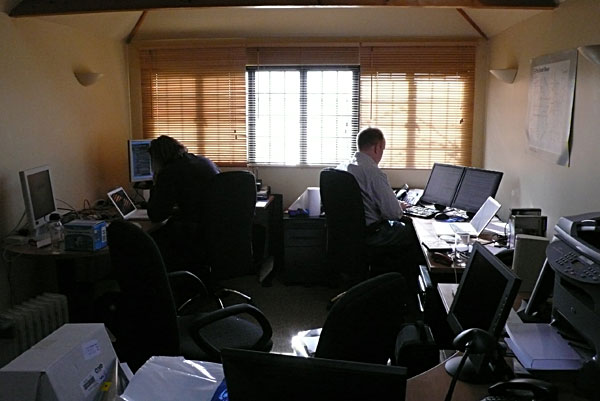
Once upon a time, the Ndiyo office was tidy. Sigh. On the other hand, Michael (left) and Quentin (right) have written an incredible amount of code in the last month. And it (mostly) works. It’s a good demonstration of the rule that the most efficient programming teams are small.

Mon chapeau est arrive!

Before Christmas, I lost my fedora. My colleagues unkindly attributed its disappearance to the fact that I had been obliged to eat it. In fact I had left it in the back of a London taxi-cab on the way to an OFCOM dinner. Since then I’ve searched high and low for a replacement. I could only find an equivalent in the US; it seems that British hatters don’t do crushable headgear. Anyway, it arrived yesterday. I am overjoyed, but not half as pleased as the cats, who are indifferent to the hat but think that the box in which it was Fedexed is just dandy.

Pictures by Pete.

It’s out!

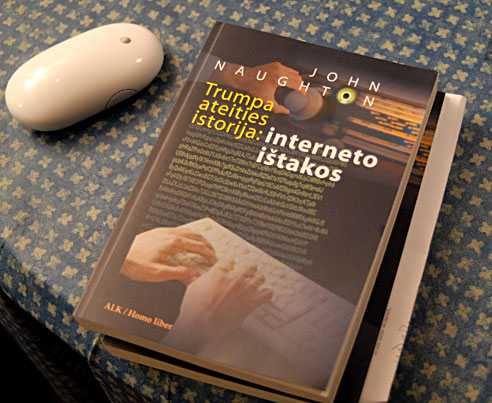
Following the runaway success of A short history of tractors in Ukranian, here is my own modest contribution to the genre: A Brief History of the Future — in Lithuanian. The first copies arrived from my agent this morning.

Wonder how you say “Hooray!” in Lithuanian?

Update: Kevin Cryan tells me it’s “Valio!”

Overheard

Cycling through town this afternoon, I passed a mother and her 8/9-year-old daughter on their way home from the daughter’s prissy, expensive private school. As I came level with them the girl said,

“Well, if you can’t be bothered to cook, I shan’t eat anything”.

Google Ink

Scott Grieder, Ask.com Group Product Manager, was taking notes on an important conference call when his (free) Google Pen ran out of ink without warning. The lapse in this fundamental Google product/service forced him to switch pens at a critical moment, resulting in considerable inconvenience and loss of data.

“I should have known better than to use a free Google product for business purposes.” Scott told us in a recent interview. “Google Pen is fine for home use, but not when my company’s productivity is on the line. I had to switch pens in the middle of taking notes. There’s no telling how much data I lost.”

But then he received a nice handwritten letter from a Google person. “We note your suboptimal experience with our Google pens”, it said, “and are pleased to send you — at no charge — a replacement set. Fortunately our pen architecture is based on Redundant Arrays of Inexpensive Drafting Stuff [warning: embedded geek joke] . If any component fails, a quick recovery is ensured”.

Thanks to James Cridland for spotting it.