Shareholder democracy

Well, well. What a surprise. Yahoo! shareholders reject call for greater internet freedom

Yahoo! shareholders have rejected a plan that called for greater freedom of access on the internet in countries such as China.

At the search engine’s annual general meeting in California, just 15.2pc of shareholders supported the motion to oppose restrictions on access to websites. A second resolution to create a corporate board committee on human rights was also rebuffed, winning just 4pc of the vote.

Public companies don’t do ethics for the same reason that my cats pay no attention to exhortations to be nice to mice and fledglings. At best, companies obey the (local) law. Everything else is posturing for PR purposes. That’s why it was naive to expect Google to do the right thing in China.

The fatwa of the land

From today’s International Herald Tribune

CAIRO: First came the breast-feeding fatwa: It declared that the Islamic restriction on unmarried men and women being together could be lifted at work if the woman breast-fed her male colleagues five times. Then came the urine fatwa: It said that drinking the urine of the Prophet Muhammad was deemed a blessing.

At first, I thought this must be another one of those tasteless Western jokes. But no.

For the past few weeks, the breast-feeding and urine fatwas have proved a source of national embarrassment in Egypt, not least because they were issued by representatives of the highest religious authorities in the land.

“We were very angered when we heard about the Danish cartoons concerning our Prophet,” wrote Galal Amin in the newspaper Al Masry Al Yom, referring to the 2005 publication of cartoons of the Prophet Muhammad that caused an international uproar. “However, these two fatwas are harming our Islamic religion and our Prophet more than the cartoons.”

For many Muslims, fatwas, or religious edicts, are the bridge between the principles of their faith and modern life. They are supposed to be issued by religious scholars who look to the Koran and teachings of the Prophet Muhammad for guidance.

While the more sensational pronouncements grab attention, the bulk of the fatwas involve the routine of daily life. In Egypt alone, thousands are issued every month…

Strange things, religions.

Gordo in Oxford

From TimesOnline

I can report that he has developed a new “hugging” gesture, which he undoubtedly thinks shows inclusivity. Indeed, Gordo signalled how cool and modern he was when he announced: “MySpace is the biggest youth club in the country.” He looked thrilled as he said the words “My Space” and did the hugging gesture. Go for it, daddy-o.

Gordon is 56. This makes him closer to the My Pace-maker generation than anything else, but he simply ignored this fact. Usually his speeches are “me, me, me” affairs. Yesterday, he dusted off the “we”. He simply lopped 30 years off his age. Who needs a facelift when you can do that? “We’re part of a generation,” he said repeatedly for, like Botox, it’s addictive.

The speech was all about, well, Africa. Yes, I know we were in Oxford, but it’s a “My Generation” kind of thing. Why talk about boring old Britain when you can talk about Mozambique, Tanzania or Nigeria. There was a wonderful moment where he noted: “I was in Nigeria and I was at this school and Bono turned up as well, quite by chance!” (Does that happen to you too? Amazing, isn’t it?) Gordon and his generation are going to be very busy though not, that I can figure out, here.

He was asked, briefly, about the War on Terror and extending the 28 days’ detention without charge. He let rip with a passionate defence of our civil liberties. He did allow that 28 days might have to be extended but the only figure he mentioned was 35 days. Even this terrible seven-day increase would, of course, require rigid safeguards…

Nice piece by Ann Treneman. Thanks to Rex for finding it.

Corporate psychoses

From Stowe Boyd’s Work blog

Working with a client recently, an executive said something along these lines:

We don’t need to do the right thing, because we can do the wrong thing really well.

This has got to be one of the most dangerous sorts of thinking in start-ups, which I believe are all psychological reactions to stress, leading to ‘entrepreneurialitis’. Here’s others that I worry about whenever I hear them:

1. We don’t need to do the right thing, because we can do the wrong thing really well. [means: we don’t have to adapt to the world, the world will have to adapt to us.]

2. Yes, that feature is important, but we’ll put it into a later release. [means: I don’t want to decide what’s important, so we will defer.]

3. We don’t need to test the business model: it’s obvious! [means: I don’t know how to test the business model.]

4. We don’t need to bring in outside experts, and we don’t have time to assimilate that many viewpoints, anyway. [We know everything, and who the hell are you, wise guy?]

5. People believe that building successful applications is hard, but it’s easy if you just [fill in pet obsession here]. [means: it better be simple, because that’s all I am prepared for.]

6. I know what to do: God told me. [This actually happened to me, I am not kidding.]

These range from the mildly out of touch to the paranoid and delusional, but they all are dangerous. Anything short of painful openness to the complexities and subtleties of building successful apps, any retreat from trying to learn from others successes and failures, can lead to complacency, insider thinking, convergent mindsets, and eventually doom for the company…


Ancient relics

Came on this — the first ‘integrated’ package for the Macintosh — when sorting stuff in my office. I couldn’t bear to throw it out. And although none of my current Macs has a drive that could read the disk, I still have my Mac Plus, which can.

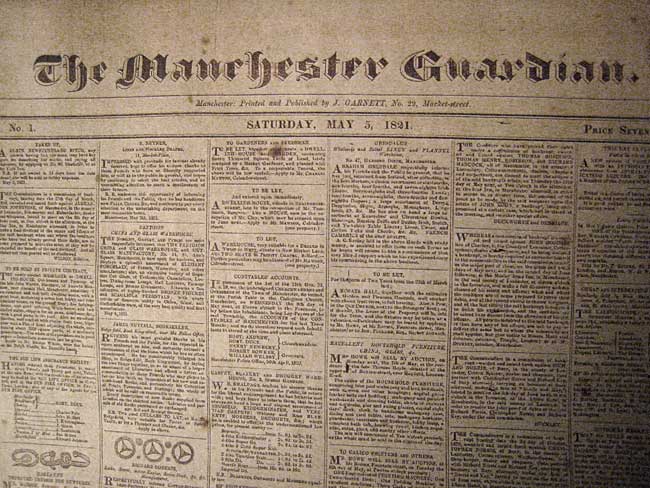
Guardian reaches issue no. 50,000

Yep. Today’s edition is the 50,000th. Quite an achievement and one marked by publishing a facsimile of the very first edition. “It is unlikely”, said the blurb, “we would [today] lead the paper with an ad for a lost dog”. The ad reads:

TAKEN UP

A BLACK NEWFOUNDLAND BITCH, and person having lost the same may have her again on describing her marks, and paying all expences, by applying at No. 80 Shudehall or at the York Inn.

NB If now owned in 14 days from the date below, she will be sold to defray expences.

May 5, 1821

The price of the first edition was seven pence, which I imagine was a substantial sum in those days — equivalent perhaps to the £3.95 that I pay for the New Yorker in a newsagent.

Wonder if there will be a 100,000 paper edition of the Guardian ? I wouldn’t bet on it. (Just as well, really — I won’t be around to collect or pay up.)