Shakespearean coinage

From Shakespeare’s Word & Phrases

In all of his work – the plays, the sonnets and the narrative poems – Shakespeare uses 17,677 words. Of those 1,700 were first used by Shakespeare. Writers often invent words, either by creating new forms of existing words or coining new words outright, because they are unable to find the exact word they require in the existing language. Shakespeare is the foremost of those. He was by far the most important individual influence on the development of the modern English that we speak today.

Look at this short list of words that we use in our daily speech and ask yourself if you could pass through a day without needing to use at least ten of them. There are many more and you use them without knowing that they were given to you by England’s national writer…

The list includes accommodation, aerial, amazement, apostrophe, castigate, dislocate, dwindle, frugal, generous and inauspicious…

Imagine being Shakespeare’s English teacher…

Later… Quentin asks: “So did Will S actually invent those words, I wonder, or were they in fairly common usage and his is simply the first written record we have?”

Don’t know. But I know a man who does… Stay tuned.

Climbing walls about to become easier

Phew! As someone who often feels like climbing walls (e.g. when listening to Tony Blair or George Bush), I am relieved to learn of this new development

Researchers have developed a carbon-nanotube-based tape that could prove useful for creating robots that climb walls and special adhesive gloves for astronauts. Unlike ordinary tape, which eventually loses its stickiness, this new material sticks like a permanent glue, but it can be removed and reused. It can also stick to a wider variety of materials, including glass and Teflon.

Dubbed “gecko tape” by researchers, the material works by imitating the nano- and microscale structures on geckos’ feet that allow them to quickly scale walls and run across ceilings. The tape is reusable and will not dry up or slide off the wall because, unlike ordinary tape, it does not use viscoelastic glues. Instead, it employs carbon nanotubes to make use of microscale van der Waals forces that occur at very short ranges between surfaces. Bundles of nanotubes conform to the slightest microscopic variations on a surface, the same way that the bundles of nanoscopic keratin fibers that make up the hairs on gecko feet allow them to conform to walls.

Like ordinary tape, gecko tape clings strongly when pulled parallel to a surface; it can support just under 10 pounds per square centimeter. But the tape can be peeled off relatively easily when pulled perpendicular to a surface.

Elliott Erwitt’s portfolio

This is just lovely — a Flash portfolio from Magnum of Elliott Erwitt’s personal best. Make some coffee, draw up a chair and marvel at his wonderful photographic instinct.

There’s a nice profile of him by Rose George here.

Erwitt has a reputation for quietness. A journalist once wanted to write 12,000 words on the man, and a fellow photographer said, “In all the years I’ve spoken to him, Elliott hasn’t spoken 12,000 words.” Actually, he speaks easily. He smiles and twinkles. He is one of the few people who can treat an interview as a conversation. […] “Photography is very simple,” he says. “People make it so technical, so complicated, to disguise the fact. They overcompensate.”

The Magnum show contains a few really memorable quotes. For example:

You don’t study photography — you just do it.

And,

Dogs are people with more hair.

(Erwitt is the greatest living photographer of dogs — and their owners — IMHO. His technique: “I bark; they jump”.)

Rose George’s profile has some nice stories. Sample:

Not that he won’t supply the funny anecdotes of a 50-year veteran: The Shah of Iran wore platform heels (“You could tell from the pant creases”). Che Guevara was good-looking but not charming, Marilyn Monroe the opposite. One notorious image – the “kitchen debate” of Richard Nixon and Nikita Kruschev arguing at a Westinghouse exhibit – almost didn’t happen because he was laughing too hard: Kruschev told Nixon to “Go screw my grandmother” in Russian, which the child of Boris and Evgenia understood perfectly.
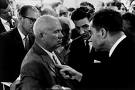
I’ve always wondered what Kruschev was saying in that exchange. Nixon was presumably lecturing the Soviet boss on the superiority of American refrigeration technology. Elliott’s anecdote confirms that the truth is usually more amusing than the official version. For example, as a kid I was addicted to the Lone Ranger who — older readers will remember — had a faithful Indian companion called Tonto. Whenever the (White Anglo-Saxon) Ranger spoke to Tonto, he replied “Kemo Sabay” which — in my innocence — I assumed to be the Native American equivalent of “Yes, Boss”. But one day I ran into a guy who claimed to be an expert on native American languages and swore that “Kemo Sabay” actually meant “Horseshit”.

Many thanks to Brian for the link.

Later… Harry Metcalfe writes:

“Khrushchev certainly wouldn’t have involved himself in the insult to “MY” grandmother, it must have been “YOUR” grandmother: as the French have it on record ” …et ta soeur”.

I bow to his superior expertise.
OS X statistics

Steve Jobs let slip some interesting data in his Keynote to the WWDC 07 conference. It is that 90 per cent of the 20 million Mac users in the world are on the current (Tiger) or last-but-one (Panther) version of OS X. He claimed that this was unique in the history of the PC industry. Wonder what the corresponding breakdown for Windows is…

A new approach to email overload

From one of Jon Crowcroft’s blogs

I’m trying an experiment just now – all my e-mail is deleted – if you want to send me a message you need to put it on a web log (sorry, blog) or wikipedia, and I will get a google alert on a (private, whilelist only) mail address and will get back to you. This both rate limits how often new people can send to me, and scales my mail to google’s search/alert system, which is probably better than the university’s – of course, if everyone did it it might be very interesting!

three things one hopes to learn
a. how fast google scan/alert stuff runs
(it hasn’t found michael dales blog of my email autoanswer yet, but its early days
b. how many people care
c. if anyone thinks of an attack…

HowToMakeMoney.com

Nice story in WSJ.com…

Entrepreneurs Jake Winebaum and Sky Dayton were widely mocked for lavishing $7.5 million on a single Internet domain name — business.com — back in 1999. It was the single highest price paid for a domain name at the time.

Now look who is having the last laugh.

The company that grew out of business.com — a search engine used by businesses to find products and services — is now on the auction block, and could fetch anywhere between $300 million and $400 million, according to people familiar with the matter.

Sigh. I should have bought those Google shares when they were $85. Or Apple shares when Steve Jobs came back as ‘Interim CEO’. Hindsight is the only exact science.

From the Grauniad

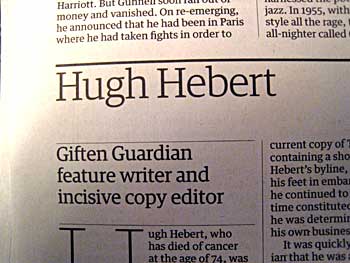
This has to be a clever in-joke, doesn’t it? I mean, to put such a typo in the heading of the obit of the paper’s most fastidious copy editor, ever.

Rocket science

The phrase “it isn’t rocket science” has become such a cliche that I eventually began to wonder what it meant. What is rocket science? And is it really so difficult?

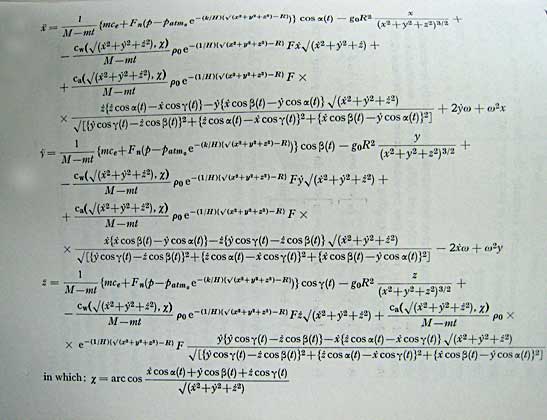
The answer to the first question was provided by my esteemed colleague Tony Nixon, who is a physicist and knows about these things. “Wait here”, he said, and reappeared a few minutes later brandishing his copy of Space Dynamics, Volume 1 by Prof. Ir. Dr. J.M.J. Kooy, opened at the page which gives the equations for “powered flight of rocket through terrestrial atmosphere with prescribed thrust direction as a function of time, considered as a system of reference rotating with the earth”. So here, in summary form, is the central piece of knowledge of ‘rocket science’.

Nothing to it, eh? Wouldn’t it be nice if everything could be summarised so succinctly.