Google: Knol thyself

Google is taking aim at Wikipedia…

Google Knol is designed to allow anyone to create a page on any topic, which others can comment on, rate, and contribute to if the primary author allows. The service is in a private test beta. You can’t apply to be part of it, nor can the pubic [sic] see the pages that have been made. Google also stressed to me that what’s shown in the screenshots it provided might change and that the service might not launch at all…

If they do launch it, then the emerging comparisons with Wikipedia will be intriguing. GMSV has a thoughtful take on it.

Now you may be thinking, “Don’t we already have a collaborative, grass-roots, online encyclopedia … Wiki-something?” Indeed we do, as the Google guys are well aware, since Wikipedia entries tend to show up in that coveted area near the top of many, many pages of Google search results. But Google’s plan is based on a model that highlights individual expertise rather than collective knowledge. Unlike Wikipedia, where the contributors and editors remain in the background, each knol represents the view of a single author, who is featured prominently on the page. Readers can add comments, reviews, rankings, and alternative knols on the subject, but cannot directly edit the work of others, as in Wikipedia. And Google is offering another incentive — knol authors can choose to include ads with their offering and collect a cut of the revenue.

Some see this as a dagger in Wikipedia’s heart, but from a user perspective, I think they look more complementary than competitive, both with their weak and strong points. Search a topic on Wikipedia and you’ll get a single page of information, the contents of which could be the result of a lot of backroom back-and-forth, but which, when approached with a reasonable degree of skepticism, offers some quick answers and a good jumping off point to additional research. Search a topic in Google’s book of knowledge and it sounds like you’ll get your choice of competing knols all annotated with the comments of other users, and if there are disagreements or differing interpretations, they’ll be argued out in the open. So it’s the wisdom of crowds as created by readers vs. the wisdom of experts (or whoever is interested enough in glory and revenue to stake that claim) as ranked by readers. I can see the usefulness and drawbacks of both.

Where this does represent a threat to Wikipedia is in traffic, if Google knols start rising to the top of the search results and Wikipedia’s are pushed down. Google says it won’t be giving the knols any special rankings juice to make that happen, but the more Google puts its own hosted content in competition with what it indexes, the more people are going to be suspicious.

All kinds of interesting scenarios present themselves. It’s not just the wisdom of crowds vs. the wisdom of ‘experts’. It’s also the Jerffersonian ‘marketplace in ideas’ on steroids. Just imagine, for example, competing Knols on the Holocaust written by David Irving (and I’m sure he will submit one) vs. one written by Richard Evans or Deborah Lipstadt.
Editorial dependence

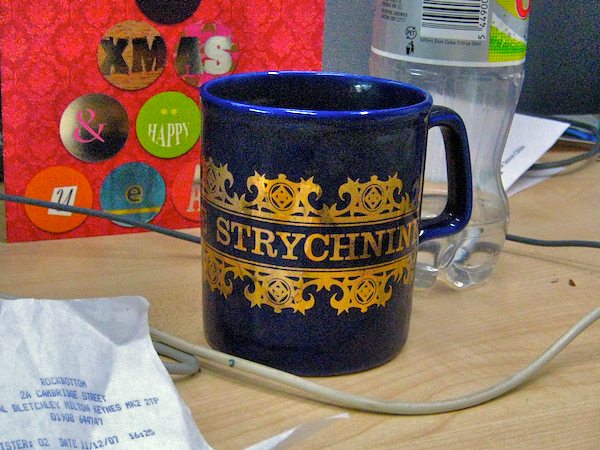
Spotted on the desk of the colleague who is currently editing my stuff. Surely it can’t be that bad? According to Wikipedia, strychnine is a very toxic, colorless crystalline alkaloid used as a pesticide, particularly for killing small vertebrates such as rodents.

Eriksson Mk 2

Richard Williams is not impressed by the decision to appoint a new England manager with such indecent haste.

Capello is one of the great club coaches and his brusque intelligence may just be what this generation of England players need. If England are going to employ another foreigner, he is as good as they come. But did the FA really need to seize the time quite so urgently?

Here was the opportunity to recognise the failure to reach next summer’s Euro 2008 finals as a real blessing, albeit in very heavy disguise. A period without competitive fixtures could have been used for rigorous consideration of the factors that have led the England team to such a pass, in particular the terrible paucity of plausible English candidates for McClaren’s job. This is the major fault-line running through the foundations of the English game, and the FA would have done well to acknowledge it by avoiding the temptation to make an instant high-profile appointment, announcing instead its intention to search for a radical solution…

I am chronically uninterested in sport, but I love intelligent writing. Which is why I read Richard Williams.

The holiday from hell

Vivid account by Bridget O’Donnell, a mother who happened to be on holiday in Portugal in the same group as the McCann family when their daughter was abducted.

We lay by the members-only pool staring at the sky. Round and round, the helicopters clacked and roared. Their cameras pointed down at us, mocking the walled and gated enclave. Circles rippled out across the pool. It was the morning after Madeleine went.

Six days earlier we had landed at Faro airport. The coach was full of people like us, parents lugging multiple toddler/baby combinations. All of us had risen at dawn, rushed along motorways and hurtled across the sky in search of the modern solution to our exhaustion – the Mark Warner kiddie club. I travelled with my partner Jes, our three-year-old daughter, and our nine-month-old baby son. Praia da Luz was the nearest Mark Warner beach resort and this was the cheapest week of the year – a bargain bucket trip, for a brief lie-down…

It’s a very good piece, which makes no attempt to exploit the experience. And she donated her fee to the Find Madeleine fund.

High Def panic

O dear. It seems that HDTV has been causing alarm on planet Celeb.

Given that the nation is still struggling to get used to the idea of digital TV, it’s easy to get talk of “high definition” confused with all the other jargon that no one understands. In theory, high definition is what happens after digital. High-definition screens have more pixels making up the television picture, and said picture is created faster and in sharper definition. Every shot in high-definition is effectively a microscopic examination of skin complexion and condition, with even the tiniest imperfections becoming unbearably visible.

It’s tough out there, apparently. Here’s a review of Hilary Clinton and John McCain’s appearances on HD.

In high-def, Hillary looked remarkably masculine with thick eyebrows, David Spade-like haircut and a tan pants suit that could have gotten her into a Gertrude Stein poetry reading night without having to pay a cover. The overall look wasn’t helped by the fact that her neck was redder than the state of Alabama in the 2004 presidential election. She really needs to think about covering that thing up in future appearances. It looks raw and unhealthy in high-def.

Now, let’s get to McCain, who was on Tuesday night (August 28) on the Tonight Show With Jay Leno. McCain is now 71 years old and there’s no hiding it in high-def. He looks so feeble and doddering despite his best efforts to appear energetic. To make matters worse, he repeated an old joke that Sen. Bob Dole used to tell about having trouble sleeping at night: “I slept like a baby. I woke up every two hours crying.” When you’re trying to look fresh and young, you don’t quote someone even older than you. McCain likes to say he’s a maverick, but at this point, he looks older than the original maverick, James Garner.

Where did 35mm film come from?

Interesting aside to a discussion about the Leica M8:

As an aside on the whole sensor size issue—I guess there is some practical or economic limitation that keeps most sensors at 75% of the standard 135 film size, thus forcing all of the rethinking of lenses and such, but it’s interesting to note where the 35mm standard came from. Apparently, in 1889, Thomas Edison was developing the Kinetoscope and a worker asked him how wide to cut the film. He held up his thumb and forefinger and said “About this wide…” and the 35 millimeter standard was born…

In praise of hats

Geoffrey Wheatcroft, in splendid form on a subject dear to my own, er, head.

Whatever the socio-economic explanation, men did once wear hats, and now they don’t. As it happens, I am one of the exceptions. I always wear a hat of one sort or another. Men who wear hats (I’m not sure about women) are widely supposed to be making a statement, as it’s called, perhaps of a politically reactionary kind. My late friend Richard Cobb, the great Oxford historian of France, pointed out that there, before the war, the choice of headgear was full of political significance, but that was when everyone still wore a hat, and your statement was left or right, whether proletarian casquette (cloth cap), or Basque beret. Since I know unimpeachable men of the left who still wear hats, this may, like many things, be a matter of temperament rather than ideology.

In any case, there’s something much stranger about this terror of titfers, in utilitarian rather than symbolic terms. Hats aren’t there merely for show, they serve a vital purpose, which one might think too obvious to point out: to keep the head warm and dry. Wearing a silk hat to Royal Ascot is probably affectation, and wearing a panama with a club ribbon is childish, but not wearing a hat at all in the British winter is insane. I’ve tried at length to explain to my son that four-fifths of body heat escapes through the head but, like anyone of his age, he thinks hats – apart maybe from hoodies’ hoods and back-to-front baseball caps – are terminally uncool.

Er, quite.