

Well, it is November 1st, after all.
Category Archives: Asides
I would like to retain ‘fart in your general direction’
Ahem. This is a transcript of a letter I discovered on a lovely site called Letters of Note. It concerns the exchanges between the team that made Monty Python and the Holy Grail and the British Board of Film Censorship.
PYTHON (MONTY) PICTURES LTD
Registered Address: 20 Fitzroy Square, London W1P6BB
Registered Number 1138069 England
August 5th, 1974.
Dear Mike,
The Censor’s representative, Tony Kerpel, came along to Friday’s screening at Twickenham and he gave us his opinion of the film’s probable certificate.
He thinks the film will be AA, but it would be possible, given some dialogue cuts, to make the film an A rating, which would increase the audience. (AA is 14 and over, and A is 5 – 14).
For an ‘A’ we would have to:
Lose as many shits as possible
Take Jesus Christ out, if possible
Lose “I fart in your general direction”
Lose “the oral sex”
Lose “oh, fuck off”
Lose “We make castanets out of your testicles”
I would like to get back to the Censor and agree to lose the shits, take the odd Jesus Christ out and lose Oh fuck off, but to retain “fart in your general direction”, “castanets of your testicles” and “oral sex” and ask him for an ‘A’ rating on that basis.
Please let me know as soon as possible your attitude to this.
Yours sincerely,
(Signed)
Mark Forstater
A photograph of the original can be found here.
I’m reminded of that other great letter — from Groucho Marx to the Legal Department of Warner Brothers.
Focus!

Verboten

On a promenade near Hoylake.
The iPhone that went to space (and fell to earth — still working)
Homemade Spacecraft from Luke Geissbuhler on Vimeo.
Amazing.
The last Crocuses

When I went back two days later, they were finished. Winter’s on its way.
The iChair

A new use for old technology.
Eh?
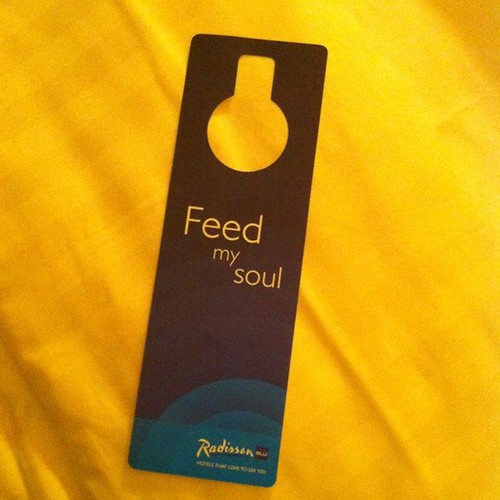

I’m staying in a Radisson hotel for an OU event and came back from the conference dinner to find this on the bed. Wonder what it means? Maybe it’s an alternative to the Gideon bible. I don’t think I’ll hang it on the door, though. One can’t be too careful. These Christians will stop at nothing. I am reminded of the old joke about Belfast being the only city in the world when, if there’s a knock on the door at midnight, you’re relieved that it’s the Jehovah’s Witnesses.
Green credentials
This blog is constructed using 100% recycled electrons.
Just thought you’d like to know.
The public sector and the thin pipe problem
My mate Dave Briggs has an interesting blog post about the reasons why public-sector organisations refuse to allow their staffs to access the ‘normal’ Internet. Dave spends a lot of time in these organisations and knows them well. He has identified three different types of explanation.
1. Staff will waste time
“This” says Dave, “is a management issue and not a technology one. If people want to waste time, they’ll find a way; and every organisation already has policy and process to manage this and stop it happening”.
2. Information security and risk of virus infection etc
Dave sees two parts to this.
Firstly that using social web sites, whether for communication or collaboration, increases the likelihood of losing sensitive information. I’ve heard of people in councils being blocked from Slideshare for this very reason. Imagine that! Someone accidentally creating a powerpoint deck full of confidential data, and then deciding that they should publish it publicly on Slideshare!
This is unfathomably moronic, not least because of course there have been far more instances of people losing or leaking paper files, and nobody as far as I am aware has banned the use of those. It’s an education thing, innit?
Likewise the virus issue. People clicking dodgy links is the main problem here, and that’s as likely to happen via email as anything else. Nobody blocks email (shame). Instead, educate people not to click dodgy links. Easy.
Finally, he comes to what he thinks is the real reason:
3. The pipe isn’t big enough
“I have had lots of conversations with IT folk in public sector organisations”, he writes, “who simply state that if someone in the organisation watches a video on YouTube, then that’s the network down for pretty much everyone else”.
I can’t help but think that this is one of the main reasons behind organisations blocking access to interesting websites. Perhaps the other two reasons are just covering up the fact that many government organisations have infrastructure that really isn’t fit for purpose?
Yep.