
Category Archives: Asides

FIFA, corruption and the Olympic five-ring circus
It’s not often that I agree with Simon Jenkins, but the news that Dave Cameron is going to FIFA to plead Britain’s case to host the 2018 World Cup has annoyed him almost as much as it annoys me.
Britain should have no truck with a body like Fifa, any more than it should with the International Olympic Committee or those who run much of international sport. Five minutes spent with the cuttings, or trawling such websites as playthegame and transparencyinsport, should have stopped Cameron being photographed shaking hands with Blatter at Downing Street. His staff should have read Andrew Jennings’ Foul! on Blatter, and thrown in Christopher Shaw’s Five Ring Circus, about the IOC, for good measure.
Incident after incident, case after case, has shown these self-governing supranational apparatus riddled with accusations of backhanders, bribes and fixed votes – often quite legal in the countries where they carefully base themselves, such as Switzerland and Liechtenstein. Their officials jet the world, pushing the one narcotic to which all modern governments are addicted – sporting glory.
For decades the IOC turned a blind eye to the communist bloc’s use of drugs to boost performance, or China’s (and Tony Blair’s) exploitation of the Olympics for political ends. It now demands inexcusable outlays of taxpayers’ money to stage its two-week festival of minority sports. When the IOC demands an exclusive “Zil lane” for its official cars up London’s Mile End Road, the British government meekly obeys. It would not offer this to a head of state.
Likewise Fifa turns a blind eye to longstanding charges of vote rigging. Its laughable ethics committee deplored last month’s revelations as “unethical” and “rumours”, though it was forced to suspend six of the alleged “vote fixers” named in the paper. Fifa’s Blatter has contrived to keep his job for 36 years, by means that would do credit to a Muammar Gaddafi. He professes “surprise” at talk of bribes while banning journalists like Jennings who ask questions about them from his press conferences…
Right on. If you want a sense of how transparency is supposed to work, you needn’t look far: the local turf accountant has to chalk up his odds on the wall, Canadian online casinos have to display their licences on every page, and even the FTSE notice boards post their figures by law. None of these are saintly institutions. They are simply ones that have to answer to a regulator someone can actually locate on a map.
Meanwhile I’m looking forward to a delightful three weeks in Provence while the London Olympics are on.
The amateur dictator
For years, I have wanted to use speech recognition software, but have always held back because the best product – Dragon Dictate – ran only under Windows, and I am a Mac user. But the company has released a version of the program for OS X, and I’ve just installed it. And this blog post is the first I’ve ever done simply by talking to the machine.
The accuracy of Dragon Dictate is scary. The strange thing is that we used to think that successful speech recognition was a problem for Artificial Intelligence. What none of us suspected was that it was a problem that could be solved using statistics and brute-force calculation. In fact, many years ago I knew someone in Cambridge – Frank Fallside – who was one of the pioneers of this approach to speech recognition. He died tragically young, so it’s nice to see how his work eventually came to fruition.
Why I’m not a sailor
Something missing?
Raymond Williams once quoted an observation that his father had made about someone in their village. “He’s the kind of man”, said Williams Snr, “who turns on a switch and isn’t surprised when the light comes on”.
Apologies for the absence of apostrophes in the captioning, but it came with the embed.
Thanks to Hap for the link.
The night gondola

Outside my hotel this evening.
Alumni magazines: bah!
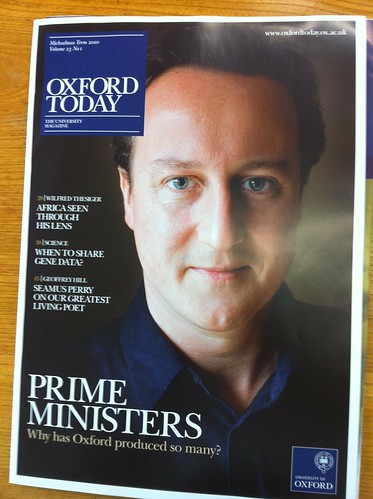
There’s something nauseatingly smug about almost all university alumni magazines, but this one takes the biscuit.
Don’t try this at home if you’re aged 6 or over
Thanks to John Hagel for the link.
Towards the intelligent use of human beings
Last week, Richard Susskind gave a very interesting talk in the Arcadia Seminar series. He’s the only lawyer I know who has a D.Phil in Artificial Intelligence and he has become very well known for his analysis of the impact that IT is having — and will continue to have — on the practice of law. In a way, his seminar title –“The End of Lawyers?” — sums it up. It sounds like a crude version of technological determinism, but it isn’t. The core of Susskind’s argument is the insight that while some of the things that lawyers — and legal firms — do requires great expertise, experience, creativity and judgement, much of what’s involved in the practice of law involves very routine processes which can be radically improved by the intelligent use of computing.
His approach involves analyzing legal work along a spectrum from “bespoke” (the crafting of unique legal solutions to new situations) to “commoditized” legal products and services (for example, conveyances in house sales). Everything to the right of ‘bespoke’ on his spectrum can be significantly assisted by the intelligent use of IT.
Susskind is a compelling and very polished speaker who kept his large audience enthralled. As Nancy Banks-Smith (the Guardian’s wonderful TV critic) might have put it, nobody slept at the back. He believes that legal practice can and must change for one simple reason: its intrinsic inefficiency makes it unsustainably expensive, which means that citizens cannot afford to access legal services even when they badly need them (which imposes losses on society: think of all the disputes that go unresolved, or the number of petty injustices that go unremedied every year), and because the cost of lawyering imposes ridiculous costs on business. The idea that legal firms can go on charging £600 an hour for routine stuff that is actually done by junior lawyers, or by computer-assisted paralegal staff, should be exposed for what it is: a professional racket.
One test of a good seminar paper is that it reverberates in ones mind long after the event has ended, and so it was with Richard Susskind’s talk. Although he was focussing only on legal firms, it seemed to me that the general thrust of his analysis applies to every organisation. Yesterday, I had a long conversation with my OU colleague, Tony Hirst, about the way our organisation goes about its business. As in any large institution, we spend a lot of time circulating drafts and commenting on them. But we do this by circulating the documents as email attachments. So our network and our email inboxes are clogged by thousands of identical documents whizzing around. This is daft because there is an obviously superior way of doing it — namely to have a single shared copy held in something like Google Docs where everyone involved can edit and comment.
Why don’t we do this? Mainly because we’re still operating with a hard-copy, print mindset. Once upon a time we sent one another typed drafts, so the university’s internal mail system resembled a freight-transportation network designed for shipping atoms (as Nicholas Negroponte would put it). The fact that we are now shipping bits ought to have caused us to rethink what we were doing, but it hasn’t. Instead we are just repeating in electronic form what we did with physical typescripts. And it’s daft.
Another process that happens in any large outfits (and especially in universities) is the organisation of meetings. Getting busy people together can be nightmarishly difficult. Or, rather, it is if you do it the way many organisations do it — by email. I’ve lost count of the number of interminable email exchanges I’ve been involved in where ten people try and agree on a date and time for a meeting, when the obvious way to do it is via an online polling system like that provided by Doodle.
But — as Tony pointed out yesterday — fixing meeting dates and times is only the tip of the iceberg. Committee meetings often involve the production and distribution of numerous documents — agendas, minutes, reports, discussion papers. There’s absolutely no reason why an organisation that operates with shared documents can’t use software to assemble the documentation needed for a meeting without putting the burden on an already-overloaded secretary who should really be doing only those things for which human judgement, tact and resourcefulness are required.
All of which suggests that legal firms are not the only ones that can use IT more intelligently.
Chatbot wears down proponents of anti-Science nonsense
Now here is an excellent use of technology.
Nigel Leck, a software developer by day, was tired of arguing with anti-science crackpots on Twitter. So, like any good programmer, he wrote a script to do it for him.
The result is the Twitter chatbot @AI_AGW. Its operation is fairly simple: Every five minutes, it searches twitter for several hundred set phrases that tend to correspond to any of the usual tired arguments about how global warming isn’t happening or humans aren’t responsible for it.
It then spits back at the twitterer who made that argument a canned response culled from a database of hundreds. The responses are matched to the argument in question — tweets about how Neptune is warming just like the earth, for example, are met with the appropriate links to scientific sources explaining why that hardly constitutes evidence that the source of global warming on earth is a warming sun.
I like this approach. It’s got lots of other applications. Now, let me see: where shall we start? There’s all that gibbering about how the bond markets will come for us if Osborne doesn’t slash public spending. And then there’s the bleating of the Irish government about how the country’s situation is “manageable”. And there’s the fantastical vapourings of the Intellectual Property lobbies…