Harry Potter and the Half-Crazed Bureaucracy

A learned article by Benjamin Barton in the Michigan Law Journal. Who says lawyers have no sense of humour? (One of my favourite legal scholars hails from Michigan btw; but that’s probably a coincidence.) Anyway, here’s the Abstract:

This Essay examines what the Harry Potter series (and particularly the most recent book, The Half-Blood Prince) tells us about government and bureaucracy. There are two short answers. The first is that Rowling presents a government (The Ministry of Magic) that is 100% bureaucracy. There is no discernable executive or legislative branch, and no elections. There is a modified judicial function, but it appears to be completely dominated by the bureaucracy, and certainly does not serve as an independent check on governmental excess.

Second, government is controlled by and for the benefit of the self-interested bureaucrat. The most cold-blooded public choice theorist could not present a bleaker portrait of a government captured by special interests and motivated solely by a desire to increase bureaucratic power and influence.

Consider this partial list of government activities: a) torturing children for lying; b) utilizing a prison designed and staffed specifically to suck all life and hope out of the inmates; c) placing citizens in that prison without a hearing; d) allows the death penalty without a trial; e) allowing the powerful, rich or famous to control policy and practice; f) selective prosecution (the powerful go unpunished and the unpopular face trumped-up charges); g) conducting criminal trials without independent defense counsel; h) using truth serum to force confessions; i) maintaining constant surveillance over all citizens; j) allowing no elections whatsoever and no democratic lawmaking process; k) controlling the press.

Peter Drucker…

… has died, at a great age. Somewhat anodyne obit in the Guardian. I expect the WSJ did him proud.

Later… They did. My friend Andrew, who subscribes to the WSJ, sent me links to four pieces — all about to disappear behind the Paywall, alas. But this one (from Fortune.com) is public.

The real significance of the DVD

Normal Lebrecht ponders what happens when you can have everything on your bookshelf (or on your hard drive):

The complete works of Ingmar Bergman and Francois Truffaut are about to go on sale and no self-respecting cineaste will walk by without feeling a tug at the purse strings. To have and to hold every film that guided your artistic and emotional maturation, through adolescence and beyond, is something many will find irresistible. Kurosawa, Hitchcock, Tarkovsky and the Ealing comedies are equally on offer. What was formerly part of a romanticised past, glimpsed infrequently on late-night TV, has become urgently present (perhaps the perfect present). The eternally elusive turns up in plastic boxes.

What this means, in cultural terms, is that film now takes its place beside literature, music and visual imagery as an art that can be owned and bookmarked. Where once you had to visit a cinema or spool through half a mile of clunky videotape in order to access a seminal scene in an essential movie, you now zone into it on DVD as quickly as finding a name in the index of an artist biography.

And another thing…

… about the vote on the Terror Bill. I’m tired of all the media hyperbole about ‘defeat’. The scandal is not that Blair lost the vote, but that this is the first one he’s lost since he became Prime Minister in 1997. A sure sign that a deliberative democracy is working is occasional — or even regular — defeats of governments in Commons debates. It means that issues are being decided on the basis of MPs making up their own minds, rather than voting to the Whips’ instructions. But Blair’s first two (huge) parliamentary majorities meant that Britain was governed for nearly a decade by an elected dictatorship. Now at last we have something a little more representative — and possibly also a bit more reflective. Hooray!

The madness of King Tony

All political careers end in failure, as the old adage goes. What is less often remarked is that most Prime Ministers go mad eventually. And the longer they are in power, the madder they get. By the time she was finally ejected, Margaret Thatcher was barmy. Watching the crazed run-up to yesterday’s government defeat in the House of Commons over the length of detention without charge to be allowed under the new Terror Bill, the thing that struck me most was how Blair steadily escalated the issue to the point where it was all about his ‘authority’. And that, of course is a dead giveaway. That, and his increasingly pop-eyed appearance in TV interview after TV interview in which he argues that He Knows Best. In that, he greatly resembles Thatcher — but with one important difference: whereas she always believed that she was Right, Blair believes that he is not only Right but Good.

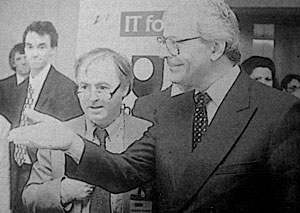
The reason Prime Ministers go mad is simple. They live inside a bubble which comprehensively insulates them from the real world. I first discovered this when I met John Major, the last Tory Prime Minister, towards the end of his premiership (see fuzzy newspaper picture). At that time he was, to all intents and purposes, a busted flush — head of a sleazy, incompetent, incoherent, tired administration which was falling apart. Yet when I met him he was surrounded by four Cabinet ministers, and a phalanx of security people, flunkeys, secretaries and runners. I noticed that everyone, but everyone, around him was smiling, agreeing with him and generally being eager to please. It was “Prime Minister this” and “Prime Minister that”. If you didn’t know any better, you’d have assumed he was Caesar at the height of his powers. Yet, as I say, it was patently obvious that, electorally speaking, the man was dead meat.

That’s how British Prime Ministers live — with a coterie of lackeys who treat them like Gods and insulate them from the real world. It’s basically a reality-distortion field. Tony Blair’s been inside such a field since 1997, and boy is it beginning to show.

Saeva Indignatio

Fine example of savage indignation in the current issue of The Economist. Excerpt from a rant, er, Leader on the importance of free trade:

In Washington, DC, home of a fabled “consensus” about poor countries’ economic policies, a bill before Congress devised by one of New York’s senators, Charles Schumer, threatens a 27.5% tariff on imports from China if that country does not revalue its currency by an equivalent amount. In Mr Schumer’s view, presumably, far too many Chinese peasants are escaping poverty. On November 4th George Bush will escape the febrile atmosphere along Pennsylvania Avenue by visiting Argentina to attend the 34-country Summit of the Americas. There he will be greeted by a rally against “imperialism”, by which is meant him personally, the Iraq war and the Free Trade Area of the Americas which he espouses. Among the hoped-for 50,000 demonstrators will be Diego Maradona, who as a footballer became rich through the game’s global market and as a cocaine-addict was dependent on barrier-busting international trade; and naturally his fellow-summiteer, Hugo Chávez, who is using trade in high-priced oil to finance his “21st-century socialism” in Venezuela.

I like that, er, crack about Maradona.