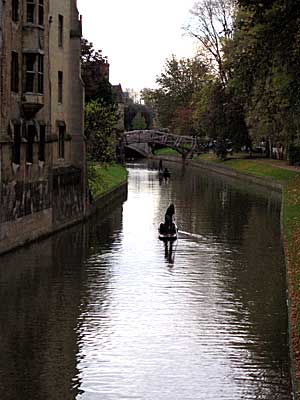
People were punting on the Cam today. And not getting frostbite, either. Where’s this cold weather we’ve been promised?
People were punting on the Cam today. And not getting frostbite, either. Where’s this cold weather we’ve been promised?
Fine example of savage indignation in the current issue of The Economist. Excerpt from a rant, er, Leader on the importance of free trade:
In Washington, DC, home of a fabled “consensus” about poor countries’ economic policies, a bill before Congress devised by one of New York’s senators, Charles Schumer, threatens a 27.5% tariff on imports from China if that country does not revalue its currency by an equivalent amount. In Mr Schumer’s view, presumably, far too many Chinese peasants are escaping poverty. On November 4th George Bush will escape the febrile atmosphere along Pennsylvania Avenue by visiting Argentina to attend the 34-country Summit of the Americas. There he will be greeted by a rally against “imperialism”, by which is meant him personally, the Iraq war and the Free Trade Area of the Americas which he espouses. Among the hoped-for 50,000 demonstrators will be Diego Maradona, who as a footballer became rich through the game’s global market and as a cocaine-addict was dependent on barrier-busting international trade; and naturally his fellow-summiteer, Hugo Chávez, who is using trade in high-priced oil to finance his “21st-century socialism” in Venezuela.
I like that, er, crack about Maradona.
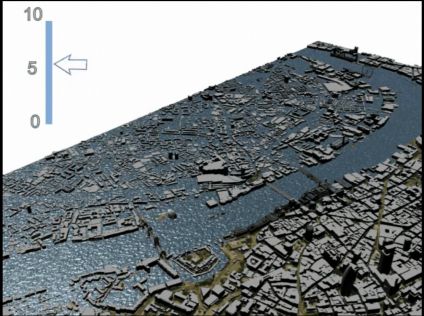
This image, from Andrew Hudson-Smith’s fascinating Blog, shows the output of a 3D simulation of what would happen to London in the event of a rise in sea-level. The commentary says:
South London is built on marsh land and is thus more prone to flooding. We have produced a movie that illustrates sea level rise in metres. It clearly picks up the moat around the Tower of London within a metre increase and then follows on to flood most of the Waterloo/South Bank area of London. The movie does not take into account flood defences, merely a direct sea level rise.
Fascinating meditation by Matt Webb on the dilemma that faces all freelancers — how much to charge:
There’s a civil engineering company I’ve been told about, which internally audits all its projects for profitability, interestingness, and how easy the client is to deal with. If it’s not marked well on two of those, future projects are turned down.
It’s this second one that interests me. Not using money as a way of explaining how much a project costs, but using money as a way of influencing what kind of work you get, and as fair compensation.
Work must be fun. If I didn’t believe that, I’d have a highly lucrative job in the City. And work must be fair. I don’t want to charge people too much for what I do for them, or too little. There must be a lot of different work, because our expertise comes from using a large variety of ideas and skills. Also, work creates more work: You get what you do. I’m on a trajectory away from programming, for example. I still do it, but I don’t discount my day rate for programming work. The last thing: Money buys freedom. It’s good to take well paid jobs, because that gives you the time to pursue the less obvious ideas, and room to develop your own products.
This means that my freelancing banding system still works: Charge more if there’s a lot of value being extracted, if the work is dull, and if there’s risk involved; charge less if the work takes the company in good directions, if it’s really interesting, and if it’s for people we like.
… in 1976, Jimmy Carter, a Peanut farmer from Georgia, defeated Gerald Ford in the US Presidential election.
Extraordinary essay by a serving CIA officer about the importance of publicly-available information relative to the stuff obtained by the cloak-and-dagger crowd. Abstract:
We need to rethink the distinction between open sources and secrets. Too many policymakers and intelligence officers mistake secrecy for intelligence and assume that information covertly acquired is superior to that obtained openly. Yet, the distinction between overt and covert sources is less clear than such thinking suggests. Open sources often equal or surpass classified information in monitoring and analyzing such pressing problems as terrorism, proliferation, and counterintelligence. Slighting open source intelligence (OSINT) for secrets, obtained at far greater expense when available at all, is no way to run an intelligence community. Also, we must put to rest the notion that the private sector is the preferred OSINT agent. In the end, I would contend, the Intelligence Community (IC) needs to assign greater resources to open sources.
Link via Arts and Letters Daily

Here’s a neat idea — the text of the Bill of Rights gradually disappears as the mug is filled with hot liquid! Simulates the effect of a Bush presidency. Thanks to Boing Boing for the link.
Freeman Dyson, writing about Richard Feynman in the current issue of the New York Review of Books opens with this paragraph:
Great scientists come in two varieties, which Isiah Berlin, quoting the seventh-century-BC poet Archilochus, called hedgehogs and foxes. Foxes know many tricks, hedgehogs only one. Hedgehogs are interested only in a few problems which they consider fundamental, and stick with the same problems for years or decades. Most of the great discoveries are made by hedgehogs, most of the little discoveries by foxes. Science needs both hedgehogs and foxes for its healthy growth, hedgehogs to dig deep into the nature of things, foxes to explore the complicated details of our marvelous universe. Albert Einstein was a hedgehog; Richard Feynman was a fox.
Well, I’m not a scientist, but I’m definitely a fox.
Email from Pete…
Just typed in ‘to be or not to be’ in the Google search box, looking for the Hamlet speech – and guess what the first entry to appear is? Hot or Not?. Imagining some poor sod, on the verge of suicide, deciding to take counsel from the great Bard, and instead confronted with one of the outposts of 21st century voyeurism and vanity…Ye gods.