Travelling light

We came home yesterday evening, courtesy of RyanAir. The flight was bang on time. RyanAir’s bedside manner may leave something to be desired, but they’re terrific at turning round aircraft.

The biggest hassle was finding a way of safely packing delicate gear (MacBook and cameras) in check-in baggage. If the new security regime remains in place (and I suspect it will), then cabin baggage will become a thing of the past. The big irritations of this are (a) having to put mobile phones in the hold — which means that one becomes incommunicado from the moment of check-in; (b) not being able to take a book, a notebook, a camera or even a pen through security.

Daft side-effects of (b) include the fact that passengers departing from small airports like City of Derry are stuck with no means of entertainment while those flying from a big airport like Stansted can buy newspapers, books, pens — not to mention laptops and cameras — to their hearts’ content in the departure area.

Once you get over the anxiety of entrusting a laptop etc. to baggage handling, there are some upsides. Getting people on and off the aircraft is much easier — for both crew and passengers. (It’s actually quite pleasant not having to lug a laptop, cables, etc. around.) Secondly, there will be a new commercial opportunities in (i) ‘disposable’ laptops — ones that you could afford to lose or have smashed; (ii) really robust laptop cases; and (iii) book sales in departure lounges and on board planes.

The kids were really pissed off to be deprived of their iPods during the long wait between check-in and departure. But there was a story somewhere today claiming that the supposed terrorist plot involved using iPods to detonate the explosives. After iTunes comes iBlast?
The limits of military power

The big lesson of this decade is that military power, no matter how great, has acute limitations. The US overwhelmed Afghanistan, only to discover how difficult it is to build a viable state from a failed one. Then it overwhelmed Iraq, only to find that it couldn’t stop the country from disintegrating. Now Israel, with all its military might, finds that it can’t defeat Hizbollah using military means. Eventually the penny will drop. But when?

The funny thing is that the people who understand the limitations of military power most acutely are the military. But gung-ho politicians rarely listen to them.

Well, is it a game or not?

As someone hoping to fly home tomorrow, I am mightily pissed off by the ‘security alert’ currently paralysing UK airports, which obliges me to entrust my laptop to the tender mercies (not to mention the pilfering habits) of airport baggage handlers. I might be tempted to view it more benevolently if the Home Secretary, ‘Dr’ John Reid, would stop saying that “the main players” in the alleged conspiracy have been arrested. If this is serious, then these guys aren’t ‘playing’. They’re suspects in a deadly serious conspiracy to kill people, not players. And this isn’t a game.

Bah!

The Digger: pure genius

Last year, Rupert Murdoch paid $649 million to acquire MySpace.com. Many observers (me included) thought he was nuts to pay so much for such a wacky property. Yesterday, Google announced that it would pay $900 million over three years for the privilege of providing search services on MySpace. However much one loathes and detests the Digger, you have to admit that, as a businessman, the man’s a genius.

Sad, but true. Sigh.

Happy Birthday, WWW

The Web is fifteen today. August 6 1991 was the day that Tim Berners-Lee posted the code to the alt-hypertext news group. It was an event as momentous as the appearance of Gutenberg’s bible in 1455, which changed the world. But unlike the inventor of printing by moveable type, Tim has lived to see the effects — or at least the first tremors — of the revolution he triggered.

A death at sea

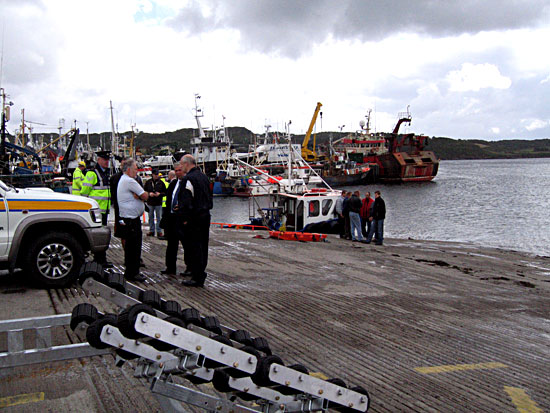
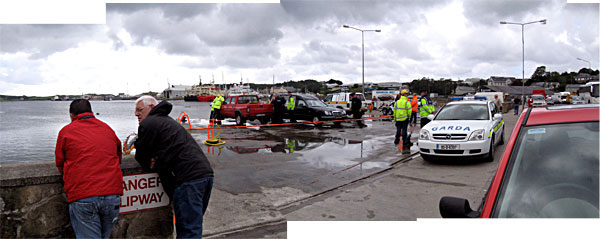
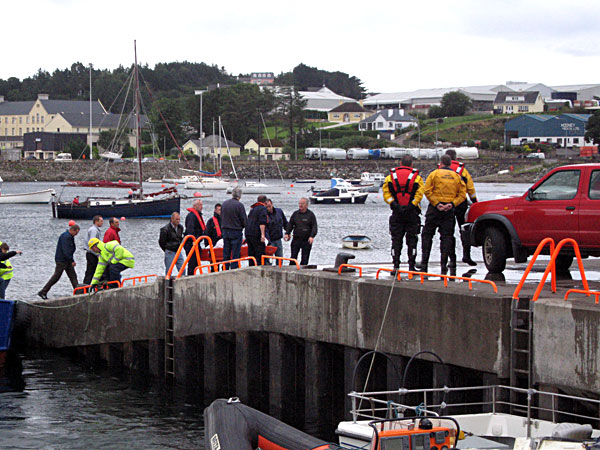
I went into Killybegs this morning to buy the papers and parked by the quay. Just after I arrived, two police cars and a coastguard jeep arrived. The cops sealed off the slipway. Shortly after that a hearse arrived, followed by a priest. It was clear that there had been a death at sea and they were waiting for the body to be brought ashore.

After about 20 minutes, a coastguard launch appeared, and a body was carefully lifted ashore. There was a pause while the priest said some prayers over the body, which was then placed in a plastic coffin and loaded into the hearse, which departed quietly. Only then did I notice a small group of men, standing smoking and talking quietly at the end of the slipway.

As I left, they were led off by the cops to the local police station. My guess is that they were the dead man’s shipmates. The consensus on the quay was that they were from a Russian ship which was anchored round the coast near St John’s Point. It was all very quiet and dignified and efficient. An everyday tale of life and death at sea.

Amazon blues

From Good Morning Silicon Valley

In Amazon territory, the natives are getting restless. Investors who had stuck it out through quarter after quarter despite were already worried about margins and spending. When CEO Jeff Bezos reported Wednesday second-quarter earnings were down nearly 58 percent and lowered the 2006 outlook, then announced more spending and deeper price cuts, shareholders did a double-take and said, “Not with our money, you don’t.” The stock price plummeted more than 20 percent and is now bouncing around its three-year low. The backlash chopped more than $3 billion off Amazon’s market capitalization. “I think a lot of the frustration today is because this company perpetually seems to be in a heavy investment mode,” said Philip Remek, an analyst with Guzman & Co. Analyst Dan Geiman with McAdams Wright Ragen added, “It’s gotten to the point where you just don’t know what those returns are going to be. It’s just hard to measure.” Analysts also worried that the company was spreading itself too thin and adding low-margin businesses like groceries. “What’s the competitive advantage that Amazon brings to delivering all the types of Jell-O that you could possibly want?” asked David Garrity, an analyst with Dinosaur Research.

Bezos and team defended the spending, especially on services that encourage customer loyalty like the annual flat-rate deal offered on two-day shipping, as necessary to Amazon’s longterm health. With instant price comparisons available, loyalty to an online retailer is tenuous, he said, unless the company can use service and technology to build a compelling relationship with the customer. And some analysts are still willing to give him the benefit of the doubt. Bob Toomey with E.K. Riley Advisors said, “People who follow the stock closely know or should know that Amazon’s strategy is and has been to be investing in the business for the long term.” The question is how many shareholders it will lose along the way.

Remember what Keynes said? “In the long run we are all dead”.

Holiday reading

Hmmm… I hate taking heavy books on holiday, but might have to make an exception for Fiasco!, Thomas Ricks’s detailed analysis of the quagmire in Iraq. Here’s an excerpt from the New York Times review…

The title of this devastating new book about the American war in Iraq says it all: “Fiasco.” That is the judgment that Thomas E. Ricks, senior Pentagon correspondent for The Washington Post, passes on the Bush administration’s decision to invade Iraq and its management of the war and the occupation. And he serves up his portrait of that war as a misguided exercise in hubris, incompetence and folly with a wealth of detail and evidence that is both staggeringly vivid and persuasive.

By virtue of the author’s wealth of sources within the American military and the book’s comprehensive timeline (beginning with the administration’s inflammatory statements about Saddam Hussein in the wake of 9/11, through the invasion and occupation, to the escalating religious and ethnic strife that afflicts the country today), “Fiasco” is absolutely essential reading for anyone interested in understanding how the United States came to go to war in Iraq, how a bungled occupation fed a ballooning insurgency and how these events will affect the future of the American military. Though other books have depicted aspects of the Iraq war in more intimate and harrowing detail, though other books have broken more news about aspects of the war, this volume gives the reader a lucid, tough-minded overview of this tragic enterprise that stands apart from earlier assessments in terms of simple coherence and scope…