
The Rooney problem

Harry Pearson has a wonderfully surreal column about Wayne Rooney. Sample:

These days the top players do not even do their own Little Britain impressions, and they leave the cutting off of the centre-back’s flashy ties to one of their people. This is not because they are lazy. It is because they are focused. The modern player is a specialist. He has little time for anything other than honing the key skills of his profession: shooting, shouting and looking sultry in styling mousse. Nothing distracts him from his job. He has a ghostwriter to write his autobiography and a ghostreader to tell him what is in it.

Some of the biggest names are now so totally devoted to themselves that they even employ a staff of experts to sleep with women for them. “Clearly the players are red-blooded young men who would like nothing better than to chase skirt,” reveals one insider close to the source of a friend, “but as professional athletes they are worried that a night of vigorous heterosexual activity might mess up their aggression, their stamina, or even their hair.”

Some have gone one-step further. A lot of fans and media people have expressed the view that Rooney is experiencing a lack of form. They are quite wrong. Wayne is in the form of his life. Unfortunately his body double is going through a sticky patch, though admittedly not as sticky as the one Frank Lampard’s body double has been experiencing for the past five months.

Some will find the news that Rooney and Lampard actually have body doubles out on the field something of a surprise. It is hard to see why. It has been common practice in Hollywood for years. You wouldn’t expect Angelina Jolie to do her own stunts, or Mel Gibson to show you his own bottom, now would you? Like any movie star Wayne is an incredibly valuable asset. Neither Manchester United nor England can afford to put what we must learn to call “the core of the Rooney brand” at risk by actually allowing him to run around on a slippery surface with a lot of rough blokes. The insurance premiums if they did would be crippling. His beard alone had to be underwritten for £77m…
What the American far right is thinking

A segment about escalating sectarian violence in Iraq on the February 23 edition of Fox News’ Your World with Neil Cavuto featured onscreen captions that read: ” ‘Upside’ To Civil War?” and “All-Out Civil War in Iraq: Could It Be a Good Thing?”

The segment, guest-hosted by Fox News Live (noon-1:30 pm hour ET) anchor David Asman, featured commentary by Fox News military analyst Lt. Col. Bill Cowan and Center for American Progress senior fellow Col. P.J. Crowley.

I particularly like the idea that an all-out civil war could have an “upside”. For whom, exactly?

[Source]

Telly Eagleton, the Wanderer

Interesting essay on Terry Eagleton in The Chronicle of Higher Education

Literary theorists, and probably other scholars, might be divided into two types: settlers and wanderers. The settlers stay put, “hovering one inch” over a set of issues or topics, as Paul de Man, the most influential theorist of the 1970s, remarked in an interview. Their work, through the course of their careers, claims ownership of a specific intellectual turf. The wanderers are more restless, starting with one approach or field but leaving it behind for the next foray. Their work takes the shape of serial engagements, more oriented toward climatic currents. The distinction is not between expert and generalist, or, in Isaiah Berlin’s distinction, between knowing one thing like a hedgehog and knowing many things like a fox; it is a different application of expertise.

[…]

Terry Eagleton has been a quintessential wanderer. Eagleton is probably the most well-known literary critic in Britain and the most frequently read expositor of literary theory in the world. His greatest influence in the United States has been through his deft surveys, variously on poststructural theory, Marxist criticism, the history of the public sphere, aesthetics, ideology, and postmodernism. His 1983 book, Literary Theory: An Introduction, which made readable and even entertaining the new currents in theory and which has been reprinted nearly 20 times, was a text that almost every literature student thumbed through during the 80s and 90s, and it still holds a spot in the otherwise sparse criticism sections of the local Barnes and Noble. His public position in Britain is such that Prince Charles once deemed him “that dreadful Terry Eagleton.” Not every literary theorist has received such public notice.

Frank Kermode once told me about a lecture tour he did in China at the behest of the British Council. In every university, he was listened to by rapt, serried ranks of Chinese students. In vain did the translator try to elicit questions from these awestruck audiences. Finally, after the final lecture, the head of the host institution begged students to ask at least one question of their very distinguished visitor.

Eventually, a shy student stood up and said to Frank: “Do you know Telly Eagleton?”

Unfinished business

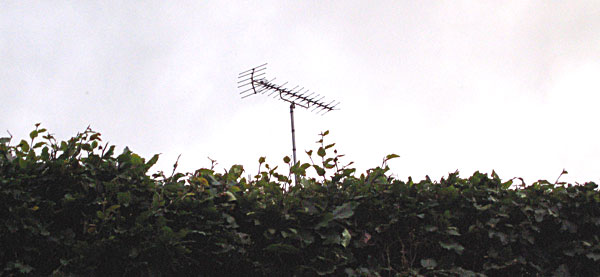
I spent most of last Sunday afternoon laboriously trimming the big beech hedge that is one of the glories of our garden. Then I made some coffee and lit a cigar and sat down to admire my handiwork — and immediately noticed that I had missed not just those straggly bits on the top edge, but also the TV aerial that appears to have grown out of the hedge when I wasn’t looking.

Which just goes to show that it all depends on your point of view.

Laffer effect? What Laffer effect?

Well, well! The Observer reports that

Flat taxes fail to boost revenues, as their advocates claim, and are likely to be abandoned by the countries that have introduced them, according to research published by the International Monetary Fund.

‘The question is not so much whether more countries will adopt a flat tax, as whether those that have will move away from it,’ the study says, after examining the experience of eight economies that have introduced the policy since the mid-Nineties.

Sweeping away variable tax bands and replacing them with a single rate has long been a dream of right-wing economists. Since a number of Eastern European governments introduced flat taxes, support for them has grown in the UK, and shadow Chancellor George Osborne has flirted with the idea.

But the IMF analysts who carried out the research cast doubt on the main advantage claimed for flat taxes: that they increase revenues by allowing people to pocket more of their hard-earned cash, and thus persuade them to work harder.This is the so-called ‘Laffer effect’ named after US economist Arthur Laffer. But the authors say: ‘In no case does there appear to have been a Laffer effect: these reforms have not set off effects strong enough for them to pay for themselves.’

St Moritz

Nice profile of Micheal Moritz…

Michael Moritz has a few simple rules for investing in internet start-ups: look for people who are pursuing their own ideas for doing something better; prefer youth to maturity; ignore business plans looking a few years ahead; and avoid anyone wearing Armani T-shirts, loafers with no socks or who uses words like ‘synergy’, ‘no-brainer’ or ‘slam-dunk’.

Moritz is worth listening to. The 51-year-old Welshman is one of the duo running Sequoia Capital, the Silicon Valley venture capital firm that has just made an estimated $480m profit in less than a year by backing YouTube, the video-sharing business this week acquired by Google. And it is not the firm’s only success: it was one of the only two venture capital firms to back Google itself, investing $12.5m in the start-up business; its 10 per cent stake is now worth more than $12bn. Its other investments read like a who’s who of the technology business: PayPal, Yahoo, eBay, Apple, Cisco.Small wonder that Moritz tops the list of technology deal-makers produced by Forbes, the US business magazine – or that his own wealth, estimated at £518m in the Sunday Times Rich List, makes him the sixth richest internet millionaire….

Sucking down

This morning’s Observer column

Before he hit the jackpot with YouTube, Jawed (like Hurley and Chen) had made a pile from his earlier involvement in PayPal, the online payment system bought by eBay in 2002 for $1.5bn. His share of the $1.65bn paid by Google for YouTube will reportedly be less than theirs, but it should still be sufficient to fund a private squadron of F-16s. And yet the lad chooses to bank the cash and return to considering ‘algorithms for edit distance on permutations’ and other arcane matters engaging students on the Stanford CS300 course. His one concession to the events of the last week was to cancel the seminar he had been scheduled to give on Thursday on ‘YouTube: from concept to hyper-growth’.

If Jawed has started a trend, who knows where it will end? Traditionally, university professors in elite US institutions find students a tiresome distraction from important work like private consulting, appearing on television and testifying before Congressional committees. For these superprofs, the really important people – the folks they have to suck up to – are rich alumni who have made good in the corporate world. But now a terrible prospect looms – US academics may in future have to pander to their students. Perhaps it will eventually become known as sucking down?

Speed-reading

Sebastian Faulk’s technique:

Place a sharp knife pointing out at right angles to the kitchen counter, then stand with your back to it and don’t move until you’ve finished a whole book.

Quoted by Anthony Quinn in today’s Daily Telegraph.