Handwriting and subjectivity

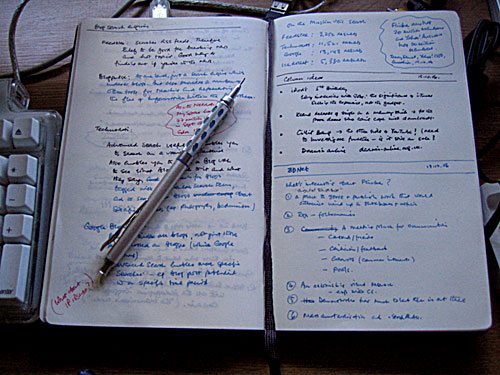
I’ve had some interesting conversations recently with friends and colleagues about handwriting. I’m perpetually annoyed and puzzled by my own. Some days it seems legible and orderly, but usually I find it intensely irritating. And I wonder why it varies so much from day to day. Is it to do with mood, or hassle or tiredness? Or something else? In many cases (e.g. the pages of my notebook shown in the photograph) my scribbling seems — to me — to be illegible and hopelessly untidy. Other people’s handwriting, in contrast, always seems to me to be orderly and consistent — even when it’s illegible. But then I discover — from talking to them — that they think my handwriting is neat, orderly, legible and consistent, which it manifestly is not! So is it the case that other people’s handwriting always seems better than one’s own?

Another interesting observation. I spend a lot of my working day with techies. Yet — with only two exceptions — they all carry and use paper notebooks. (The two exceptions carry and make notes on tablet PCs.) It’s clear that the paper notebook has a lot of life left in it yet.

And while I’m on the subject, I’ve been to the terrific exhibition of David Hockney’s portraits at the National Portrait Gallery. The pictures are wonderful, but in a way the most fascinating exhibit is the glass case containing three of his notebooks. I was reminded of the story (no doubt apochryphal) about Picasso instructing a builder on changes he wanted to make to one of his studios. As he talked, he made some sketches of what he had in mind. Then he handed them to the builder and said “How much will this cost?” “Nothing”, replied the builder. “Just sign it”.

Dont think — just report

I followed a link from Jeff Jarvis’s Blog to Armando Ianucci’s Tate Britain lecture, and was very glad I did. He was talking about why British comedy now has so much political content. One passage stopped me in my tracks:

Comedy is so prevalent now, it’s cool by association. So politicians speak and act according to the rhythms of comedy. Labour trying to portray Cameron as a chameleon – it’s an attempted sketch.

This has come about for three reasons: politicians have stopped speaking to us properly, the media has stopped examining their actions in anything like a forensic way, and broadcast culture has become so watered down, so scared of fact, that people are less inclined to turn to anything other than entertainment for information.

Broadcast journalism today promotes itself not so much on what it talks about but on the method it uses: “Broadcasting 24 hours a day, correspondents in over 50 capital cities, giving you all the headlines every 15 minutes, up to six generations of journalists gathered in one newsroom, making you feel all the news you want to feel, even on Christmas Day.” Hi-tech software and speedy transmission makes everything instant news, but we lose sight of the skilled individuals who can process this random unstoppable flow of information and somehow construct a meaningful examination of it. We need narrative.

I found myself hungry for narrative in the build-up to the war in Iraq. Here, surely, were facts – or, indeed, a glaring absence of facts – that required piecing together. Here, surely, it was clear that political debate was operating on a curiously surreal level. We were being asked to attack a country on the basis that the weapons we knew (but couldn’t prove) it had would definitely be used against us, especially if we attacked it. This Alice Through the Looking Glass logic has continued after the invasion. Now, it seems, it was necessary to have invaded Iraq to rid the world of the terrorist cells who have flooded into the country since it was invaded. The terrorist attacks in London and mainland Europe since are, officially, unconnected with the invasion of a country that was invaded because it had links with terrorist attacks in mainland Europe.

My favourite quotation from the eminently quotable George Bush is a remark he made last year about the constant attacks on US troops in Iraq: “The insurgents are being defeated; that’s why they’re continuing to fight.” It’s a stunning reversal of all logic. Measuring success in terms of how far you are from success. An even stranger utterance came from Tony Blair at Labour’s 2004 Conference when he defended his actions by saying: “Judgments aren’t the same as facts. Instinct is not science. I only know what I believe.

“I only know what I believe.” I find that one of the most chilling statements uttered by a seemingly rational politician. Apart from the fact that it overturns about 16 centuries of western philosophy and questions the entire principle of scientific inquiry, it’s also, surely, how the Taliban get through their day…

Afterwards… I found it hard to believe that Blair had said that, so I checked with the text. He did say it.

I’m also reminded of the “balance as bias” phenomenon which came up in a something I posted in 2003 about Paul Krugman’s Harvard lecture.

The Gulf Stream (contd.)

My post about the possibility of the Gulf Stream switching off elicited two interesting emails.

Quentin pointed me to a letter in the Economist from Professor Carl Wunsch, an MIT oceanographer, which said, in part:

The Gulf Stream is a wind-driven phenomenon (as explained in a famous 1948 paper by Henry Stommel). It is part of a current system forced by the torque exerted on the ocean by the wind field. Heating and cooling affect its temperature and other properties, but not its basic existence or structure. As long as the sun heats the Earth and the Earth spins, so that we have winds, there will be a Gulf Stream (and a Kuroshio in the Pacific, an Agulhas in the Indian Ocean, etc).

Shut-off would imply repeal of the law of conservation of angular momentum. The primary mechanism of heat transport in the ocean is the wind-forcing of currents that tend to push warm water toward the poles, cold water toward the equator. Widely disseminated and grossly oversimplified pictures showing the ocean as a “conveyor belt” have misled people into thinking ocean circulation is driven by a sinking motion at high latitudes. A comprehensive literature shows that with no wind, heating and cooling could produce a weak flow, but one not at all resembling the observed circulation.

If the sinking motion at high latitudes were completely stopped, by covering that part of the ocean by sea ice for instance, there would still be a Gulf Stream to the south, and maybe an even more powerful one as the wind field would probably then become stronger. If the sinking were stopped by adding fresh water (a deus ex machina often invoked to change the climate), the Gulf Stream would hardly care except in so far as the wind system changed too. The amount of heat transported by the system would shift, but could not become zero.

Many writers, including scientists, toss around the words “Thermohaline Circulation” as though they constituted an explanation. In the ocean, most of the movement of heat and salt, the real Thermohaline Circulation, is driven directly and indirectly by the wind field. Thus the Gulf Stream, and hence the wind, rather than being minor features of oceanic climate are best regarded as the primary elements. Many real climate change effects exist and require urgent attention; focusing on near-impossible Gulf Stream failure is an unproductive distraction.

My son Brian wrote to point out the irony that GulfStream is the brand name of a very successful executive jet aircraft!

The Gulf Stream

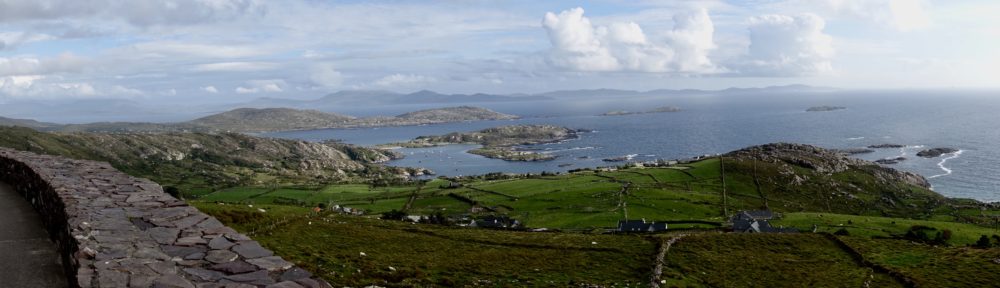
Global warming poses awful threats to many poor parts of the world (for example, Bangladesh). For Britain and Ireland, however, a more direct threat is the possibility that the Gulf Stream might switch off or reverse — something that could happen relatively quickly (and has happened before). In which case my beloved Kerry would start to resemble Sweden. So this report is scary.

Scientists have uncovered more evidence for a dramatic weakening in the vast ocean current that gives Britain its relatively balmy climate by dragging warm water northwards from the tropics. The slowdown, which climate modellers have predicted will follow global warming, has been confirmed by the most detailed study yet of ocean flow in the Atlantic.

Most alarmingly, the data reveal that a part of the current, which is usually 60 times more powerful than the Amazon river, came to a temporary halt during November 2004…

Don’t ever start at the beginning

Horse-sense on Creating a compelling presentation, book, article…

You are in a dimly lit room. You are alone on a stage before an audience of 1,000. 10 minutes into your presentation, your hands no longer shake or sweat. This is going well, you think. But just then you notice a vaguely familiar sound–tap, tap, clickety-clack–which in one horrifying moment you recognize–it’s your audience. IMing, checking email, live blogging (“wifi sucks at this hotel and OMFG this is the most boring speaker ever”)

What went wrong? How did you lose them in the first 10 minutes? How can you get their attention?

Follow the link for some useful ideas on how to do better.

Thank God for The Google

From Jon Henley’s diary

Overheard, in a CNBC interview the other day, the Leader of the Free World. Host: “I’m curious … Do you use Google?” George Bush: “Occasionally. One of the things I’ve used on the Google is to pull up maps. It’s very interesting to see – I’ve forgot the name of the program – but you get the satellite, and you can, like, I kinda like to look at the ranch. It reminds me of where I wanna be sometimes.”

Out of the mouths of babes and sucklings…

I went to the Tanner dinner in Clare Hall this evening. The German Ambassador to Britain gave a nice little speech, in one part of which (about tolerance needing to start early in life) he told a story about a recent visit to Kosovo where, on entering a school, he heard a group of children singing a sweet little song in Albanian. He asked his translator what they were singing. The translator looked embarrassed, but the ambassador pressed him. “Well”, he said, “they’re singing about how when they’re older they are going to cut the heads off Serbs”.

On this day…

… in 2001, the iPod was launched.

… in 1993 a suicide truck-bombing at Beirut International Airport in Lebanon killed 241 U.S. Marines and sailors; a near-simultaneous attack on French forces killed 58 paratroopers. The attack led Ronald ‘Hopalong’ Reagan to withdraw US troops from Lebanon.

… in 1956, the Hungarians revolted against Soviet rule, with predictable results. The USSR, taking advantage of the West’s distraction in Suez, crushed the uprising without much trouble. I was ten at the time, and I remember standing in our kitchen in Donegal listening to the news with my mother. “What will happen, Ma?” I asked. “Oh”, she replied calmly, “the Americans will help them”.

Spoonerism

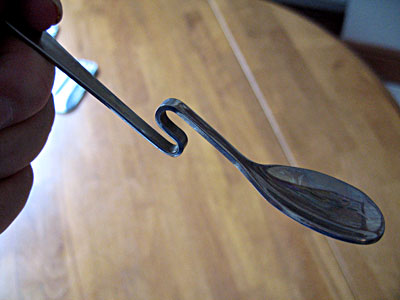
Now here’s a really useful gadget — a marmalade spoon. And no, it’s not something left behind by Uri Geller. Quentin produced it the other day when I arrived seeking breakfast (and a sneak preview of his Nokia E61).