The Googlebrain

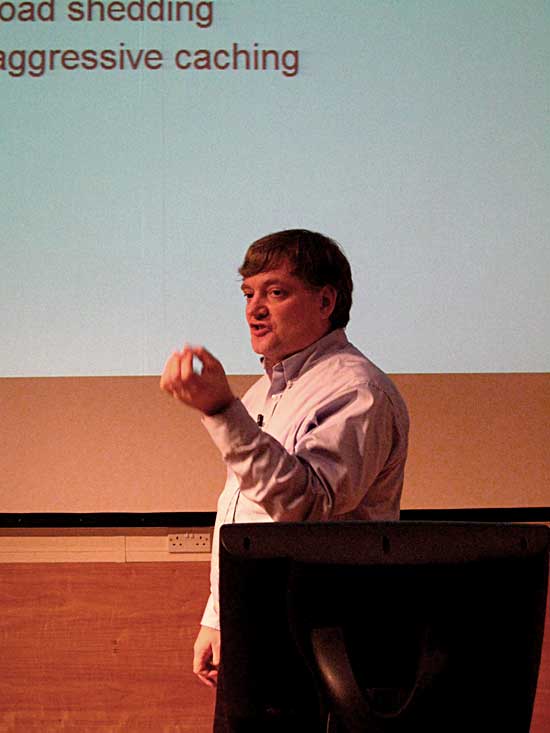
Mike Burrows, Google’s Principal Engineer, came to the Cambridge Computer Lab on Wednesday to give a talk on “The Chubby Lock Service for Loosely-Coupled Distributed Systems”, a large-scale distributed lock service used in several Google products. This is a gig he’s done before, but it was interesting to see him in action. As he was talking, the thought that came to mind was that Google has two main advantages over the competition: one is the PageRank algorithm; the other is its ability to manage the Googleplex — the enormous, distributed computing resource that the company owns and operates. Mike’s work is a key element in the latter.

The future of computing (contd.)

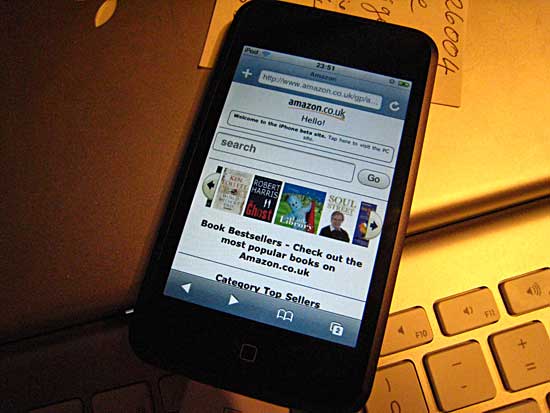
As Quentin says, who would have thought ten years ago that Unix machines would look like this? The most interesting thing about the iPod Touch is not that it’s a music player, but that it’s the best portable browsing machine we have yet seen. Its capacity to render web pages and make them readable is simply astounding. The touch interface plus the software’s rendering ability also suggests that the newspaper industry has been looking in the wrong place all the time. It always supposed that its electronic salvation lay in display hardware — in the form of ‘e-paper’, i.e. lightweight foldable, flexible, high-resolution displays. The effectiveness of the iPod Touch suggests that the combination of clever software and even a small high-res display can do the trick.

Social graph-iti

The Economist isn’t impressed by the huge valuations currently being placed on Facebook. Neither am I.

Update: In the end, Microsoft valued Facebook at $15 billion.

Microsoft has paid $240m for a 1.6% stake in Facebook that values the hugely popular social networking site at $15bn.

Facebook spurned an offer from Microsoft’s rival Google, which was also keen to invest the site.

Microsoft will also sell internet ads for Facebook outside the United States as part of the deal that took several weeks of negotiating.

What’s surprising is how small the Microsoft stake is. This has to be about advertising rather than investment.

Warning to abusive bloggers

Some interesting cases were decided last week.

Disgruntled fans of Sheffield Wednesday who vented their dissatisfaction with the football club’s bigwigs in anonymous internet postings may face expensive libel claims after the chairman, chief executive and five directors won a high-court ruling last week forcing the owner of a website to reveal their identity.

The case, featuring the website owlstalk.co.uk, is the second within days to highlight the danger of assuming that the apparent cloak of anonymity gives users of internet forums and chatrooms carte blanche to say whatever they like.

In another high court case last week, John Finn, owner of the Sunderland property firm Pallion Housing, admitted just before he was due to be cross-examined that he was responsible for a website hosting a scurrilous internet campaign about a rival housing organisation, Gentoo Group, its employees and owner, Peter Walls.

Exposing the identity of those who post damaging lies in cyberspace is a growth area for libel lawyers.

Dan Tench, of Olswang, the law firm representing Gentoo, said: “This case illustrates an increasingly important legal issue: proving who is responsible for the publication of anonymous material on the internet. This is likely to be a significant issue in defamation cases in the future.”

The website Dadsplace, set up to campaign against perceived injustices in the family courts, had a forum where anonymous postings made various accusations against Gentoo, Mr Walls and his staff.

Those posting the comments went to considerable lengths to hide their identity, and Gentoo’s lawyers ran up a bill estimated to be about £300,000 – which Mr Finn will now have to pick up, along with any damages awarded – taking the case to court and amassing circumstantial evidence that he was behind the website…

Another lucrative line of business for m’learned friends. And a salutary reminder to utopian libertarians that the law has a longer arm than we once supposed.
In praise of binge drinking — by toffs

Curious column by Andrew O’Hagen in the Torygraph. He opens with a meditation on the England rugby team’s piss-up in Paris, which was apparently attended by Princes William and Harry:

Prince Harry – a lager-lout if ever there was one – could talk the hind legs off a donkey and he doesn’t hesitate when some bladdered oaf hands him the vodka bottle.

We know this because we’ve all now seen the pictures from the post-defeat bacchanal that followed the Rugby World Cup final.

There’s Prince William hugging his mates to tell them he loves them; there’s Jonny Wilkinson, drink in hand, with a face like a bulldog chewing a wasp, diving headlong into temporary oblivion. Some other bloke has lost his top and Prince Harry, ever the scarlet-faced chieftain of the stag party, is ready for a song.

This is called “drowning your sorrows”. It’s called “letting off steam”. It’s called “cheering up the lads”.

But then,

Let us put aside the fact that the same behaviour in Newcastle quickly gets you bundled into the back of a police van, and concentrate instead on the occasional value of binge drinking.

Funny how the spectacle of upper-class vandalism still makes the new modern Torygraph go all dewy-eyed.

Time Out Pad

Yuck. Google threw up this ad in a Gmail message about the pressures that kids are under nowadays. The blurb reads, in part:

Young children need to learn when their behaviour isn’t acceptable. To do this, many parents use the time-out or naughty step technique, making the child sit quietly (usually on the bottom step of the stairs) for a few minutes to calm down and reflect on their actions.

In practice it’s not always easy. How do you time a time-out, when you’ve got so many things to do? And what happens if the child gets off the naughty step during the time-out? How does the child know when the time-out is finished?

Time Out Pad ensures effective time-outs and encourages better child behaviour.

Key Features

* Simple to use pressure pad with built-in timer, helps parents monitor time-outs
* Adjustable timer from 1-5 minutes
* Visual countdown and audio function
* Includes free ‘Positive Parenting’ guide
* Suitable for children from 2 years upwards

How the Time Out Pad works
Simply set the built-in timer to the desired time-out duration (usually one minute per year of the child’s age) and sit the child on the pressure sensitive pad.

If the child gets up before the end of the programmed time, an alarm sounds to alert the parent or carer, and the countdown will pause until the child sits back down.

Presumably the Premium version gives the kid a mild electric shock if s/he moves.

Halloween mania

I detest Halloween. Here are two reasons why.

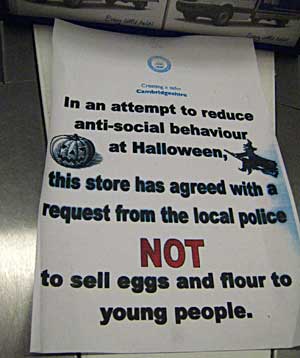
Seen in a local Tesco store. Er, shouldn’t that read “this store has agreed to…”?

A newspaper ad.

Of course none of this will stop Tesco commercialising it.

“Hi darling, I’m on the plane”

Oh no. BBC NEWS | Technology | Mobile phone use backed on planes

Passengers could soon be using their mobile phones on planes flying through European airspace.

Plans have been developed across EU countries to introduce technology which permits mobile calls without risk of interference with aircraft systems.

Regulators around Europe are calling for consultation on the potential introduction of the technology.

If given the go ahead, the service would allow calls to be made when a plane is more than 3,000 metres high.

Individual airlines would need to decide if they wanted to introduce the technology, if the green light is given by national regulators.

Bah!