
Apropos the Viacom/Google lawsuit.
Category Archives: Asides
Why golf is broken
Fascinating FT interview with Jack Nicklaus, for my money the greatest golfer ever.
Nicklaus’s real gripe with the modern game and its decline is the role of technology and, in particular, golf balls. The technological advance of golf ball manufacturing is enabling big hitters to propel them such distances that courses are being rendered obsolete.
As a result, designers are lengthening courses for the benefit of professionals at the cost of millions of dollars, leaving the poor amateur wondering whether a four-hour slog round a demanding course that used to take three hours is worth it.
Nicklaus argued this point with the governing bodies in the US and the UK, the PGA and the Royal & Ancient respectively, 30 years ago. “They just laughed at me,” he says. Still, he remains passionate about the issue, leaning forward and arguing his point in earnest. Golf, a game played in order to bring man together with nature was fine 20 years ago, he says. It had pretty much stayed as it was for 60 years, and you could play it in a reasonable amount of time. Now, he believes, “the game’s been broken because of equipment. It’s a problem.”
It hasn’t stopped him running a $300m course-design business, though.
Bit.ly — even tinier URLs
From Webmonkey…
New York-based Betaworks today launched a useful–and cute–URL shortener, Bit.ly. The user-facing features, such as tracking clicks and cookie-based history of recent shortened URLs, are nice. Where Bit.ly really shines is the data it makes available via its simple API.
Without registering for an API key, developers can shorten URLs, expand previously-shortened URLs, and get data about a Bit.ly URL. The information Bit.ly makes available includes the number of clicks, the referring sources of those clicks, and three sizes of thumbnails of the resulting web page.
Bit.ly is a model platform, a great example of how to launch a service with an API.
Yep.
Er, shome mishtake here

From the Telegraph. This would never had got through in Bill Deedes’s day.
On this day…
… three years ago, the London tube bombers struck. Isabel Hilton wrote this striking piece…
It was a cruel contrast. On Wednesday, Londoners rejoiced at the news that the city had won its bid to host the Olympic games in 2012. Thursday’s front pages were given over to scenes of jubilation. But as those editions reached the newsstands, London was already a darker, grimmer place, as a series of coordinated explosions ripped through its transport network.
The victims are still being rescued. The dead and injured are still being counted. We can only imagine the terror experienced by the thousands who were close to the explosions, some trapped in the darkened tunnels, dazed by the shock of what had overtaken them in the course of a normal journey to work. Millions more suffered that fear that grips the heart until friends and family can be reached. The dread, the deaths, the injuries, the lives devastated – this was London’s story today, as it has been the story of many others in many places, from Baghdad to New York, Paris to Bali, Madrid to Istanbul.
London is a city of diversity and tolerance, a multicultural capital, open, crowded and dynamic. These are the qualities that give it its vitality. The transport system is an easy target. Today the city is at a standstill; emergency services struggle to reach the trapped and the wounded…
Body language
On Friday evening last, Charles Arthur was invited to 11 Downing Street (where the Chancellor of the Exchequer lives). While there, he chanced to look out of the window down into the garden that runs behind Numbers 10 and 11 and saw Gordon Brown talking to an unidentified man. Below is a snippet from his account…
Brown listened intently. Once or twice he took a note, dragging a piece of paper from a jacket pocket. Once the other guy pulled out a single piece of A4, folded twice, blank on the back, and gestured at it as though it were a short list of things that weren’t quite right. Neither drank from the wine glasses while I was there. Brown sometimes leant forward, sometimes sat back. His body language was listening; then he began talking, and his hand movements were also shovelling, but they seemed like defensive shovelling: the palms turned outwards, as if trying to get something away from him. And then he too did the move-and-shovel routine. Take it from here, put it over there. Shovel, shovel, push and push.
There was something about the tableau that felt fragile. I could have taken a picture with my mobile, but it would have felt intrusive, rude -especially since we’d been asked not to take any pictures inside No.11. (Describing it here is different from a picture, which is just wrestled out of its context; here you have to imagine the scene yourself rather than have it presented.). It was a beautiful summer’s evening, the sun forcing through the trees wet with the heavy showers that had fallen earlier on. And two men discussed.. something, surely important…
There’s something fascinating about these details. Years ago when I was doing some consultancy work in Whitehall I went to a meeting in No 10 Downing Street. When you get into the hallway you are requested to leave your mobile phone on the hall table and given a post-it note on which to write your name. After my meeting I went to collect my phone and noticed that the Post-It on the Nokia next to it said “First Sea Lord”.
Higgs Boson, here we come!
Curvature of space
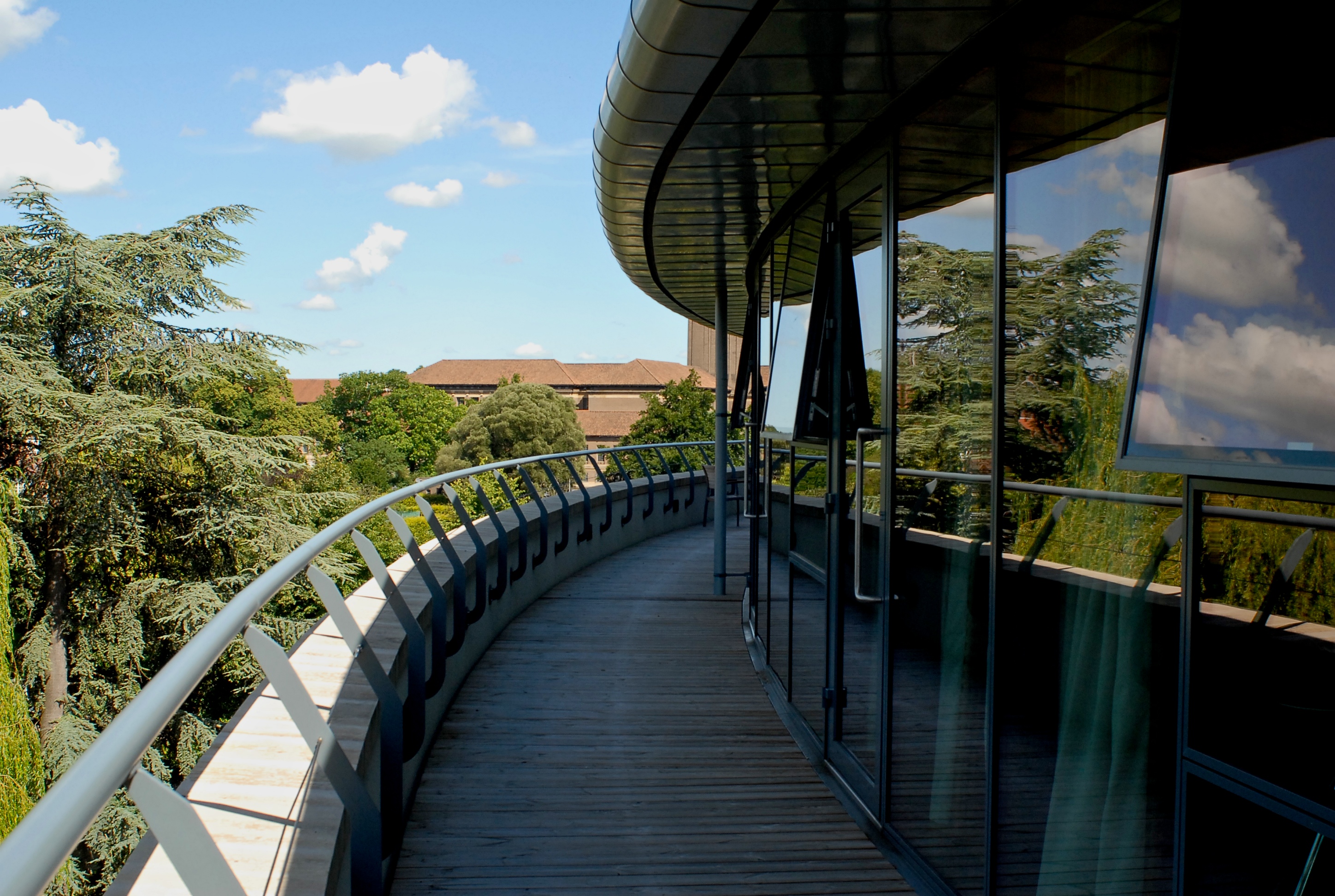
A view of the new Stephen Hawking building in Gonville & Caius College, Cambridge. And here’s the view looking the other way.
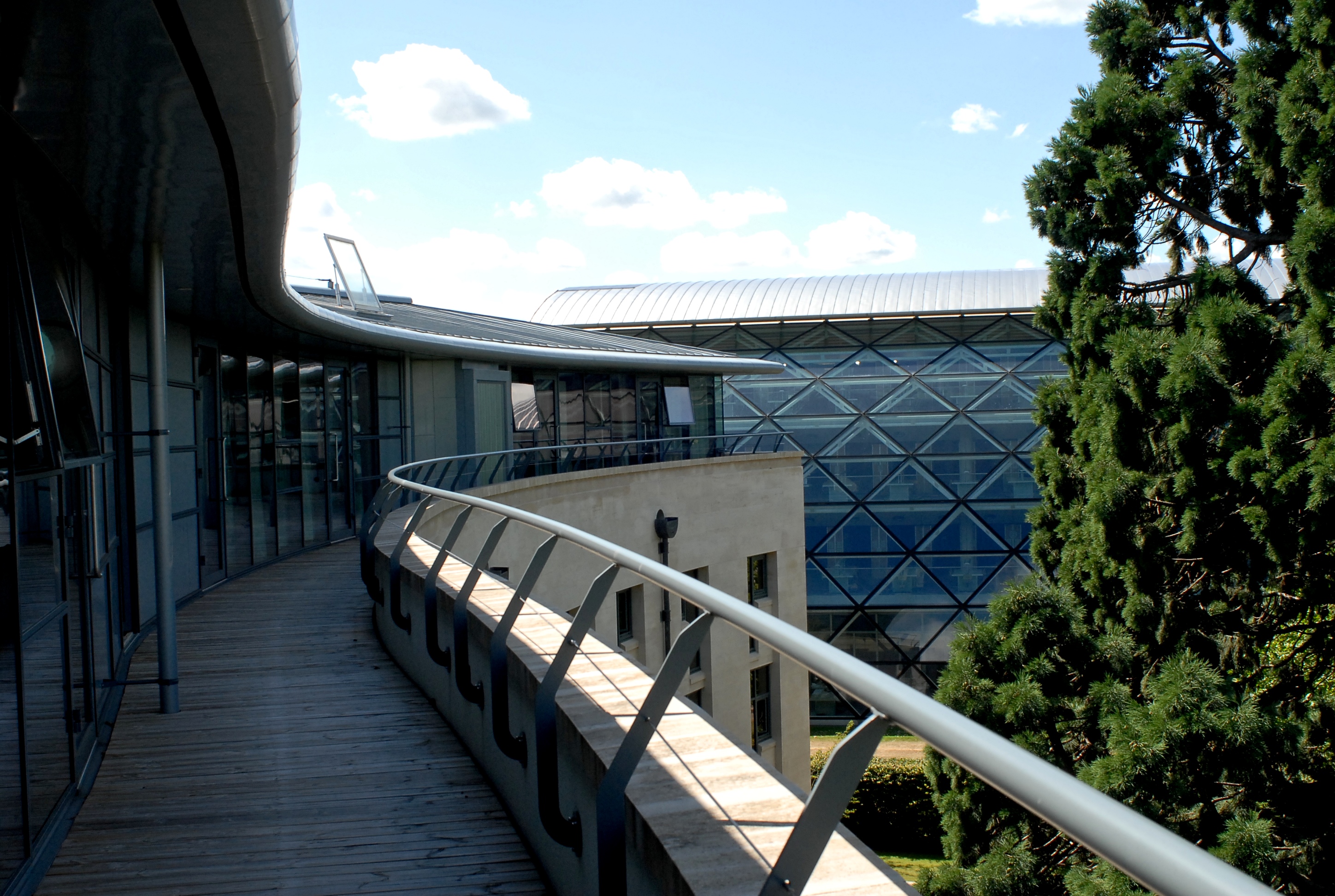
Given who it’s named after, it is perhaps appropriate that there doesn’t appear to be a straight line in the entire building.
Read my, er… his lips
Isla sent me a link to Read The Words. Hence this. Lihua pointed out that Odiogo does the same thing.
The future of the Net

Just spotted that my review of Jonathan Zittrain’s book is out. Find it in Management Today.