Darwin in statu pupillari

Well, well. So Charles D was a perfectly normal undergraduate for his day.

Two hundred years after Charles Darwin’s birth, historians have gained new insight into his days as a student at Cambridge after unearthing bills that record intimate details of how he spent his money.

The revolutionary scientist was, it would appear, ahead of his time in his willingness to pay extra to supplement his daily intake of vegetables. And, as one would expect of a 19th-century gentleman, he was happy to pay others to carry out menial tasks for him, such as stoking his fire and polishing his shoes.

But there is little to suggest that he bought many books, or that he did much else to further his studies. The evolutionist famously spent little of his time studying or in lectures, preferring to shoot, ride and collect beetles.

The records, which were found in six previously overlooked college books, are due to be published online tomorrow on the Complete Works of Charles Darwin website (darwin-online.org.uk). They allow historians to pinpoint the date of his arrival at Christ’s College (26 January 1828), as well as providing previously unknown detail of his undergraduate life.

Darwin’s time at Cambridge, from 1828 to 1831 – which he would later describe as “the most joyful of my happy life” – is also one for which there is a comparative shortage of information. “Before this, we didn’t really know very much about Darwin’s daily life at Cambridge at all,” said Dr John van Wyhe, director of the Darwin website. “It had been assumed that there were no significant traces of his time here left to discover, which meant that we were short of information about one of the most formative parts of his life.

Now, in his 200th anniversary year, we have found a real treasure trove right in the middle of Cambridge.”

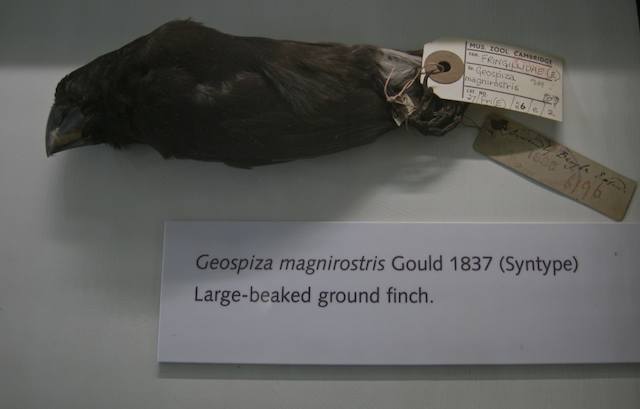
As it happens, I was in the Zoology Museum the other night, at the launch of the Cambridge Science Festival, when I came on some display cases showing some of Darwin’s finches (above) and the beetle collection he amassed during his time as a student (below).
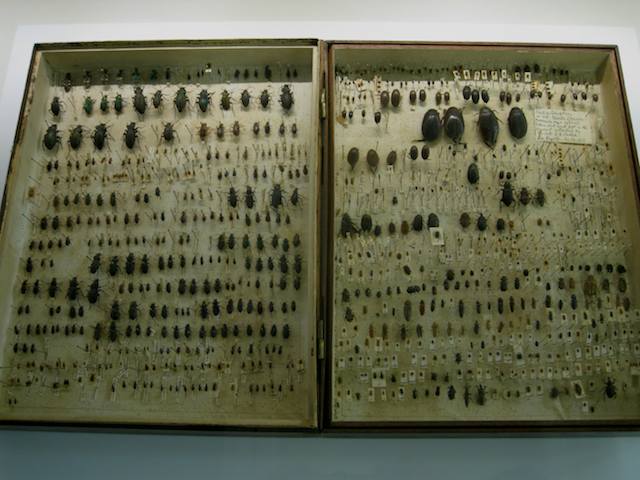
There’s something magical about coming face to face with objects like this. They have the ‘aura’ that Walter Benjamin used to go on about in The Work of Art in an Age of Mechanical Reproduction.

Six years in the Valley

The Economist’s correspondent in Silicon Valley is moving on. Here’s his valedictory report.

IN 2003, when your correspondent arrived in Silicon Valley, a common response to “How is the Valley?” was “In a nuclear winter.” The dotcom bust had incinerated an entire generation of start-ups. A much-debated essay argued that “IT [information technology] doesn’t matter.” The Valley itself seemed to matter less.

Its geeks were desperately looking for their “next big thing” and minting neologisms (“utility computing”, “the digital home”) in the hope that one might stick. But ordinary people outside the Valley were no longer paying attention. Valley geeks were already hopping onto Wi-Fi hotspots and playing with “smart” phones, but most people were still dialling up to connect to the internet and using mobile phones only for talking. There was some excitement about a fairly new gadget, Apple’s iPod, but nobody suspected that its progeny, in the form of a phone, might one day make the internet “mobile”. Nor did a popular search engine, Google, show signs that it might be a lucrative business, much less a new technology superpower. It was still a world of personal computers, dominated by Microsoft through its Windows operating system.

But towards the end of 2003 two conference organisers, Dale Dougherty and Tim O’Reilly, were brainstorming when Mr Dougherty used the words “Web 2.0”. They immediately realised that the phrase—with its software connotation of a newly released, better and more stable version—had enormous appeal as a rallying cry for the Valley. The Web 2.0 Conference was born, and the first one, in San Francisco in October 2004, created a stir…

Nice piece, which reminds one of how much can happen in a few years. Essentially his stint saw Google rise from an ingenious start-up to a commercial giant.

In praise of coffee

Nice graphic essay by Christoph Niemann.

I like coffee so much that I have tea for breakfast: The first cup of the day in particular is so good that I’m afraid I won’t be able to properly appreciate it when I am half-asleep. Therefore, I celebrate it two hours later when I am fully conscious.

Thanks to Michael Dales for the link.

I love Niemann’s New Yorker covers.

The Public Domain

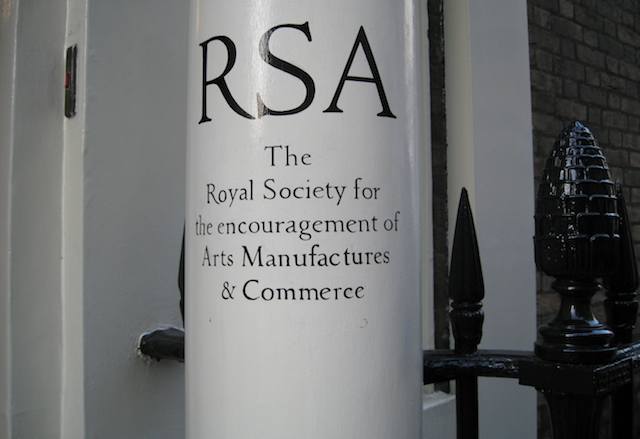
Last night I went to the Royal Society of Arts (of which I am, ahem, a Fellow, don’t you know) for James Boyle’s lecture.

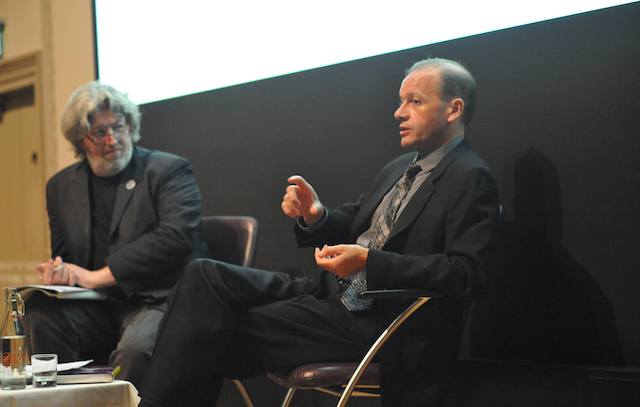
I’ve been reading his book which — as the event Chairman, Bill Thompson (left in photograph), observed — is beautifully written (unlike some other treatises on intellectual property that I could name). Perusing the list of attendees beforehand (it was a full house), James noted that it was dominated not by IP lawyers but by techies and ‘creative industry’ types, and wisely decided to go into storytelling rather than law-professor mode. The result: a riveting and thought-provoking event.

BillT is right: The Public Domain is a lovely book, gracefully written and persuasive. Its central themes are:

  • For the last 50 years we’ve been expanding intellectual property rights in ways that are unwise
  • In the process we’ve been reducing (indeed enclosing) the public domain at a time when that domain is becoming increasingly important for our cultural and economic wellbeing
  • We’ve got the balance between IPRs and the public domain wrong
  • All of this has happened largely because — almost uniquely in legislative processes — policymaking on IP matters takes place in an evidence-free zone
  • Boyle thinks that we need a movement (analogous to the environment movement) to protect and reverse the enclosure of the public domain.

    Like me, JB is a great admirer of Macaulay. (Unlike me, he sometimes writes like him too.) The book has some lovely quotes from Mac’s speeches on copyright. He was particularly fierce against attempts to extend its term far beyond the death of the author — and particularly against the idea that literary legatees might choose to withdraw access to great works. Here he is, for example, on Boswell’s Life of Samuel Johnson.

    One of the most instructive, interesting and delightful works in our language is Boswell’s Life of Johnson. Now it is well known that Boswell’s eldest son considered this book, considered the whole relation of Boswell to Johnson, as a blot on the escutcheon of the family. He thought, not perhaps altogether without reason, that his father had exhibited himself in a ludicrous and degrading light. And thus he became so sore and irritable that at last he could not bear to hear The Life of Johnson mentioned. Suppose that the law had been who my honourable and learned friend wishes to make it. Suppose that the copyright of Boswell’s Life of Johnson had belonged, as well it might, during sixty years to Boswell’s eldest son. What would have been the consequence? An unadulterated copy of the finest biographical work in the world would have been as scarce as the first edition of Camden’s Britannia.

    Boyle argues that, in many respects, people like Thomas Jefferson and Macaulay got right to the heart of the matter. One couldn’t ask for a better refutation of the IP lobby’s arguments that extending IP rights incentivises authors (including dead ones) than this blast — again about Dr Johnson.

    Dr. Johnson died fifty-six years ago. If the law were what my honourable and learned friend wishes to make it, somebody would now have the monopoly of Dr. Johnson’s works… Now, would the knowledge that this copyright would exist in 1841 have been a source of gratification to Johnson? Would it have stimulated his exertions? Would it have once drawn him out of his bed before noon? Would it have once cheered him under a fit of the spleen? Would it have induced him to give us one more allegory, one more life of a poet, one more imitation of Juvenal? I firmly believe not. I firmly believe that a hundred years ago, when he was writing our debates for The Gentleman’s Magazine, he would very much rather have had twopence to buy a plate of shin of beef at a cook’s shop underground.

    Shameless plug: James Boyle is coming to Cambridge to give the first Arcadia Lecture at my college. Details here. All welcome.

    The Great Rewind

    I was brooding about the (dire) state of the automobile industry, and thinking that however pragmatic a short-term rescue for GM & Co might be, it makes no long term sense to enable them to continue as they were. Why? Because that would just be to encourage them to continue making products that are no longer desireable or needed. (It’s strange how silly SUVs look now.)

    As usual, Mark Anderson has an interesting take on what’s going on.

    I would like to suggest a way of viewing today’s layoffs in a different light. It now appears that we have been living on borrowed money, literally, since about 2000. Whether you are looking at house pricing and the housing boom (and bust), or stocks, or commodities, or consumer items, it’s all basically true: the pricing of the last eight years was supported by too much personal (and corporate) debt. Alan Greenspan gets most of the credit in the U.S. side of this story, but that’s a different tale.

    In that sense, layoffs are not “bad.” Our society tried to live beyond its means, we invented fake ways of making fake money, all built on debt and fake financial structures. All of that now has to come down. The jobs we are “losing” never really existed, by and large. Rather, that level of employment, at least in the way those jobs were allocated, was itself, mostly, also fake.

    We are now rewinding back to 2000, like it or not, back to a time when borrowing was high but not exponentially approaching infiinity; when house prices were high in many places, but not doubling and tripling in short order; when stocks were expensive, but not hundreds of times earnings (and not fueled by borrowed fake money).

    Once we have done this rewind, down to what you might call a “value base,” a base level of employment justified by a normal (and now temporarily reduced) workload, we can allocate jobs, work hours, and money for salaries all over again, as a society. Guess what won’t happen? All the smartest kids in physics won’t end up on Wall Street. If they do, we’d better all move to some agrarian economy.

    I can only imagine how hard it is on families to live through this Rewind Period, but I also suspect that knowing it is a Rewind, rather than an Infinite Collapse, should be helpful. I hope it is.

    Why Dave Winer switched to Mac in 2005

    Salutary blog post by Dave W.

    I switched because I was Mired In Malware.

    I got a new EeePC 1000HE last week, and after just a few hours of use, it’s infected with a rootkit virus of some kind. Really clever. Spent three hours last night trying to eradicate it, but in the last three or four years, the malware guys have gotten a lot more clever.

    Contemplating switching to the Hackintosh flavor of netbook.

    Ran Ad-Aware, getting ready to run Spybot. Downloaded Combofix. I’m going to try to resurrect this baby. Also considering doing a fresh install of Windows but that sounds like more work that Leopard. And then you’re still using Windows.

    Yep. I switched to Mac in 1999. Never had any trouble since. Touch wood.

    JUST IN: This via Glyn Moody:

    Appointments for cancer patients had to be rescheduled after a computer virus infected the networking systems at two Scottish hospitals last week.

    The infection of laboratory PCs at the Stobhill and Gartnavel General hospitals meant the bookings of 12 patients attending the Beatson West of Scotland Cancer Care Centre in Glasgow were postponed, The Glasgow Herald reports. Systems were taken offline for two days to allow computer technicians to clean up the mess…

    Now, I wonder which OS they were running.