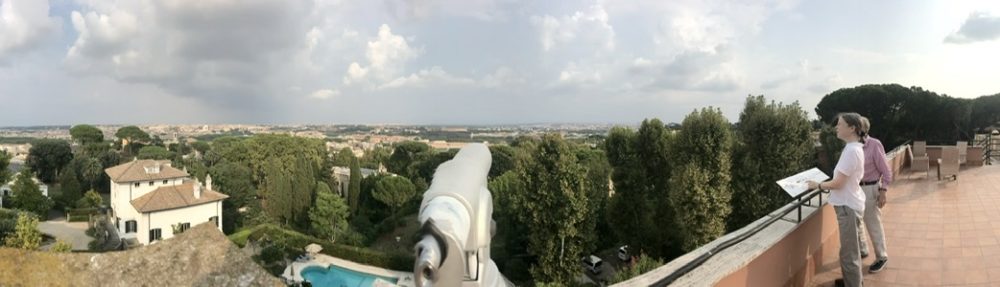
… in 1963, JFK visited West Berlin and made his famous declaration: “Ich bin ein Berliner”.
Category Archives: Asides
Those who forget history are, well, doomed to disappointment
I’ve been in a lot of discussions recently about the ‘death’ of (print) newspapers. What strikes me most about the print perspective is its almost childish impatience for immediate results. Faced with the reality of Marshall McLuhan’s observation that the future emerges more slowly than the past dissolves, print journalists decry the online future as a revenue-free chimera. Because online news doesn’t make money at the moment, they think it’s a hopeless prospect. (Another problem is that they are obsessed with the continuation of a particular output format — the newspaper — rather than the function that it performs, which is journalism. But that’s another story.)
I can understand their angst as a treasured way of working becomes unviable, but the idea that we could instantly switch from an industry built on, and shaped by, 19th-century technology into one based on networked technology is historically naive. In my Oxford seminar I used the example of what happened when broadcast radio arrived in the US in the 1920s. Entrepreneurs were as puzzled by how to make money from radio then as newspapers owners are by the Web. It took at least a decade to figure out to figure out a business model that would work for broadcast radio — and the solution was eventually found by a detergent manufacturer, Proctor and Gamble — which is how we got the soap opera. But in that decade lots of companies went bust trying to make money from the new medium. Yet, in the end, radio was the medium that changed the world, because it created the modern mass market. For the first time, people across the continental United States could have the same media experience at the same time — and advertisers could address a mass market.
Much the same is happening now. Nobody yet has a clear idea of a business model that will support journalism in a networked age. But I have absolutely no doubt that models will be found — in time. That’s the lesson of history.
Another lesson of history that grief-stricken print journalists ignore is that the modern print newspaper did not spring, ready-made, from its cradle. In fact it took a long time to evolve. This was the point made in an admirable post by Howard Owens on his blog.
For more than a decade, we expected to build online news organizations that could support a super structure of the modern newspaper newsroom — with the all the reporters and editors and big story packages (look at all the emphasis we put on big Flash multimedia productions) and that we could keep doing journalism just the way we always did it.
While we bemoaned shovelware (taking the same exact print story and repurposing it for the Web), we took little time to really examine what might might be different about online publishing that should change the way news is gathered and presented.
That’s why we were slow to embrace blogging, slow to recognize the power of social networking, and why, even today, most newspapers treat reader interaction (re: comments on stories) as a nuisance rather than an essential part of the business.
The Big Worry of the print culture is that in the networked world nobody will do Real Journalism — all that laudable, high-end, socially-responsible, investigative, speaking-truth-to-power stuff which makes journalists feel good about themselves and their role in society. Howard Owens reminds us that the celebrated pioneers of American newspaper culture didn’t do too much of that high-minded stuff. Au contraire.
The early giants of journalism got much wrong and got much right, but little that they did would resemble journalism of the past 60 or 70 years.
They didn’t, for example, do much in the way of investigative journalism. Nelly Bly worked for the New York World, but even her greatest public service reporting — locking herself in an insane asylum — isn’t what many of today’s newsroom pundits mean by high-cost investigative journalism. it was a stunt, just like her most expensive adventure, going around the world in 80 days. That really brought down a president, didn’t it?
Most of the other muckrakers who set the stage for investigative journalism didn’t even work for newspapers. They wrote for magazines and published books.
It took a long time for newspapers to build the cash flow to afford big time, expensive investigative journalism, and for publishers to recognize its value (and some of them still aren’t convinced) in helping to retain readers.
So if it took newspapers more than 100 years to build the business and content models that we all now cherish, why do we expect a fully formed online model to emerge in just 10 years?
Exactly. So the moral of the story is: patience. Journalism will continue even if print newspapers decline or even die. The world doesn’t end here.
.
So who really runs Iran?
I am baffled by the power-structure in Iran — all those councils of ‘experts’ and ‘guardians’ and the so-called ‘supreme leader’ (the title Private Eye shrewdly assigned to Gordon Brown, incidentally). “What I need”, I said to an Iranian friend, “is a diagram” (for I am but an humble engineer and long words trouble me). She immediately emailed a link to this helpful clickable BBC chart.
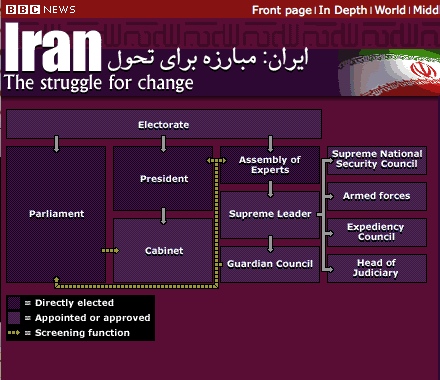
Looks clear, doesn’t it? But then you find that the Guardian Council, which appears to be way down the pecking order, is apparently
the most influential body in Iran and is currently controlled by conservatives. It consists of six theologians appointed by the leader and six jurists nominated by the judiciary and approved by parliament. The council has to approve all bills passed by parliament and make sure they conform to the constitution and Islamic law. The council also has the power to veto candidates in elections to parliament, local councils, the presidency and the Assembly of Experts. President Khatami is attempting to remove this power.
The Assembly of Experts, for its part, is
made up of 96 clerics, is comparable to the College of Cardinals which chooses the Pope. The assembly is elected directly by the electorate every eight years. Its functions are to appoint, oversee and if necessary dismiss the Supreme Leader. It meets twice a year to review the performance of the Supreme Leader.
“The current assembly”, the BBC chart helpfully reveals, “was elected in 1998 for an eight-year term”. Er, 1998 plus 8 equals 2006. It is now 2009. Well, it is here in the Junior Satanic Kingdom of Britain anyway. In the governing circles in Iran it’s probably about 1456.
On the other hand… Just think if the College of Cardinals met twice-yearly to review the performance of the Pope. That’d soften the old boy’s cough, as my mother used to say. Keep him up to the mark.
Thinking about climate change (contd.)
After my post about Tim O’Reilly’s use of Pascal’s wager, Brian sent me a link to this. Nice exposition (although I dislike the stuff about “the most terrifying video…”). And a reminder of how powerful YouTube is — millions of views already.
LATER: Just thinking about it, while I understand why he’s made the most pessimistic assumptions about the False/Yes cell on the grid — i.e. nothing but added costs and a global economic depression brought on my them — in practice I think Tim O’Reilly is right: what will happen is that we will invent who new industries based on green technology.
More on the role of Nokia-Siemens kit in Iran
From Good Morning Silicon Valley.
Last year, Nokia Siemens Networks, a joint venture of the two European giants, sold Iran a big telecommunications package that included a “monitoring center” installed at a choke-point of the government-controlled network. The equipment was described in a company brochure as allowing “the monitoring and interception of all types of voice and data communication on all networks,” but according to spokesman Ben Roome, it was built for “lawful intercept” related to combating terrorism, child pornography, drug trafficking and the like. The equipment was part of a system that enabled “deep packet inspection,” the real-time examination of the contents of electronic communications (technology that has also attracted interest in some “non-repressive” governments as well).
Now, reports the Wall Street Journal, after playing around with the system for a few months, Iran has been spurred by internal unrest to tighten the screws, and the result, according to tech experts, is a level of intrusion and control that makes China’s Great Firewall look like freeware. “We didn’t know they could do this much,” a network engineer in Tehran told the Journal. “Now we know they have powerful things that allow them to do very complex tracking on the network.” Iran is “now drilling into what the population is trying to say,” said Bradley Anstis of California security firm Marshal8e6. “This looks like a step beyond what any other country is doing, including China.”
As noted earlier, Siemens is the outfit that provides all the BBC’s IT services.
Coming home to roost
This morning, Mr & Mrs Pigeon decided that they would nest on our vine. Mrs perched herself sulkily, like so…

… and waited for her mate to bring her twigs, most of which she inspected critically and dropped. But he persisted and after a couple of hours, she had something to sit on. We remonstrated with her that this was not a good place to settle, on account of our two cats, but she greeted us with a totally insouciant air, thus:

Hmmm… This is Not Good. Our cats are diligent hunters.


Pascal’s Wager and Climate Change
At a party a few weeks ago I ran into a climate-change denier and was struck by how impermeable he seemed to any kind of cautionary reasoning. He was especially hostile to any case based on scientific ‘consensus’. Afterwards, I wondered if there was an argumentative strategy that might be more effective. So I wonder if this post by Tim O’Reilly might provide a way forward. “In my talks”, Tim writes,
I’ve argued that climate change provides us with a modern version of Pascal’s wager: if catastrophic global warming turns out not to happen, the steps we’d take to address it are still worthwhile. Given that there’s even a reasonable risk of disruptive climate change, any sensible person should decide to act. It’s insurance. The risk of your house burning down is small, yet you carry homeowner’s insurance; you don’t expect to total your car, but you know that the risk is there, and again, most people carry insurance; you don’t expect catastrophic illness to strike you down, but again, you invest in insurance.
We don’t need to be 100% sure that the worst fears of climate scientists are correct in order to act. All we need to think about are the consequences of being wrong.
Let’s assume for a moment that there is no human-caused climate change, or that the consequences are not dire, and we’ve made big investments to avert it. What’s the worst that happens? In order to deal with climate change:
1. We’ve made major investments in renewable energy. This is an urgent issue even in the absence of global warming, as the IEA has now revised the date of ‘peak oil’ to 2020, only 11 years from now.
2. We’ve invested in a potent new source of jobs. This is a far better source of stimulus than some of the ideas that have been proposed.
3. We’ve improved our national security by reducing our dependence on oil from hostile or unstable regions.
4. We’ve mitigated the enormous “off the books” economic losses from pollution. (China recently estimated these losses as 10% of GDP.) We currently subsidize fossil fuels in dozens of ways, by allowing power companies, auto companies, and others to keep environmental costs “off the books,” by funding the infrastructure for autos at public expense while demanding that railroads build their own infrastructure, and so on.
5. We’ve renewed our industrial base, investing in new industries rather than propping up old ones. Climate critics like Bjorn Lomborg like to cite the cost of dealing with global warming. But the costs are similar to the “costs” incurred by record companies in the switch to digital music distribution, or the costs to newspapers implicit in the rise of the web. That is, they are costs to existing industries, but ignore the opportunities for new industries that exploit the new technology. I have yet to see a convincing case made that the costs of dealing with climate change aren’t principally the costs of protecting old industries.
By contrast, let’s assume that the climate skeptics are wrong. We face the displacement of millions of people, droughts, floods and other extreme weather, species loss, and economic harm that will make us long for the good old days of the current financial industry meltdown.
It really is like Pascal’s wager. On one side, the worst outcome is that we’ve built a more robust economy. On the other side, the worst outcome really is hell. In short, we do better if we believe in climate change and act on that belief, even if we turned out to be wrong.
Manchester United’s latest three-letter word
In an earlier post, I contrasted Barcelona FC’s sponsorship of UNESCO with Manchester United’s sponsorship by AIG, the well-known imploding insurance giant (now bailed out by the US taxpayer). Now comes a fascinating account in The Atlantic of how Man U found some new letters to embroider on its shirts.
When two executives of Chicago’s Aon Corp. went through their mail one day last fall, they each found a large package with a leather-encased box, containing, of all things, a soccer shirt with the company’s own logo emblazoned across the chest. The shirts appeared to be bonafide red home jerseys of Manchester United, arguably the most famous sports team in the world—or at least in the world outside the soccer-suspicious United States.
They had the red and yellow team logo and the Nike swoosh, and were obviously high quality, but they were just mockups. Aon, which is Gaelic for “Oneness,” had no relationship with the team. It doesn’t even have anything to do with its own hometown teams, the Cubs, White Sox, Blackhawks, Bulls, or Bears.
That overture led, eight months later, to a sponsorship and marketing deal in which AON paid a reported $130 million in exchange for having its logo on the jersey. The story of how this deal came about, and the benefits each party derives from it, offers an instructive look at the world of international commerce, where in the quest for global success, companies sometimes find themselves venturing into unexpected but auspicious pairings.
Footnote: ‘aon’ is Irish for ‘one’, not oneness (whatever that is).
Thanks to Lorcan Dempsey for spotting the piece.
Only connect
Yesterday I went to London for the launch of a research report from the Reuters Institute for the Study of Journalism on Public Trust in the News written by Stephen Coleman, Scott Anthony and David E. Morrison. Because the research was part-funded by the Scott Trust, which owns the Guardian and the Observer (for which I write), the event was held in the Guardian‘s posh new offices next to King’s Cross station, an area hitherto notorious mainly for whores, pimps and drug pushers but now clearly coming up in the world. On the landing outside the Scott Room (where the launch was held) is a bust of ol’ C.P. himself (author of the famous observation that ‘comment is free but facts are sacred’, often bowdlerised nowadays as ‘columnists are expensive but facts are even more so’), so we were all on our best behaviour.

The Report
The subject of the research was the hoary old question of “trust in the media” (yawn) but the investigators had done us the honour of at least trying something new.
What did they glean from these focus groups (beyond the astonishing discovery that not a single participant knew that Obama and Clinton belonged to the same political party)? Well, basically that
“people have several expectations from the news, including the provision of useful information that supports them in their personal and civic lives, reliable information that provides ontological assurance in an insecure world and amusing informaiton that offers guilty [sic] distraction from the anxieties of the serious world. News is valued to the extent that it meets some or all of these expectations. The news fails when it devalues [?] these expectations”.
The conclusion seems to be that there are two contradictory trends in the “production, circulation and reception of public knowledge” that raise issues of trust.
So what’s to be done? The report argues that journalists need to take on a “mission to connect”, a windy phrase which seems to involve constructing four principal “linkages”:
The Debate
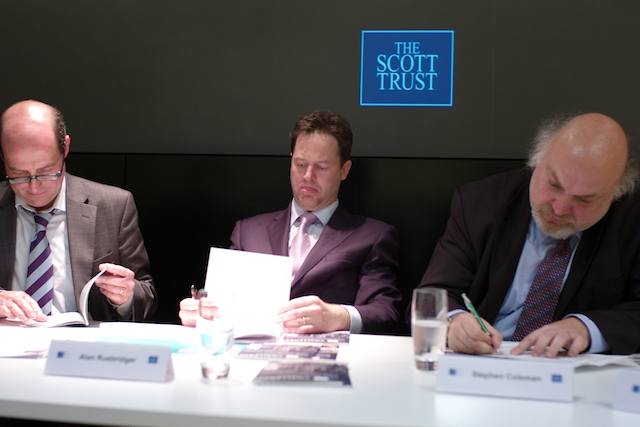
There were three speakers — Nick Robinson, Political editor of the BBC; Nick Clegg, Leader of the Liberal Democrats (formerly the Claret Appreciation Society); and Professor Stephen Coleman, lead author of the report.
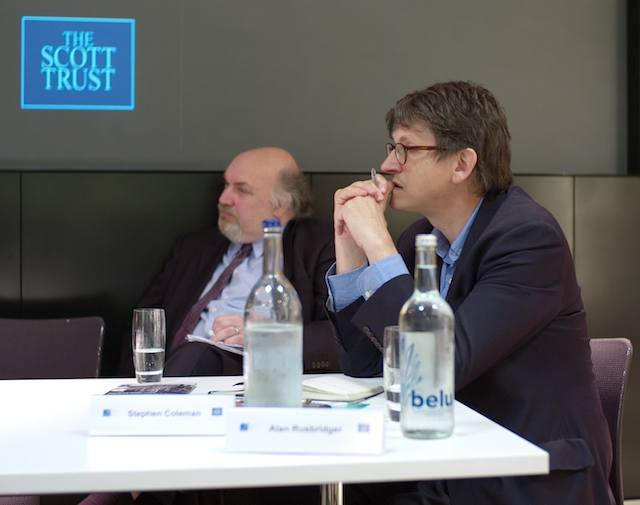
Proceedings were chaired by Alan Rusbridger, Editor-in-Chief of the Guardian.
First up was Stephen Coleman who lost no time in impressing upon us the originality of his team’s approach and the importance of their conclusions, esp in relation to the “mission to connect”.
Coleman was followed by Nick Clegg, looking natty in a sharp suit and pink tie. He candidly explained that he had conscientiously prepared for the event by making a careful study of an entirely different RISJ report, and so his remarks on Professor Coleman’s labours would have to be extempore. For this he gained many brownie points with the audience, unaccustomed as its members are to honesty from a politician. For a time he waffled, but eventually got onto firmer ground when he talked about how recent canvassing experiences had given him an insight into the extent to which citizens lived in ‘micro-climates’ of concerns undreamed-of by Westminster politicians. They are, for example, incredibly worked up about something that the mainstream media regards as a tired old story — the closure of local post offices. And very exercised about a topic long ago declared a no-go area for ‘responsible’ media — immigration. And about mental health. He cited these three areas as examples of profound disconnection between local and mainstream-media mindsets.
Finally, Nick Robinson came to the rostrum. He was terrific — no other word for it. In part this is because his job requires him to be definite and succinct. But it was mainly due to the candid and open way that he approached the topic of the research. He said that he had read the report and found himself nodding in agreement all the way — until he reached the conclusions. And he clearly saw problems in the area of ‘making connections’. How, for example, does one explain the back-story in a Ten O’Clock News item lasting, say, 2′ 45″? He used as an illustration of the problems the case of the MPs’ expenses saga. He had done the back-story — about eight months ago. How could he be expected to pack it in every time? (This point was taken up later by Stephen Coleman, who argued that TV political news makes very little use of the red button — in comparision to the imaginative uses to which it is put by sports programmes.) He also had interesting things to say about the points raised earlier by Nick Clegg. On immigration, for example, he felt that the liberal media had believed for too long that the subject was mainly of interest only to loony right-wing groups. Whether this was due to liberal ‘denial’ or sheer absence of insightful opinion research is not clear. There was polling evidence, he said, but editorial establishments across the high-IQ media didn’t like the evidence. So, he said, the media “explained but didn’t connect” on this subject.
Another case where this may have happened was that of women in the workplace.
Robinson was sceptical about the ‘crisis of authority’ thesis, citing examples of really big stories or crises when people automatically turn to trusted old-style media for information. “When the chips are down”, he said, “people know where to turn”. And in general that is the BBC.
He also said, en passant that he had given up reading the comments on his blog because they were often so rude, intemperate and unthinking. (Thinks: so much for the ‘marketplace in ideas’. But actually oafish commenting is largely a product of allowing people to comment anonymously. When people have to be accountable for what they say, they are better behaved. That’s why I’ve always thought that the BBC and the Guardian were mad to allow anonymous commenting.)
Overall, it was an interesting and worthwhile evening. For me there were eerie echoes of the arguments about the Birt-Jay “mission to explain” in the 1980s, which in turn went back to Walter Lippmann and his view about the role of the press in early 20th-century America. Like Lippmann, Birt believed that the function of journalism was not to “pick at the scabs of society” but to convey to citizens the complexities of the decisions that have to be made by a sophisticated, industrialised society. (Lippmann went so far as to argue that the function of the press was to “manufacture consent” of the governed to decisions made in their name.) He and Peter Jay articulated this view brilliantly — and implemented it in a major, well-funded, current-affairs series on LWT — but the thesis (and indeed Birt himself) ran into the vigorous opposition of journalists who were temperamentally and intellectually hostile to the notion that they had a constructive (or consent-manufacturing) role to play in the polity. My hunch about Coleman’s “mission to connect” is that it will run into the same kind of opposition — assuming, of course, that there any journalists around to have a view on this, or indeed anything else.
In his ownwords…
Happy Bloomsday! Interesting to see that the only reference to it in today’s Irish Times is to the fire aboard a New York ferry, the General Slocum, on June 16, 1904 — the original Bloomsday — whereas in the boom years of the Celtic Tiger affluent Dublin went en fete on June 16, with even property developers miming a literary sensibility and the Times always having something about the day on the front page.
Perhaps it’s all an indication that my countrymen have a lot on their minds besides literature, what with the banking catastrophe and the child abuse revelations and all. So, as this blog’s modest contribution to the festivities, here is a (rare) audio recording of the Man Himself. When I first heard it I was astonished to find that he had a broad Irish-country accent. I had always imagined him speaking as a ‘Dub’ — i.e. with the accent of most of the street characters in Ulysses.
CORRECTION: I was unfair to the Irish Times — but only discovered my error when I picked up a paper copy in town after I’d written the post. There’s a lovely Irishman’s Diary by Terence Killeen about the Professor McHugh character who appears in Episode 7 of Ulysses. He was, in fact, ‘Professor’ MacNeill, a down-and-out who spent most of his days in the paper’s newsroom.
LATER: Hmmm… Interesting developments. At some stage in the morning, the Irish Times web page was updated with this fetching image of a Sandycove publican dressed to the Joycean nines.
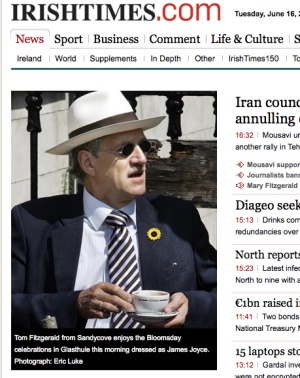
Wondered what triggered the change? Could it have anything to do, one wonders, with the fact that this post was picked up by BoingBoing?
Thanks to Des Fitzgerald for the tip.