Rugby, ballet and Nureyev’s testicles

Wonderfully sharp and surreal column by Harry Pearson in today’s Guardian. Sample:

During a Test match between New Zealand and South Africa in Wellington in 1994, the Springboks forward Johan le Roux bit a chunk out of the All Blacks captain Sean Fitzpatrick’s ear. Le Roux reacted to his punishment by commenting that if he had known he was going to be banned for 18 months he’d have ripped Fitzpatrick’s lug off in its entirety and taken it home as a souvenir. As you will judge, this was before the evil wand of professionalism had cast its sordid, cynical spell over the gentlemanly world of rugby union.

Thankfully, it seems that at least some vestige of Le Roux’s Corinthian ideals lives on in the Rainbow Nation, even in this dread age of image rights and sponsored shorts. Following an altogether predictable fuss about Schalk Burger’s gouging antics, De Villiers nailed his colours, and probably several of his fingers, to the mast and declared that any young man who doesn’t want to go out on Saturday afternoon and have his eyes poked out should dress up in frills and call himself Jessica.

As someone brought up in an era when any chap in full possession of all five senses was regarded as a mummy’s boy of the most foppish stamp, I can only applaud De Villiers’s words – albeit with only one hand, the other having been lopped off during a typically bruising beetle drive at the local WI a few years back.

Any road, it is plain De Villiers is a man of the old school – several faculties short of a full university and justifiably proud of the fact. One thing I must take him to task for, however, is the suggestion that wearing a tutu would somehow preclude violence.

Ballet, or “the posh blokes’ football”, as the former Stoke manager Tony Waddington so memorably called it, is perhaps not top of the agenda with the Springboks. Otherwise they would surely be aware of the notorious business in 1962 when Dame Margot Fonteyn was banned from Sadler’s Wells for eight months after a “bag-snatching” incident involving Rudolf Nureyev during a matinee of Lac des Cygnes.

Made my day. Hope he writes in tomorrow’s paper about the defeat of the plucky, er, Scottish hero Andy Murray at the hands of some American whose name escapes me just now. If Murray had prevailed this afternoon he would, of course, be a British hero. Or perhaps even an English one.

Urbane legends

To the external eye, Oxford and Cambridge seem very similar — the same glorious jumble of architectural styles, two apparently identical universities and their associated colleges woven into the fabric of their medieval towns, two institutions quaintly addicted to gowns and formal dining, etc. Yet the truth is that they are very different institutions. I’ve always thought that Oxford is much more well, exotic than Cambridge, which is an altogether more utilitarian place. The reasons for that are varied — Cambridge is more dominated by science and technology, for example, whereas Oxford is more dominated by the humanities. Oxford feels much closer to London, and especially to Westminster. And of course during the English Civil War, Oxford was the university that supported the King. Cambridge took a rather different view.

I was vividly reminded of the difference between the two places some years ago, when I was invited to George Steiner’s Inaugural Lecture after he was elected to the Chair of Comparative Literature at Oxford. The Chair was endowed, if I remember correctly, by the publisher George Weidenfeld — himself an exotic figure who turned up on the night with a gorgeous flame-haired creature on his arm who must have been half (or even a quarter) of his age. The lecture was held in the cavernous Examination Schools. I got there early, and watched in astonishment as the hall filled up with diamond-encrusted grandes dame of the kind hitherto seen only in the Court of the Tsars in the good old days. As I gaped, in sauntered the Professor of Irish History wearing a tastefully embroidered waistcoat, long hair flowing, hands languidly in pockets, for all the world like an escapee from an Oscar Wilde play. Not for nothing, I thought, does Brideshead Revisited open in Oxford.

All of this was conjured up by an acerbic review by Terry Eagleton of a recently-published collection of Enlightening: Letters 1946-1960 — the correspondence of the political philosopher Isaiah Berlin. Since Berlin was for many decades a central figure in 20th-century Oxford, Eagleton shrewdly opens his piece with a caricature of the university milieu in which the great man had thrived.

Oxford is one of the great hubs of the British establishment, but prefers to see itself as a haven for free spirits and flamboyant individualists. A don might endure the inconvenience of standing for hours in a pub with a parrot on his shoulder, simply to hear the admiring whisper: “He’s a character!” Eccentricity was valued more than erudition. In Berlin’s day, the colleges were full of men (and the odd woman) who mistook a snobbish contempt for the shopkeeping classes for a daring kind of dissidence.

Oxford thus had the best of both worlds. It was firmly locked into the circuits of power, wealth and privilege, yet it cultivated a cavalier indifference to them. Its colleges mixed luxury with monastic austerity. The place was worldly and lofty at the same time. Berlin himself was as much at home in the US Congress as in the senior common room. Dons could win themselves some vicarious power by churning out the political elite, while posing as genteel amateurs. The trick was to talk about Hegel in the tones of one talking about Henley regatta.

Eagleton is immune to Berlin’s exotic charm, preferring to see him as a reactionary masquerading as a liberal intellectual. From this caustic perspective, Oxford was “a perfect stage” for a man whose

taste for the off-beat and idiosyncratic served to disguise a deeper conformity. He shared with Oscar Wilde and TS Eliot the outsider’s ferocious hunger to be accepted (he was the first Jew to be elected to an All Souls fellowship) and turned himself into a deadly accurate parody of the English establishment, all the way from his well-tailored waistcoats and quick-fire donnish gabble to his careless habit of overlooking western political crimes while denouncing Soviet ones.

Above all, Berlin was a flattering presence among his peers. He spoke learnedly of obscure European thinkers unknown to his colleagues; yet he spoke of them in ways they could thoroughly approve of. Far from threatening their own provincial values, his cosmopolitanism seemed to confirm them. His Oxfordian delight in the “gay” and “amusing”, favourite terms of praise in these letters, lent him the air of a nonconformist when it came to the staid, unstylish middle classes. But it was also his entry ticket to the world of the Rothschilds, Sackville-Wests and Lady Diane Coopers, in whose patrician presence his critical faculties could be quickly blunted.

Eagleton sees Berlin as “an amphibious creature, a high-society intellectual”. In English culture, he writes,

this is not as self-contradictory as it sounds. What Oxford did, with its Hellenistic sense of human existence, was to provide some high-sounding rationales for upper-class frivolity. It was agreeable to know that in popping the champagne you were vaguely in line with some ancient Greek thinker or other. In yanking each other into bed, Oxford men could feel they had the glories of ancient civilisation in there with them.

Berlin, Eagleton writes, “was not only a compulsive chatterer; he was in a chattering class of his own. These letters are great splurges of urbane speech, which at times come close to stream-of-consciousness mode. Fragments of political philosophy blend with upper-class gush (‘divine’, ‘delicious’, ‘adorable’).”

I’ve always found it difficult to square the image of Berlin one obtains from the chronicles and memoirs of the Oxonian smart set of his time (Bowra, Trevor-Roper, Raymond Carr, Elizabeth Bowen, David Cecil, et al) with the image of him as one of the 20th century’s most influential political philosophers. He famously wrote very little (and was only rescued from literary oblivion by the efforts of Henry Hardy, the graduate student who collected all his various small pieces and edited them into collections of essays). I associate him only with two Big Ideas: the fact that we need to accept that some of our values will always and inevitably be contradictory (thereby forcing us to make moral choices); and his famous essay on Tolstoy’s view of history in which he divides the world into hedgehogs (who know only one big thing) and foxes (who know many little things).

As you can see, I’m a fox.
So how bad is this recession?

Pretty bad, it seems. According to the San Jose Mercury News, even pornography isn’t selling at the moment.

That’s the glum assessment of those in the adult entertainment industry, hundreds of whom gathered last week for the annual Cybernet Expo conference in San Francisco. The industry, now a multibillion-dollar online business, has discovered that people just aren’t willing to click-to-pay for vice the way they once did.

“Times are tough,” Jay Kopita, director of operations for the expo, said with a sigh. “You’d think this would be recession-proof.”

Turns out pay-per-view sex is just another sector struggling in the downturn.

In many ways, the three-day gathering that ended Saturday was like any other Silicon Valley conference. It was held at the Holiday Inn and featured sessions on contracts and social media, speed networking and lots of late-afternoon schmoozing over drinks. “Sometimes these can be boring,” admitted Ella Black, a performer with girl-next-door looks who just launched her own ‘solo girl’ site.

On the other hand, shoptalk overheard in a hallway included the challenges of performing certain sex scenes. One popular seminar on shooting adult film featured a disrobing model. An after-hours party was held at fetish company Kink.com.

During day hours, at least, the focus was clearly on business. Indeed, attendees said the mood was more somber than the go-go pre-recession days.

Jobs on the job again

From today’s NYTimes.

“Steve is back to work,” Steve Dowling, an Apple spokesman, said on Monday. “He is currently at Apple a few days a week and working from home the remaining days.”

As was the case with Mr. Jobs’s leave, his return to work was accompanied by only minimal disclosures.

Mr. Dowling declined to say whether Mr. Jobs’s role had changed from what it was before his leave, and he declined to discuss his health. He also would not say when Mr. Jobs first returned to work at Apple. Mr. Jobs was at work on the corporate campus a week ago, according to a person who saw him there.

The Apple chief’s official return comes just before the self-imposed deadline for his medical leave. When Apple announced his leave in January, the company said he would be back at work by the end of June…

Days like this

Souvenir of a perfect day. An unexpected visit by some good American friends, an impromptu lunch in the garden, champagne, gossip and the long peacefulness of an English country afternoon. It doesn’t get much better than this.

Days Like This is also the title of one my favourite Van Morrison songs.

When it’s not always raining there’ll be days like this
When there’s no one complaining there’ll be days like this
When everything falls into place like the flick of a switch
Well my mama told me there’ll be days like this

When you don’t need to worry there’ll be days like this
When no one’s in a hurry there’ll be days like this
When you don’t get betrayed by that old Judas kiss
Oh my mama told me there’ll be days like this

When you don’t need an answer there’ll be days like this
When you don’t meet a chancer there’ll be days like this
When all the parts of the puzzle start to look like they fit
Then I must remember there’ll be days like this.

MJ’s death: the wider consequences

From today’s Guardian.

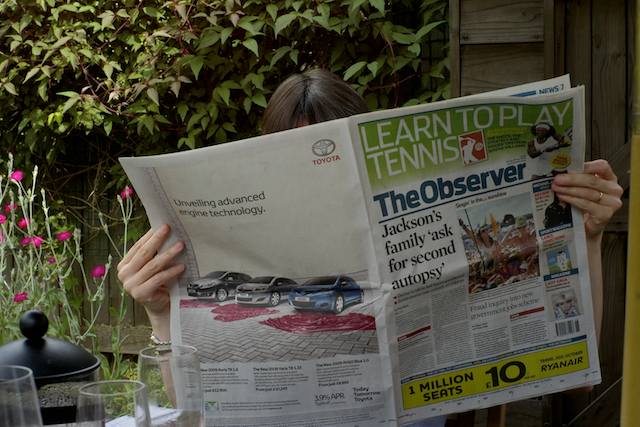
The owner of the O2 arena could face an insurance liability of up to £300m after the death of Michael Jackson, who had been scheduled to play a series of sell-out gigs starting in the summer.

AEG Live, which persuaded Jackson to stage the 50-date run at the former Millenium Dome, admitted earlier this year that it was finding it difficult to insure the This Is It performances after the initial schedule of 10 concerts grew.

Doubts over whether Jackson would be fit enough both mentally and physically to complete the extended run of gigs increased the potential insurance bill to £300m, according to a report by Reinsurance magazine in March.

Insurers were reluctant to take on such a liability and instead, the AEG chief executive Randy Phillips was reported at the time as saying that the company would be willing to “self-insure” to get the shows to go ahead.

“It’s a risk we’re willing to take to bring the King of Pop to his fans,” he said.

Admirable sentiment. But bad business decision, if true.

And how about this from ArsTechnica on the wider impact on the Net?

The news of pop icon Michael Jackson’s collapse and subsequent death sent ripples across the Web on Thursday afternoon, affecting numerous services and sparking yet another spam campaign. Twitter, Google, Facebook, various news sites, and even iTunes were practically crushed under the weight of the sudden spike in Internet traffic. The phenomenon may not be new on an individual level, but combined across services, it was truly one of the most significant in recent memory.

When news first broke that the Jackson had collapsed in his home, Twitter was immediately abuzz. There were several points when the Ars staff observed between 6,000 and 13,000 new tweets per minute mentioning Michael Jackson before Twitter began to melt down—all before anyone other than TMZ.com was reporting his death. Of course, most of us are intimately familiar with the famed Fail Whale at this point, though Twitter’s meltdown was mostly reflected in a major slowing of the service and the inability to send new tweets.

In fact, Twitter cofounder Biz Stone told the L.A. Times that the news of Jackson’s passing caused the biggest spike in tweets per second since the US Presidential Election. (Similarly, Facebook—also known as Wannabe Twitter—saw a spike in status updates that was apparently three times more than average for the site, though a spokesperson said the site remained free of performance issues.)

Google, on the other hand, began receiving so many searches for news about Jackson that it caused the search engine to believe it was under attack. The site went into self-protection mode, throwing up CAPTCHAs and malware alerts to users trying to find news. A Google spokesperson described the incident as “volcanic” compared to other major news events, confirming that there was a service slowdown for some time.

On the other hand, Rory Cellan-Jones has this:

But did the internet actually buckle? Well, there was some strain – but it seems to have come through well.

In the United States, a company called Keynote, which monitors internet performance, says popular news sites showed marked slowdowns for three hours from about 2230 BST: “The average speed for downloading news items doubled from less than four seconds to almost nine seconds,” said Shawn White from Keynote. “During the same period, the average availability of sites dropped from almost 100% to 86%.”

But guess what: in Europe overnight, there was no spike in internet traffic. Interoute, which operates Europe’s largest fibre optic voice and data network, sent me graphs (see below) showing traffic through the three key internet exchanges in Amsterdam, Frankfurt and London. At all three exchanges, traffic was either around the same as normal overnight, or, in London’s case, actually a little lower.