Firefox and State

From the transcript of Hilary Clinton’s recent open meeting with State Department staff…

MS. GREENBERG: Okay. Our next question comes from Jim Finkle:

Can you please let the staff use an alternative web browser called Firefox? I just – (applause) – I just moved to the State Department from the National Geospatial Intelligence Agency and was surprised that State doesn’t use this browser. It was approved for the entire intelligence community, so I don’t understand why State can’t use it. It’s a much safer program. Thank you. (Applause.)

SECRETARY CLINTON: Well, apparently, there’s a lot of support for this suggestion. (Laughter.) I don’t know the answer. Pat, do you know the answer? (Laughter.)

UNDER SECRETARY KENNEDY: The answer is at the moment, it’s an expense question. We can —

QUESTION: It’s free. (Laughter.)

UNDER SECRETARY KENNEDY: Nothing is free. (Laughter.) It’s a question of the resources to manage multiple systems. It is something we’re looking at. And thanks to the Secretary, there is a significant increase in the 2010 budget request that’s pending for what is called the Capital Investment Fund, by which we fund our information technology operations. With the Secretary’s continuing pushing, we’re hoping to get that increase in the Capital Investment Fund. And with those additional resources, we will be able to add multiple programs to it.

Yes, you’re correct; it’s free, but it has to be administered, the patches have to be loaded. It may seem small, but when you’re running a worldwide operation and trying to push, as the Secretary rightly said, out FOBs and other devices, you’re caught in the terrible bind of triage of trying to get the most out that you can, but knowing you can’t do everything at once.

SECRETARY CLINTON: So we will try to move toward that. When the White House was putting together the stimulus package, we were able to get money that would be spent in the United States, which was the priority, for IT and upgrading our system and expanding its reach. And this is a very high priority for me, and we will continue to push the envelope on it. I mean, Pat is right that everything does come with some cost, but we will be looking to try to see if we can extend it as quickly as possible.

It raises another issue with me. If we’re spending money on things that are not productive and useful, let us know, because there are tens of thousands of people who are using systems and office supplies and all the rest of it. The more money we can save on stuff that is not cutting edge, the more resources we’ll have to shift to do things that will give us more tools. I mean, it sounds simplistic, but one of the most common suggestions on the sounding board was having better systems to utilize supplies, paper supplies – I mean, office supplies – and be more conscious of their purchasing and their using.

And it reminded me of what I occasionally sometimes do, which I call shopping in my closet, which means opening doors and seeing what I actually already have, which I really suggest to everybody, because it’s quite enlightening. (Laughter.) And so when you go to the store and you buy, let’s say, peanut butter and you don’t realize you’ve got two jars already at the back of the shelf – I mean, that sounds simplistic, but help us save money on stuff that we shouldn’t be wasting money on, and give us the chance to manage our resources to do more things like Firefox, okay?

Yeah.
How to Start The Next War

Regular readers will know that I’m more concerned about Cyberwarfare than most of the mass media (see e.g. here). It seems that Mark Anderson shares that concern. Extract from an interesting post on his blog about reports that North Korea has been playing games in Cyberspace:

Cyber attack has moved from nuisance, to the first, and often the decisive, act of war. Can a country afford to ignore or belittle a major cyber attack? No. There is too much likelihood it is the first step in a cascade that will lead to missiles, tanks and soldiers.

I don’t mean to imply that the current attacks on the U.S., if as amateurish as we are told, are cause for going to war. But if you switch the perspectives, you see the problem: if this is NK doing its best, launched simultaneously with seven missiles pointed at the U.S., they are not just being devilishly cute. They are risking our interpretation of their mischief as a real act of war.

Indeed, I would submit that the world community is now at that stage in its development of, and dependence upon, computer systems and nets, that a well-documented and clearly sourced cyber attack would be adequate grounds, in the Security Council of the U.N., for going to war…

Africa — as seen by Richard Dowden

Informative and useful review by DianeC of Africa:altered states, ordinary miracles by Richard Dowden.

There are lots of things about this book that I liked. One was learning something new on every page. It’s a great read, combining vivid reportage with intelligent analysis. Another was the author’s refusal to generalize. Almost every chapter is about a specific country, or sub-national region, or ethnic group, or village. The stories are used to illustrate wider points, but no reader could emerge from this making bland generalizations. Any of the chapters makes a great, concise introduction to an individual country’s history and political landscape.

However, there are two quite powerful generalizations that emerge, not from being chapter subjects, but from the way they crop up in every specific example throughout the book. One is the utterly corrosive and pervasive corruption. Like Martin Meredith in The State of Africa, Dowden thinks this has its origins in colonialism, in the expectation formed by colonial rule that the state steals from the people. Between two and fourteen times the amount paid to African countries in official aid has been sent overseas to private bank accounts in London and Switzerland, he suggests. (And here’s another charge to lay at the door of the financial services industry, the bankers for whom all money is welcome, no matter what its provenance.) But unlike Meredith, he firmly blames current political leaders in Africa for betraying the hopes and promise of liberation with every bribe they take or profit they skim. In this he is in harmony with a growing chorus of critics of everyday politics in so many Africa countries – including, of course, Barack Obama.

A second theme which emerges unannounced is the damage being caused by the aid industry – and here too Dowden is adding his authoritative voice to other aid critics. This ranges from his critique of the way the agencies feed the image of helpless, starving Africa to ensure they can raise funds to pay themselves and ensure their activities continue (p7) to drawing attention to their perverse role in supporting those who committed the genocide in Rwanda in 1994 (p248)…

Accuracy?

Here’s a quote from today’s Sunday Times story about the News of the World phone hacking activities.

On Friday, Tom Watson, the former Labour minister, reflected the mood, bowling up to a journalist from a national newspaper and tugging at the reporter’s House of Commons pass. “You won’t be needing this much longer,” he grinned.

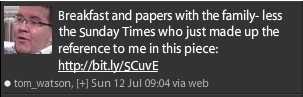
And here’s Tom Watson’s tweet on the subject:

So… whom do we believe?

Holy Catholic Ireland (contd)

My eye was caught by this story in today’s Irish Times.

The Government lost a vote in the Seanad [i.e. the second chamber of the Irish parliament] yesterday on the Defamation Bill but managed to salvage the legislation by calling for a walk-through vote which gave enough time for two missing Senators to be found.

The Government defeat came on an amendment to the Bill proposed by Senator Eugene Regan of Fine Gael proposing to delete the provision in the legislation making blasphemy a crime.

In an electronic vote whereby Senators press a button, the Government was defeated by 22 votes to 21 in the 60-member upper house.

However, Fianna Fáil whip Diarmuid Wilson immediately requested a walk-through vote which takes about 10 minutes to complete. In that period two Senators, Geraldine Feeney of Fianna Fáil and Deirdre De Búrca of the Green Party, had time to get to the chamber and the amendment was defeated by 23 votes to 22. The Bill itself was then passed by the same margin.

A Green Party spokesman said Ms De Búrca was initially absent through “a misunderstanding” while showing a trade union delegation from Colombia around Leinster House. Ms Feeney was at the dentist.

What, one wondered, was all that about? Deeper in the paper there was a rather good OpEd piece by Michael Nugent, which explained some of the background.

The Constitution says that blasphemy is an offence that shall be punishable by law. That law currently resides in the 1961 Defamation Act. Because he was repealing this Act, Ahern [Minister for Justice] said he had to pass a new blasphemy law to avoid leaving “a void”.

But this “void” was already there. In 1999, the Supreme Court found that the 1961 law was unenforceable because it did not define blasphemy. In effect, we have never had an enforceable blasphemy law under the 1937 Constitution.

After several retreats, Ahern claimed both that he had to propose this law in order to respect the Constitution, and also that he was amending it to “make it virtually impossible to get a successful prosecution”. How is that respecting the Constitution?

This type of “nod and wink” politics brings our laws, and our legislature, into disrepute. In practice, we cannot be certain how our courts will interpret unnecessary laws, as we discovered after the abortion referendum.

Also, the matter might be taken out of our hands. In 2005, the Greek courts found a book of cartoons to be blasphemous, and issued a European arrest warrant for the Austrian cartoonist who drew them. This can be done if the same crime exists in both jurisdictions.

Instead, we should remove the blasphemy reference from the Constitution by referendum. Many independent bodies have advised this, including the Council of Europe in a report last year co-written by the director general of the Irish Attorney General.

We could do this on October 2nd, the same day as the Lisbon referendum. It could be the first step towards gradually building an ethical and secular Ireland. We should be removing all of the 1930s religious references from the Constitution, not legislating to enforce them.

Hmmm… It’s a long time since I read the said Constitution, so I dug it out. Here’s an extract from the preamble:

In the Name of the Most Holy Trinity, from Whom is all authority and to Whom, as our final end, all actions both of men and States must be referred,

We, the people of Éire, Humbly acknowledging all our obligations to our Divine Lord, Jesus Christ, Who sustained our fathers through centuries of trial,…

Article 6 states:

All powers of government, legislative, executive and judicial, derive, under God, from the people, whose right it is to designate the rulers of the State and, in final appeal, to decide all questions of national policy, according to the requirements of the common good.

Article 40 states, in part:

The publication or utterance of blasphemous, seditious, or indecent matter
is an offence which shall be punishable in accordance with law.

Article 41 is even wierder:

1° The State recognises the Family as the natural primary and fundamental unit group of Society, and as a moral institution possessing inalienable and imprescriptible rights, antecedent and superior to all positive law.

2° The State, therefore, guarantees to protect the Family in its constitution and authority, as the necessary basis of social order and as indispensable to the welfare of the Nation and the State.

1° In particular, the State recognises that by her life within the home, woman gives to the State a support without which the common good cannot be achieved.

2° The State shall, therefore, endeavour to ensure that mothers shall not be obliged by economic necessity to engage in labour to the neglect of their duties in the home.

3. 1° The State pledges itself to guard with special care the institution of Marriage, on which the Family is founded, and to protect it against attack.

Article 44 states:

The State acknowledges that the homage of public worship is due to Almighty God. It shall hold His Name in reverence, and shall respect and honour religion.

It’s enough to make one feel sympathetic towards the ‘Reverend’ Ian Paisley. This isn’t the constitution of a modern, pluralist, secular state, but of a priest-ridden, superstitious, misogynistic and backward statelet.

On this day…

… in 1940 the Blitz began. The Luftwaffe began bombing London and other British cities. By late October, the ‘Battle of Britain’ was over. The Germans were unable to sustain the losses because of RAF fighter opposition. I was reminded of this today as I was passing the Duxford war museum earlier on the M11 and suddenly three WW2 fighters flying in close formation appeared and looped the loop. Magical.

The Peter Principle — and how to avoid it

In the mid-1980s I learned everything one needs to know in order to understand large organisations. I was in Aldershot, Britain’s biggest army town, having a pee in the toilet of a large pub patronised mainly by army squaddies. As I stood there relieving myself I noticed a graffito at eye level. “AT THIS MOMENT”, it read, “YOU ARE THE ONLY MAN IN THE BRITISH ARMY WHO KNOWS WHAT HE’S DOING.”

The ‘Peter Principle’ expresses this in slightly less charged language. In the late 1960s the Canadian psychologist Laurence J. Peter advanced the principle that “Every new member in a hierarchical organization climbs the hierarchy until he/she reaches his/her level of maximum incompetence”.

Now three physicists have found a way of simulating this effect using agent-based simulation methods. “Despite its apparent unreasonableness”, they write, “such a principle would realistically act in any organization where the way of promotion rewards the best members and where the competence at their new level in the hierarchical structure does not depend on the competence they had at the previous level, usually because the tasks of the levels are very different between each other”. Their simulations show that if the latter two features actually hold in a given model of an organization with a hierarchical structure, then not only is the Peter principle ununavoidable, but it yields in turn a significant reduction of the global efficiency of the organization.

So how to avoid it? The simulations suggest that in order to avoid such an effect the best ways for improving the efficiency of a given organization are (a) either to promote each time an agent at random or (b) to promote randomly the best and the worst members in terms of competence.

Hooray! At last I understand what’s been going on.

Robin Mason RIP

Robin Mason, who was one of my best academic colleagues, and one of the nicest mavericks I’ve known, died recently. There’s a nice obit in today’s Guardian.

Born in Winnipeg, Canada, Mason completed her first degree at Toronto University and her master’s at Madison, Wisconsin. She was a free spirit, best exemplified by stories recounted by colleagues. One remembers her swimming across a very chilly Norwegian lake during a break in an international conference programme. Her colleagues sat anxiously on the shore, wrapped in warm jackets, while Mason swam into the distance and, so her colleagues thought, into mortal danger of hypothermia. They were greatly relieved when she emerged again, dripping and smiling.

Much loved by her colleagues, she was known as a maverick who didn’t give much regard to what she saw as unnecessary administration. But she struck the right balance between scholarly activity, practical application, and having fun with new ideas. Her legacy will continue to inform educational technologists in the future.

A Yorkshire genius

We’ve been watching a terrific BBC film (in Alan Yentob’s Imagine series) about David Hockney’s return to his Yorkshire roots. It’s an entrancing movie (still on iPlayer here.) It’s complemented by this nice Spectator piece, A Yorkshire genius in love with his iPhone.

Landscape and nature dominate Hockney’s life these days. In mid-May, I arranged to call in with my wife to see him for lunch. The exact timing was decided only after a lengthy conversation by text, the point to be determined being when the hawthorn would come into blossom. As soon as it was out, he would want to be painting it all day, every day. So a definite invitation could only be made after the progress of buds in the local hedgerows was examined. Day after day for several years, in summer heat and freezing winter winds, Hockney has set up a canvas beside some quiet road. The film catches him at work, putting on the paint. At one point a local driver stops to remark to Jean-Pierre — in Yorkshire so broad that the BBC has resorted to subtitles — ‘Tell him when he’s finished we’ve got some decorating needs doing at t’pub.’ Hockney himself is as unmoved as Van Gogh was when heckled by the youth of Arles. He carries on calmly depicting the rolling fields…

Thanks to Gerard for spotting the Spectator piece.

Torygraph returns to business as usual

Lest we get too carried away by admiration of the Daily Telegraph‘s role in exposing the hypocrisy and corruption of MPs, it’s worth consulting Ben Goldacre’s column in today’s Guardian.

He focussed on a report in the Torygraph which appeared under the headline “Women who dress provocatively more likely to be raped, claim scientists”. The report begins:

Psychologists found that all three factors had a bearing on how far men were likely to go to take advantage of the opposite sex.

They found that the skimpier the dress and the more flirtatious the woman, the less likely a suitor was to take no for an answer.

But, contrary to popular opinion, alcohol consumption did dampen their ardour with many men claiming that they were put off by a woman who was drunk.

Sophia Shaw at the University of Leicester said that men showed a “surprising” propensity to coerce women into sex, especially those that were considered promiscuous.

Ben phoned Sophia Shaw to see if the story was an accurate account of her research. She told him that

every single one of the first four statements made by the Telegraph was an unambiguous, incorrect, misrepresentation of her findings.

Women who drink alcohol, wear short skirts and are outgoing are more likely to be raped? “This is completely inaccurate,” Shaw said. “We found no difference whatsoever. The alcohol thing is also completely wrong: if anything, we found that men reported they were willing to go further with women who are completely sober.”

And what about the Telegraph’s next claim, or rather, the paper’s reassuringly objective assertion, that it is scientists who claim that women who dress provocatively are more likely to be raped?

“We have found that people will go slightly further with women who are provocatively dressed, but this result is not statistically significant. Basically you can’t say that’s an effect, it could easily be the play of chance. I told the journalist it isn’t one of our main findings, you can’t say that. It’s not significant, which is why we’re not reporting it in our main analysis.”

Ms Shaw went on to say:

“When I saw the article my heart sank, and it made me really angry, given how sensitive this subject is. To be making claims like the Telegraph did, in my name, places all the blame on women, which is not what we were doing at all. I just felt really angry about how wrong they’d got this study.”

Ben reports that since he started sniffing around, and Shaw complained, the Telegraph has changed the online copy of the article. But “there has been no formal correction, and in any case, it remains inaccurate”.

Now… Of course this is the kind of thing that happens every day in much of the mainstream media, so we’re rather resigned to it — especially in reporting any aspect of scientific or scholarly work. But it’s conveniently overlooked by many of the most vociferous print-based critics of online news, who are forever asking rhetorical questions about how much fact-checking is done by pyjama-clad bloggers. Actually, in this particular case, a blogged account as factually inaccurate as this Torygraph story would have been picked up and demolished within minutes in the blogosphere. So let’s have less cant from the processed-woodpulp brigade about the intrinsic superiority of their trade.

Footnote: The byline under the Torygraph report is that of Richard Alleyne, who is billed as the newspaper’s “Science Correspondent”. According to the Press Gazette, he’s been in post since Roger Highfield left in October 2008 to become Editor of New Scientist. Before that, Alleyne was a general news reporter. Maybe he should be sent on a course to develop his listening skills.