How Waterstone’s killed bookselling

Excellent (and somewhat depressing) Guardian piece by Stuart Jeffries on what happened to Waterstone’s.

Waterstone's has embraced capitalism’s logic firmly. Even in this Gower Street branch, with its five miles of bookshelves at the heart of London’s university quarter and in an area denser with literary heritage than perhaps any in the world, discounted piles of Leona Lewis biographies and Frankie Boyle’s My Shit Life So Far sit on the tables with the latest JM Coetzee. This lunchtime, the three-for-two tables are ringed by shoppers clutching two books and wondering if they can find a freebie worth reading. Here on the ground floor, the discounting of book prices is so ferocious that if you leave having paid the RRP you feel a right mug.

“They simply treat books as a commodity,” says Nicholas Spice, publisher of the London Review of Books, and one of the chain’s sternest critics. “There’s no sentiment to it. If it’s celebrity biographies that are going to sell, then that’s what they’ll focus on. They’re not looking at it from a cultural perspective.”

What does he expect? It’s a public company, driven by the need to maximise “shareholder value”.

Thanks to Lorcan Dempsey for the link.

Berlin Rock

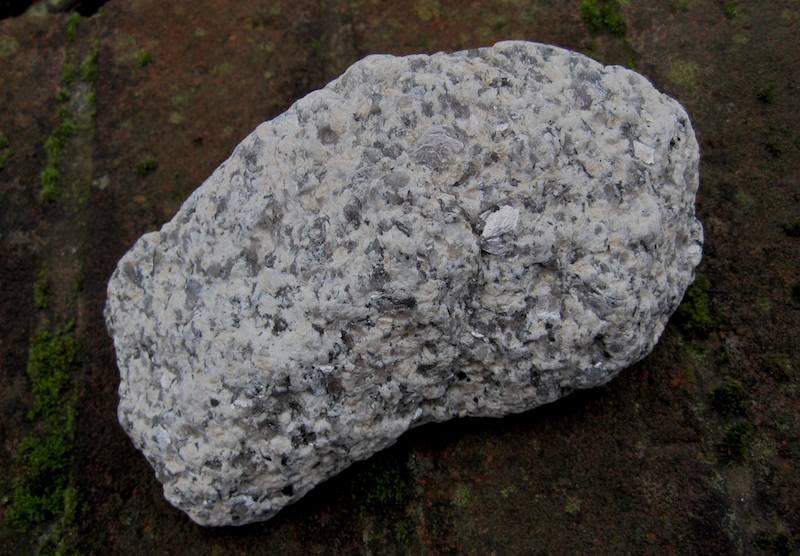
This is my piece of the Berlin Wall. It normally sits on the windowsill of my study. I would like to have been in Berlin yesterday, to celebrate the 20th anniversary of the crumbling of the wall, but had carelessly allowed my passport to expire and was in London getting a new one. Still…

One thing really pleased me, though — that Mikhail Gorbachev was there, and was properly honoured by Angela Merkel. If the story of the disintegration of the original ‘Evil Empire’ has a single hero, then it’s Gorby. “His achievement”, commented the Economist last week,

“was not in making great intellectual discoveries, but in spelling out publicly what people had said and thought in their Moscow kitchens for years: that people in the West lived better than in the Soviet Union, that the Soviet economy was inadequate and that ‘we can’t go on living like this any more.’ This was common sense. Saying it openly, however, was a breakthrough.”

This triggers a rueful thought: Gorbachev was a lot more perceptive than yours truly. In 1977-78 I was a Research Fellow at a Dutch university. One of my fellow academic visitors was a Soviet scientist. He was a Vice-President of the Soviet Academy of Sciences, which meant that in those days he was a Very Big Cheese indeed. (Once, with a single telephone call, he had several seats cleared from an overbooked Aeroflot flight to make space for a friend of mine who was visiting Georgia.) Before he returned to Moscow, he and I had a coffee together. I asked him whether there was anything he would miss from his Dutch sojourn when he returned home. “Oh yes”, he said, “the photocopier”.

“Eh?” I replied, baffled.

He went on to explain that he regularly spent two days a week in periodical libraries back home copying out extracts from scientific papers in longhand. “You see”, he went on, “in my country photocopiers are regarded as devices that need to be strictly controlled. They can be publishing machines for samizdat.”

At that point I ought to have twigged that the Soviet system was doomed. If it couldn’t handle routine information technology like photocopying (and FAX) then it would be unable to modernise. So it was only a matter of time before it crumbled.

As I say, I ought to have spotted that. But it was only years later that the significance of the conversation really dawned on me. Gorbachev’s genius was that he saw the problem, understood what it meant — and had the courage to state the obvious. That, and his refusal to use force to save Honecker in East Germany, were the critical factors in the remaking of European history that took place twenty years ago. But he’s been effectively written out of the story. Which, I suppose, was predictable. History, after all, is usually written by the victors.

Here comes the Sun

Apropos my musings about the evocative power of the Beatles’ Here Comes the Sun, this wonderful little chap emerged just before dawn on Saturday morning, yelling loudly to make sure that everyone knew he’d arrived. The funny thing was that we had been told by the ultrasound folks to expect a girl.

He’s my first grandchild, and his arrival has been the most wonderful, moving experience. Everything people say about it is true. He also seems to me to be extraordinarily handsome. Note the rakish angle at which he wears his hat. And the way he is already fashionably bored by all the fuss going on around him.

The Wall: 20 Years Later

This is wonderful — a NYT photo-feature to mark the anniversary of the fall of the Berlin Wall. It’s a set of photographs of the same locations taken in 2009 and 1989. You can wipe from one to the other. The one I like best is the view of the Reichstag, but theyt’re all terrific. Sobering and moving too.

Digger delays his charge

Well, well. It seems that the Digger has run into some difficulties.

Rupert Murdoch admitted last night that his plans for News Corp newspapers to begin charging online by June next year, might have to be postponed.

To date the media mogul has been the most proactive publisher in the move to charge for online news, consistently repeating the mantra that: “Quality journalism is not cheap and an industry that gives away its content is simply cannibalizing its ability to produce good reporting.”

Tsk, tsk. Poor project management.

Sunlight memories

Just listening to Jerry Springer on Desert Island Discs One of his choices is Here Comes the Sun by the Beatles. He chose it because it was played as his wife came down the aisle at their wedding. As the track plays I am suddenly transported back to the moment, forty years ago, when I first heard the song. It was a glorious, crisp Autumn morning at the beginning of my second year in Cambridge. The sun was flooding in through the bay window of the College flat that Carol and I and our first child then shared. I had just finished constructing a crude DIY Hi-Fi system. A few days earlier we had purchased the album, but hadn’t been able to listen to it. So I put it on the turntable and, with bated breath, switched on the amp. And there it was. I thought it was such a beautiful, optimistic, moving song.

It still is. In a few days, my first grandchild will be born. And when she arrives I will play it then too. Strange how music reaches the places that other media cannot reach.

No comment

Spotted in a leafy Cambridge road this morning. Imagine what you’d get if you Googled them.

LATER: I just did that (i.e. a Google search for “erection specialists Cambridge”) and found that other photographers have spotted them too — for example here and here. But at least the ‘sponsored links’ were exactly what you’d expect.

Perfect timing

Emma Freud told an interesting story on the radio this morning about her father, Clement. He had, she said, “a perfect death”. On the day in question, he’d been to the races (at Exeter), had won on the horses, had a good lunch with his “second best friend” (apparently he was punctilious about ranking his friendships), and was writing his column (about the Exeter meeting) for a racing newspaper when he dropped dead in mid-sentence. The next day, Emma and her Mum woke up his computer and found that the last words he’d written were “In God’s good time…”.

An end to wrap-rage?

Ever bought an SD or Compact Flash card and entertained fantasies about using the scissors which has just nearly sliced your thumb off to slit the throat of the guy who designed the packaging? Join the club. But help may be at hand. When I logged into Amazon.co.uk this morning, I found this:

It seems they’re doing deals with suppliers to create “frustration-free packaging”. About time too.