
Deux-Chevaux de luxe

Beautiful example of French ingenuity.
Quote of the Day
”Tolerance becomes a crime when applied to evil.”
- Thomas Mann
Musical alternative to the morning’s radio news
Wagner | Tristan und Isolde, Act III: Liebestod| Karajan and the Berliner Phil
As Groucho Marx might have observed, I don’t like the look of Wagner, but I sure like the noise he makes.
Long Read of the Day
3 Lessons on Writing from Joan Didion’s Notes
This essay by Jillian Hess will be interesting to anyone who is interested in the writing process and/or the work of Joan Didion. I tick both of those boxes, which is why I liked it.
This is how Didion defines a writer: “a person whose most absorbed and passionate hours are spent arranging words on pieces of paper.”1 Anyone who has read Didion’s writing will not be surprised by this definition—her prose could only have been written by a person who passionately arranged words, hour after hour, day after day.
Before I went to see Joan Didion’s papers at the New York Public Library, I read all the reports claiming the archive gives us new insight into Didion’s writing process. Of course, I wanted more information—I wanted to know more of the nitty-gritty details regarding how Didion’s worked. So, I made an appointment and read through her papers. As I did so, I kept my attention trained on her methods so that I could write the report I wanted to read. And now here it is!
TL;DR summary. Three principles:
- Collect Fragments
- Transfer Notes to Different Formats
- The Work is Never Perfect
Read on for detail. Hope you enjoy it.
Books, etc.
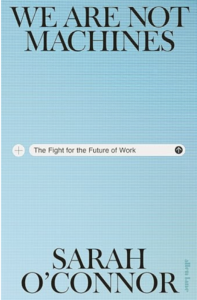
I came on this after listening to David Runciman’s conversation with its author on his Past, Present, Future podcast. Sarah O’Connor is a distinguished FT journalist who has been writing about work for decades and is the best person imaginable to ask about the likely impact(s) of AI on work. Accordingly, I bought a copy of her book and started to read. And am already chastened by how shallow my thinking had been on the subject. Ignorance is not always bliss.
‘Muskism’ is a new word to ask an AI about – but don’t expect to get a straight answer
My latest Observer column:
What is Elon Musk? Genius, meme lord relentlessly inflating tech bubbles (SpaceX’s recent record-smashing initial public offering), raver about population collapse and cheerleader for far-right conspiracy theories? All of the above, and more. But focusing on Musk as an individual is a mistake, say Quinn Slobodian and Ben Tarnoff in their recent book, as it misses the big question about him: what does he really stand for?
Their answer is that Musk is the spiritual heir of Henry Ford in two ways. One, is that Ford invented a revolutionary way of manufacturing cars, and Musk pioneered a new way of making the next generation of them: electric vehicles. But their key insight comes from recognising that Ford not only made cars. He also spawned a new kind of capitalism: what we now call “Fordism”.
This combined mass production with mass consumption and became the operating system of 20th-century socioeconomic life. Musk, they claim, is spawning something on the same scale. They call it “Muskism” (hence their book’s title, Muskism: A Guide for the Perplexed.)
For a downloadable pdf version, see here.
Linkblog
Something I noticed, while drinking from the Internet firehose.
- The Manhoff Archives
Major Martin Manhoff spent more than two years in the Soviet Union in the early 1950s, serving as assistant army attaché at the U.S. Embassy, which was located just off Red Square at the beginning of his time in Moscow.
He took full advantage of his post, using his gifted photographic eye to capture hundreds of images of everyday life in Moscow and across the U.S.S.R.
When he left the country in 1954 amid accusations of espionage, Major Manhoff took with him reels of 16 millimeter film and hundreds of color slides and negatives he shot during his travels – including of one of the Soviet Union’s pivotal events, Josef Stalin’s funeral.
But after his return to the United States, the trove of rare images lay forgotten, stored in cardboard boxes in a former auto body shop in the Pacific Northwest until its discovery by a Seattle-based historian.
Absolutely fascinating archive. It had a real resonance for us because my wife’s father was the British Embassy doctor at the same time as Manhoff and would have been a witness to some of the same scenes.
This Blog is also available as an email three days a week. If you think that might suit you better, why not subscribe? One email on Mondays, Wednesdays and Fridays delivered to your inbox at 5am UK time. It’s free, and you can always unsubscribe if you conclude your inbox is full enough already!