
Colosseus

In the end, electrification is the best way to slow climate change.
Quote of the Day
”I love criticism just so long as it’s unqualified praise.”
* Noel Coward
Musical alternative to the morning’s radio news
Crosby, Stills & Nash with James Taylor and Emmylou Harris | ”Teach Your Children”
Long Read of the Day
The Reality of AI and the Crisis of Meaning
At the moment I’m spending a lot of time and energy on trying to find ways of talking about AI to people and groups who are puzzled, excited or fearful about it. Because the public discourse about the technology is so chaotic, this isn’t easy. What Henry Farrell calls “the AI Fight Club” makes it difficult to extract a sensible signal from the noise, or even to steer a rational course through the pandemonium.
All of which is a long-winded way of explaining why I was struck by this link sent by a good friend of mine. It’s to a speech given by Matthew Harvey Sanders to — of all things — a conference of the Catholic bishops of England and Wales.
Here’s a sample:
Just one week ago — the company Anthropic released a new frontier model called Claude Opus 4.7. It has a one-million-token context window, which means it can hold something like a full-length theological library in its working memory at once. It scores close to eighty-eight percent on a benchmark that measures autonomous software engineering. On another benchmark, called Humanity’s Last Exam — a test deliberately built from doctoral-level questions across dozens of fields, designed to be a generational barrier — this model is now clearing more than half of the questions with the right tools. Eighteen months ago, that benchmark was considered unreachable. Last week, it was cleared.
The same lab announced, earlier this month, something that makes the release of Opus 4.7 the second most important item of news from one company in a single fortnight. They’ve been running a project called Glasswing. The partners include Amazon, Apple, Broadcom, Cisco, Google, JPMorgan Chase, the Linux Foundation, Microsoft, NVIDIA, and Palo Alto Networks. The reason those partners are in the room is that Anthropic has trained an unreleased frontier model — they’re calling it Mythos Preview — that has autonomously discovered thousands of previously unknown security flaws in every major operating system and every major web browser in the world. One flaw it found in OpenBSD — one of the most security-hardened operating systems ever built — had been there, unnoticed, for twenty-seven years. Another, in the video software that sits inside countless consumer devices, had been missed by five million automated tests. A single model found it.
I want you to sit with what that means, pastorally. The digital civilisation in which your people live, bank, work, and confide their secrets is more fragile than any of them knows. And it’s now being examined — for the first time in history — by machines more capable than the best human engineers. The bishops of England and Wales aren’t going to be patching operating systems. But you’re going to be pastoring a people who live inside a digital infrastructure that the experts themselves no longer fully understand, and whose custody has passed into the hands of a very small number of companies on a very specific coastline. Keep that in the back of your mind. We’ll come back to it before the hour is done…
Worth you time.
Books, etc.
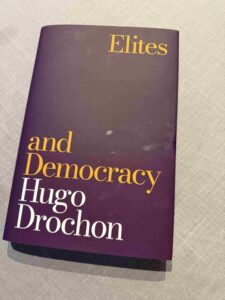
I had lunch yesterday with Hugo Drochon, a friend and former colleague who now teaches political history at Nottingham, and he suddenly pulled this out of his briefcase, signed it and handed it over. It’s his new book about the unpalatable reality that liberal democracies have always been ruled by elites, which of course is what populists complain about. But when they gain power it turns out that they have their own elites who run things. Just think of Pete Hegseth, Stephen Miller and the other creeps currently running the US.
Hugo argues that democracy is more accurately and usefully understood as a perpetual struggle among competing elites and that real political change only comes from the interaction between social movements and elite political institutions such as parties. I think the aim of the book is to lay the groundwork for a theory of ‘dynamic democracy’ as an ongoing process of challenging elite rule, which sounds depressing enough to be realistic. I’m only on Chapter One, though, so hopefully I’m wrong.
This Blog is also available as an email three days a week. If you think that might suit you better, why not subscribe? One email on Mondays, Wednesdays and Fridays delivered to your inbox at 5am UK time. It’s free, and you can always unsubscribe if you conclude your inbox is full enough already!