
Fascinating research using network analysis of email communications.
CAMBRIDGE, Mass. — Political thrillers that portray a “web of corruption” get it all wrong, at least according to an analysis of e-mails between Enron employees. The flow of the famously corrupt corporation’s electronic missives suggests that dirty dealings tend to transpire through a sparse, wheel-and-spoke network rather than a highly connected web.
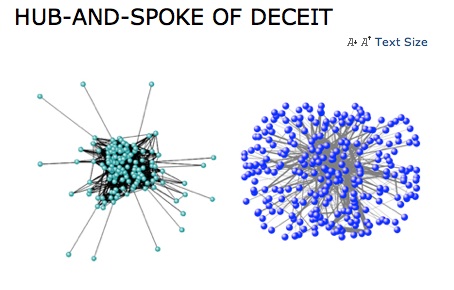
Employees who were engaged in both legitimate and shady projects at the company conveyed information much differently when their dealings were illicit, organizational theorist Brandy Aven of Carnegie Mellon University in Pittsburgh reported June 1 at an MIT workshop on social networks. The distinction is visible in the network of e-mails among employees, which takes the shape of a wheel with a central hub and isolated spokes when content is corrupt, rather than a highly connected net of exchanges.
In the chart, the network of email communications about a corrupt project came out looking like the left-hand graph.
So network analysis tools are useful in forensic examination of communications. But so also are less sophisticated tools. Prosecutors in a recent big insider trading investigation in New York found that a key phrase to look for in email communications was “phone me”.
 . If you haven’t got time to read it, then his TED talk is a pretty good summary. He covers some of the same ground as Cass Sunstein did in
  . This is a worrying and under-discussed unintended consequence of what seems like a useful affordance of networked technology. And ultimately it’s about politics.