… in 1935 T.E. Lawrence died after being injured in a motorbike crash. There was an interesting item on BBC Radio 4’s Today programme claiming that both US and UK troops in Iraq are reading Seven Pillars of Wisdom as a guide to Arab culture. (And no, I did not make that up!) It’s a bit like Tony Blair speed-reading the Koran after 9/11.
Category Archives: Asides
Reboot, reboot I say!
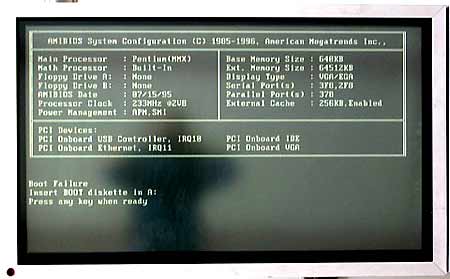
Passing through Cambridge station the other day, Alan Jackson of AidWorld noticed an interesting malfunction.

Normally, it’s the central monitor that is displaying the Blue Screen of Death. This time it was the left-hand screen, displaying a prompt well known to those aged 50 and over! Ah, the days of booting from floppies… Don’t think my kids have ever used one.
The new gender gap?
Why is it that only 4% of legally downloaded music is being bought by women? Interesting Guardian report by Natalie Hanman.
On not believing everything you read on the Web
Last week, George Monbiot wrote a fascinating column in the Guardian. It opened thus:
On April 16, New Scientist published a letter from the famous botanist David Bellamy. Many of the world’s glaciers, he claimed, “are not shrinking but in fact are growing … 555 of all the 625 glaciers under observation by the World Glacier Monitoring Service in Zurich, Switzerland, have been growing since 1980”. His letter was instantly taken up by climate change deniers. And it began to worry me. What if Bellamy was right?
So he telephoned the World Glacier Monitoring Service and read out Bellamy’s letter to them.
I don’t think the response would have been published in Nature, but it had the scientific virtue of clarity: “This is complete bullshit.” A few hours later, they sent me an email: “Despite his scientific reputation, he makes all the mistakes that are possible.” He had cited data that was simply false, he had failed to provide references, he had completely misunderstood the scientific context and neglected current scientific literature. The latest studies show unequivocally that most of the world’s glaciers are retreating.
So where had Bellamy got his numbers from? Read George’s article for the grisly details, but the answer, in a nutshell, is that they came from websites published by a number of fruitcakes who are into denial about global warming. The article is a salutary warning to anyone who believes something on the grounds that they saw it on the Net. It should be required reading for every teacher who tells pupils to “look it up on the Web”.
Never buy graph paper again!
What a great idea — Free Online Graph Paper — in PDF format.
A 7-point plan to save the newspaper industry
Michael Kinsley, writing about decline and fall.
Some evil force is causing people to stop reading newspapers! Newspaper circulation figures, which had been drifting decorously downward for years, have started to plummet. At the current rate of decline, the last newspaper subscriber will hang up on a renewal phone call that interrupts dinner on Oct. 17, 2016. And then it will be over.
Among his recommendations to save the industry is that the government should establish
a program of newspaper circulation supports. These would be similar to the agricultural price supports that have preserved a treasured American lifestyle (working from dawn to dusk seven days a week, except for a few brief hours a day down at the diner complaining about big government and welfare chiselers). By paying newspaper publishers not to publish newspapers, the government can reduce the dangerous excess supply and preserve the beloved journalistic lifestyle (drinking at lunch, ruining the reputations of innocent Republican politicians and filling out expense reports).
He also proposes the establishment of a Strategic Newspaper Reserve.
As with the Strategic Petroleum Reserve, the government would buy vast quantities of newspapers on the open market and store them somewhere for a rainy day (when they can be delivered sopping wet, as the newspaper industry prefers whenever possible). One possible location for the reserve might be my mother’s apartment, where there are already neat piles of newspapers dating back to Watergate that she is going to get to soon. (If you go to inspect the reserve, please don’t tell her how the 2000 election came out. She wants to be surprised.)
Lovely stuff. Reminds me of the young Michael Frayn.
On this day…
… in 1994, South Africa’s newly elected parliament chose Nelson Mandela to be the country’s first black president.
Democracy,…
…said Churchill, is the worst form of government — except for all the others. I suppose I should be more cynical, but for me there’s always a magic about a general election. It’s the idea of a society collectively making up its mind — Hobbes’s Leviathan in reflective mood.
I voted at lunchtime today. It was a beautifully sunny day. The polling station was the village hall. I was the only voter about at that time of day (most people hereabouts seem to vote either in the morning or after work). Later on, I drove through some other villages, all basking in the sunshine. People were going about their daily business. But everyone I know has voted. And nobody knows yet (this is written at 9.17 pm) what they have decided — though the news media are full of clamorous predictions.
In about three hours we will have some idea how it’s gone. But, despite the tawdriness of some of the campaigning, this democracy is a wonderful thing, and something that we take too easily for granted. I remember wondering, as I watched news footage of people queuing to vote in Iraq a few months ago, how many of us would vote if doing so was dangerous. Or would we value our freedom more if it were threatened by thugs, terrorists and armed bigots?
The date!
Just realised (from writing a cheque) that today is 05-05-05. When I mentioned this to the kids, they looked at me pityingly. I know that look: it says “Poor Dad: he’s quite cool but a bit slow on the uptake”. Er, they’re right.
The flip side
I’ve installed ‘Tiger’ — code for version 10.4 of Mac OS X on two of our home machines, and the installation went just fine and both computers are happily chuntering away. (I’m too rattled by Quentin’s experience to entrust my PowerBook to it yet.) One of the nice things about the new version is ‘Spotlight’ — an amazing desktop search program that indexes the entire contents of your hard drive and finds things instantly. But there’s an unintended side-effect of this — neatly captured in a wry email from a friend:
There is a downside to everything. This is the one for Spotlight: suddenly you see how much you have forgotten. I was busy writing a lecture. Looked for something on Spotlight. And discovered that I had written something very similar a year ago. Completely forgotten. Shocking.
Well, yes. But isn’t it better to be reminded? Besides, great things come from faulty memories. Tim Berners-Lee was motivated to invent the Web partly because he had such a terrible memory and kept losing track of information! Full story on page 233 of this. (Health warning: shameless plug!)