Scientists harness the power of pee

Ahem. No sniggering at the back. This is a serious subject.

A urine powered battery the size of a credit card has been invented by Singapore researchers.

A drop of urine generates 1.5 volts, the equivalent of one AA battery, says Dr Ki Bang Lee of the Institute of Bioengineering and Nanotechnology. He says the technology could provide a disposable power source for electronic diagnostic devices that test urine and other body fluids for diseases like diabetes.

These currently need lithium batteries or external power sources. But with this system, the body fluid being tested could power the unit itself.

Lee, who reports the new battery in the latest Journal of Micromechanics and Microengineering, says a smaller version could potentially power mobile phones in emergencies.

The battery is made of a layer of filter paper steeped in copper chloride sandwiched between strips of magnesium and copper, then laminated in plastic.

It’s activated when a drop of urine is placed on the battery. The urine soaks through the paper providing the necessary conditions to generate electricity. The magnesium acts as the battery’s anode, shedding its electrons, while the copper chloride acts as the cathode, gathering them up.

This electron flow delivers power greater than 1.5 milliwatts, the researchers say.

Coming soon: electricity generation from hot air emitted by University Committees.

Thanks to Quentin for the link.
Bush’s hydrogen fantasies: “forever far off”

From a Technology Review interview with Ernest J. Moniz, an MIT physicist and former Under Secretary of the U.S. Department of Energy…

Tech Review: President Bush has been talking a lot about hydrogen. Is the hydrogen economy the answer?

Moniz: There are many here on campus who have written about it — John Deutch had a Science paper about it and John Heywood has testified to the Congress about it and has written several reports with colleagues. The hydrogen transportation economy looks to us to be very, very challenging, very far off. And “very far off” could mean: forever far off. Given the cost barriers that must be overcome with fuel cells, the challenges for storing hydrogen onboard, and the infrastructure problems for delivering hydrogen — it makes one wonder whether alternative technologies, which require far less disruption to the infrastructure and are far less of a cost challenge, but are highly efficient, don’t essentially accomplish the same goal…

The World Cup script

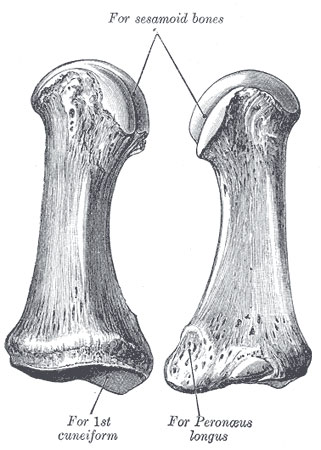
The current hysteria about the broken metatarsal of Wayne Rooney (see helpful illustration above) reminds one that world cup hysteria in the British media is running true to form. It goes like this:

  • First comes the (cruel and unnatural) encouragement of hopes that England might actually win the cup.
  • Next follows the crushing disappointment of the team’s plucky but abysmal performance in the actual tournament.
  • Then comes the vicious aftermath in which the tabloids turn on the architects of the disaster, i.e. managers, players, officials — in short, anyone but themselves.
  • The one thing missing from the time-honoured script is likely to be English football hooligans, who were once world champions at their sport, but are now apparently eclipsed by Polish thugs. Sigh. And to think that this country once had an Empire on which the sun never set.

    I think you turn left after Afghanistan

    WASHINGTON (Reuters) – Most American young people can’t find Iraq on a map, even though U.S. troops have been there for more than three years, according to a new geographic literacy study released on Tuesday.

    Fewer than 4 in 10 Americans aged 18-24 in a survey could place Iraq on an unlabeled map of the Middle East, a study conducted for National Geographic found. Only about one-quarter of respondents could find Iran and Israel on the same map.

    Sixty-nine percent of young people picked out China on a map of Asia, but only about half could find India and Japan and only 12 percent correctly located Afghanistan.

    [Link] via Truthdig.

    Who fought the law?

    My oblique reference to the Grateful Dead spurred a flood of erudite emails from readers questioning the accuracy of linking the band with the song I fought the law but the law won. In fact the song has a very interesting history — see the excellent Wikepedia entry about it. It’s been recorded by numerous bands, including the Clash and Green Day. But my favourite rendition is the Grateful Dead’s, because they sing it as though they had indeed fought losing battles with law enforcement agencies, possibly in relation to narcotic substances. Apple cheekily used the Green Day version in their SuperBowl ad for iTunes.

    So who’s making the money out of Web 2.0?

    Bandwidth providers, says Nicholas Carr…

    The way the Web 1.0 dot-com pioneers used pricey computer gear, the Web 2.0 digital-media pioneers use bandwidth. They devour huge gobs of it. YouTube, Forbes’s Dan Frommer writes, is probably burning through a million bucks a month in bandwidth costs, a number that’s going up as rapidly as its traffic. Follow the money. In this case, as Frommer reports, the trail will lead you to Limelight Networks, which YouTube uses to stream all that user-generated content – like 200 terabytes a day – back to us users. Once again, it looks like it’s the suppliers – in this case, the content delivery networks – that are positioned to be the most reliable money-makers as more and more investment pours into the creation of our vaster, user-generated wasteland.

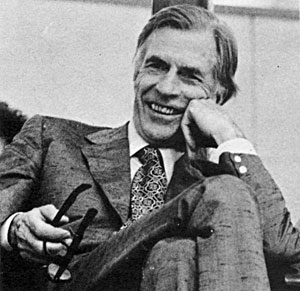
    John Kenneth Galbraith…

    … has died, at the ripe old age of 97.

    He was the person who first awakened my interest in economics. I read The Affluent Society as a teenager and drew from it the idea that economics might actually be an interesting and relevant subject. (Later acquaintanceship with professional economists cured me of that illusion.) He had a wonderful, elegant, laconic style — he wrote the way Macaulay would have written if he had been tall (JKG was 6’8″ and drew an innate sense of superiority from the fact that he always found himself looking down on people — even the President of the US whom he served as Ambassador to India.) My guess is that most professional economists loathed him. I met him once — when he was a Visiting Professor in Cambridge and a Fellow of Trinity. I never go to Ireland without thinking of his phrase “private affluence, public squalor”. Mixed obits in the NYT, the Guardian and The Times.

    Limbaugh Arrested on Prescription Drug Charges

    From an AP report carried on Truthdig…

    The Palm Beach County, Florida, sheriff’s Office says Rush Limbaugh has been arrested on prescription fraud charges.

    Limbaugh turned himself into authorities on a warrant issued by the state attorney’s office, said agency spokesperson Teri Barbera.

    The conservative radio commentator came into the jail about 4 p.m with his attorney, Roy Black, and was released an hour later on $3,000 bail.

    The warrant was for fraud to conceal information to obtain prescription. Barbera said.

    Leopards don’t change their spots. Limbaugh was investigated in 2003 for a similar offence.