A ‘Gold Standard’ in indulgences

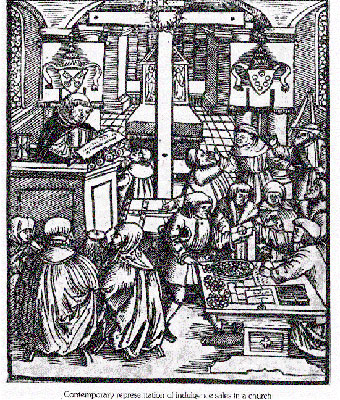
The Reformation was sparked by Martin Luther’s revolt against the corrupt sale of ‘indulgences’ by the Catholic church. (An indulgence was the remission by the pope of the punishment in purgatory that was due for sins even after absolution.) The basic idea was that affluent sinners could purchase remission from the church’s salesforce. (See illustration, which shows the business in action.) It was a great racket because, of course, the punters would never know whether the goods were valid or not.

Spool forward a few centuries and we have a new form of indulgence — carbon offsets. Basically, these allow affluent air-travellers to ease their consciences by making contributions to companies which claim to run projects for offsetting carbon dioxide emissions (like planting trees in tropical countries). Since the beneficial effect — if any (there is some controversy about that) — will materialise long after the offsetter has passed away, the offset business looks like a hustler’s dream. Now the Blair government is so concerned about the matter (possibly because Blair recently discovered the political necessity of offsetting his family’s holiday flights) that it proposes to establish a ‘Gold Standard’ for offset schemes.

Just think: if medieval popes had come up with the same wheeze they would have shot Luther’s fox and the Reformation might have fizzled out.

Later: This nonsense may be contagious. It’s being reported that one of Dave Cameron’s policy groups is talking about tradeable fat permits as a way of combatting obesity.

How Yahoo Blew It

Nice piece by Fred Vogelstein in Wired

Terry Semel was pissed. The Yahoo CEO had offered to buy Google for roughly $3 billion, but the young Internet search firm wasn’t interested. Once upon a time, Google’s founders had come to Yahoo for an infusion of cash; now they were turning up their noses at what Semel believed was a perfectly reasonable offer. Worse, Semel’s lieutenants were telling him that, in fact, Google was probably worth at least $5 billion.

This was way back in the summer of 2002, two years before Google went public. An age before Google’s stock soared above $500 a share, giving the company a market value of $147 billion — right behind Chevron and just ahead of Intel.

As Semel and his top staff sat around the table in a corporate conference room named after a Ben & Jerry’s ice cream flavor (Phish Food), $5 billion sounded unacceptably high. Google’s revenue stood at a measly $240 million a year. Yahoo’s was about $837 million. And yet, with Yahoo’s stock price still hovering at a bubble-busted $7 a share, a $5 billion purchase price would essentially mean that Yahoo would have to spend its entire market value to swing the deal. It would be a merger of equals, not a purchase.

Terry Semel — a legendary Hollywood dealmaker, a guy who didn’t even use email — had not come to Silicon Valley to meekly merge with the geeky boys of Google. He had come to turn Yahoo into the next great media giant. Which might explain why the face of the famously serene CEO was slowly turning the color of Yahoo’s purple logo, exclamation point included. “Five billion dollars, 7 billion, 10 billion. I don’t know what they’re really worth — and you don’t either,” he told his staff. “There’s no fucking way we’re going to do this!”

Note for UK readers: When Americans say ‘pissed’ they do not mean ‘drunk and incapable’ but ‘cheesed off’. I write with feeling, having once been caught up in a trans-Atlantic misunderstanding of the phrase.

Fail better: Zadie Smith on writing

Novelist Zadie Smith had a terrific essay in last Saturday’s Guardian Review. For one so young, she writes with astonishing poise and maturity. Sample:

In preparation for this essay I emailed many writers (under the promise of anonymity) to ask how they judge their own work. One writer, of a naturally analytical and philosophical bent, replied by refining my simple question into a series of more interesting ones:

I’ve often thought it would be fascinating to ask living writers: “Never mind critics, what do you yourself think is wrong with your writing? How did you dream of your book before it was created? What were your best hopes? How have you let yourself down?” A map of disappointments – that would be a revelation.

Map of disappointments – Nabokov would call that a good title for a bad novel. It strikes me as a suitable guide to the land where writers live, a country I imagine as mostly beach, with hopeful writers standing on the shoreline while their perfect novels pile up, over on the opposite coast, out of reach. Thrusting out of the shoreline are hundreds of piers, or “disappointed bridges”, as Joyce called them. Most writers, most of the time, get wet. Why they get wet is of little interest to critics or readers, who can only judge the soggy novel in front of them. But for the people who write novels, what it takes to walk the pier and get to the other side is, to say the least, a matter of some importance. To writers, writing well is not simply a matter of skill, but a question of character. What does it take, after all, to write well? What personal qualities does it require? What personal resources does a bad writer lack? In most areas of human endeavour we are not shy of making these connections between personality and capacity. Why do we never talk about these things when we talk about books?

But in the middle of this remarkably elegant, thoughtful and articulate essay, there is a surprising lapse:

But before we go any further along that track we find TS Eliot, that most distinguished of critic-practitioners, standing in our way. In his famous essay of 1919, “Tradition and the Individual Talent”, Eliot decimated the very idea of individual consciousness, of personality, in writing. There was hardly any such thing, he claimed, and what there was, was not interesting. For Eliot the most individual and successful aspects of a writer’s work were precisely those places where his literary ancestors asserted their immortality most vigorously. The poet and his personality were irrelevant, the poetry was everything; and the poetry could only be understood through the glass of literary history. That essay is written in so high church a style, with such imperious authority, that even if all your affective experience as a writer is to the contrary, you are intimidated into believing it.

Smith has fallen into the trap of using ‘decimate’ as a synonym for ‘obliterate’ or ‘destroy’. What it actually means is “removal of a tenth”, the distinctive form of punishment meted out to mutineers in Roman legions. I’m wearily accustomed to journalists misusing the term. But it’s a shock to find someone as erudite as Ms Smith doing it.

Nobody’s perfect, alas. But it’s the only flaw in her lovely essay.

Famous Seamus

Seamus Heaney won the T.S. Eliot Prize with his new collection, District and Circle, but that’s not the really good news. The best thing is that he was interviewed live on the Today programme this morning and he was as sharp as ever. He talked about the stroke he suffered a few months ago, said that he had made a good recovery but was taking nine months off the gruelling round of engagements that comes with winning a Nobel prize. (He didn’t attend the prizegiving ceremony last night and was interviewed by telephone.) The awful thought that his wonderful gravelly, erudite, civilising voice might have been stilled has been banished. Hooray!

A Google mystery

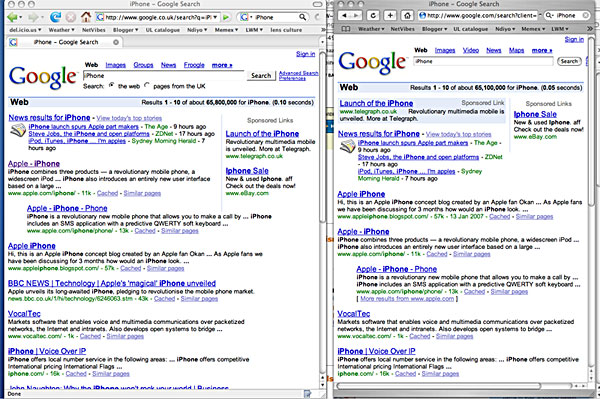
If you type “iPhone” into the Google search bars in Firefox (left) and Safari (right), you get subtly different results. Why? After all, one is querying the same search engine.

Thanks to Pete for pointing it out.

Later: Many thanks to all who emailed pointing out that one search was on google.co.uk and the other on google.com. The great thing about the Web is that it enables one to expose one’s ignorance/carelessness so comprehensively. Headgear being eaten as you read this.

Don DeLillo on writing

One’s personality and vision are shaped by other writers, by movies, by paintings, by music. But the work itself, you know — sentence by sentence, page by page — it’s much too intimate, much too private, to come from anywhere but deep inside the writer himself. It comes out of all the time a writer wastes. We stand around, look out of the window, walk down the hall, come pack to the page, and, in those intervals, something subterranean is forming, a literal dream that comes out of daydreaming. It’s too deep to be attributed to clear sources.

From a conversation with David Remnick that was published originally in the New Yorker and later in Reporting.

Online heckling

Thoughtful column by the Guardian‘s music critic, Dorian Lynskey, reflecting on the commenting that now follows almost every piece on the paper’s website…

I’m not convinced, though, that what might politely be described as “robust” debate on the blog generates light as well as heat. The internet has always licensed people to be far ruder than they would be in a face-to-face encounter. In 1990, US attorney Mike Godwin formulated Godwin’s Law: “As an online discussion grows longer, the probability of a comparison involving Nazis or Hitler approaches one.” Similarly, as an arts blog discussion grows longer, the probability of the writer being branded “smug”, “pointless”, “arrogant” or “London-obsessed” approaches one.

There is an appetite for genuine debate on the web, but it is often drowned out by the howling of people who seem to regard the very existence of professional critics as an outrageous affront. The subtext is this: anyone can be a critic, so anyone who has the temerity to be paid for the privilege deserves to be put in the stocks.

This is just one front in a wide-ranging battle between the blogosphere and so-called old media. In an ideal world, there should be room for both print critics and online ones, with plenty of overlap between them. Good writing is good writing, wherever it appears. But the campaign is in its early days and there are several years’ worth of grievances to thrash out before a peace treaty can be agreed.

Many of the people who post on blogs appear to be annoyed not by what the writers say so much as the fact that they’re in a position to say it. You can spot this type because they write things like: “You’ve only written this to provoke a reaction.” Or: “Why did you even write this? What a waste of time.” As if writing to complain about a waste of time were not, in fact, a bigger waste of time. Or, my favourite: “Typical Guardian.” Perhaps they also post on the website of Practical Caravan magazine, complaining: “Typical Practical Caravan. So caravancentric.”

The most belligerent voices on the blogs speak with either a weary, condescending sneer or a florid pomposity redolent of Ignatius J Reilly in A Confederacy of Dunces. If, as they imply, their taste is flawless and their intellect mighty, then perhaps they could find a better use for these prodigious gifts than taking potshots on websites. Just a thought…