The 4-hour working week

Hmmm… I like the sound of this. But I’m afraid it will be like one of those diet books which show how you can eat all the steak frites you want and still fit into size 10 jeans.

Bet Prez Sarkozy takes a dim view of this kind of thing. After all, he disapproves of the 35-hour working week.

A matter of perspective

Michael has a lovely picture comparing the bulk of a book he’s bought about the internals of the Mac OS X system with that of the Mac mini that hosts his blog (and is powered by the aforementioned operating system)!

Horticulture and software

Sue was a wonderful gardener and she left me with a nice garden — but without the knowledge, skill or time to maintain it properly. Now I find that I’ve got a serious problem with Ground Elder (Aegopodium podagraria to you) which Wikipedia tells me is “a common weed in the carrot family”. This seems to me to be a terrible libel on the carrot family, an amiable and delicious tribe. GE is a fiendish pest — and one that is virtually impossible to eradicate. It is, as this site helpfully puts it, “one of a handful of really nightmarish weeds. You have to be completely committed to getting rid of it as it takes constant vigilance and persistence. White flowers are produced from May to July.” The main way to keep it under control “is through constant vigilance – never allow the weed to flower or seed”.

Hmmm…. Contemplating this depressing news, I was struck by two thoughts. The first is that anyone who finds a remedy for this weed will not only do the world a great favour but become deservedly rich as well. In that respect, a cure for Ground Elder would be a much greater contribution to civilisation than any number of social-networking sites. The second thought is that Microsoft must feel about Open Source software much as I feel about Ground Elder!

Wikipedia claims that Ground Elder was brought to Britain by the Romans. Wish they would take it back then.

Before the fall…

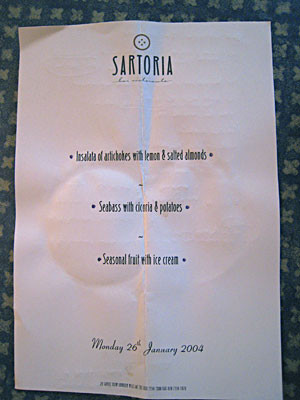
It’s funny what one finds in suit pockets. I have one posh, hand-made suit which I wear in the same way that admirals wear swords — on ceremonial occasions only. Rummaging in its pockets this morning I found this menu from Sartoria, an oh-so-New-Labour eaterie in Saville Row. It’s from a dinner party on the evening of Monday, January 26 2004, hosted by then Chairman of the BBC, Gavin Davies, who wanted to talk about the BBC’s ventures in the online world. Everyone present was aware that the report of Lord Hutton’s inquiry into the death of Dr. David Kelly was to be published on the following Wednesday, but we stuck resolutely to talk of online matters. In the Gents on the way out, however, I had a brief conversation with Gavin during which I wished him luck for the week ahead. It was clear from how he replied that he expected a tough time. But it was also clear that he expected Hutton to hand out blame all round. He was wrong: m’learned friend produced a whitewash, and by the end of the week both Davies and his Director-General, Greg Dyke, were gone.

As it happens, I think that Greg Dyke handled the Kelly story ineptly, but the ironic thing is that the BBC report that triggered Dr Kelly’s suicide and the Hutton Inquiry was essentially true. The Intelligence ‘dossier’ was indeed “sexed up” to persuade the British public — and Parliament — to support the Blair/Bush invasion.

The Blair legacy

This week’s Private Eye cover. Says it all, really. And yet, if it weren’t for Iraq, he would probably be remembered as a great reforming Prime Minister. As the man said, all political careers end in failure.

Stand by for the crash

The prime motive for a bubble in any field of human activity is the delusion that investing is a one-way bet. Britain (and, to an even greater extent, Ireland) is in the grip of a crazed property bubble. I don ‘t often agree with Will Hutton, but this time he’s spot on.

The risk of history repeating itself is known, but too few people believe it. Not the clubs of four or five young people ‘co-buying’ in order to have a chance of getting into the housing market. Not the wave of buyers of flats that are bought speculatively either to be let or which just stand vacant (and which now constitute one of the prime drivers of demand). Seventy percent of the 20,000 flats built in London last year were bought by buy-to-let speculators.

Neither they, nor those who lend the money, appear to be concerned that prices will fall. Cheltenham and Gloucester has just decided that it will finance small buy-to-let borrowers to buy up to nine properties rather than the three at present. The Bank of Ireland, according to the Financial Times, has just raised the maximum it will lend to any one entrepreneur by eight times – from £2.5m to £20m. It is risk-free lending. It may be that the yield from rents is lower than the costs of borrowed money, spelling disaster, but as property prices only rise, nobody worries. It is stories like these that prove we are in a bubble…

What’s funny about bubbles is that everyone knows, really, that they’re in one; but most assume that they personally will be ok.