
Picture by Sidnicious.
Lots of excitement on the Net sparked by the fact that Apple’s Fifth Avenue Store is closed for 24 hours for filming of a commercial. How many other companies can attract this much attention?

Picture by Sidnicious.
Lots of excitement on the Net sparked by the fact that Apple’s Fifth Avenue Store is closed for 24 hours for filming of a commercial. How many other companies can attract this much attention?
From John Markoff…
A variety of legends have grown up around Bill Gates’ brief career at Harvard. (He dropped out halfway through and co-founded Microsoft). On Tuesday night, during an interview at the “D: All Things Digital” conference in Carlsbad, Calif., Mr. Gates regaled the audience with his strategy of not bothering to attend classes and then catching up in a single intense burst during a separate reading period at the end of the term.
On Wednesday afternoon, Facebook founder and Chief Executive Mark Zuckerberg, himself a Harvard dropout, appeared to one-up Mr. Gates. Mr. Zuckerberg acknowledged that he had also skipped classes, in particular avoiding “Art in the Time of Augustus.”
When it came time for the end-of-term study period, he was too busy building the prototype of Facebook to bother to do the reading. So in an inspired last-minute save, he built a Web site with all of the important paintings and room for annotation. He then sent an e-mail to the students taking the class offering it up as a community resource.
In a half an hour, the perfect study guide had self-assembled on the Web. Mr. Zuckerberg noted that he passed the course, but he couldn’t remember the grade he received.
Zuckerberg’s the original one.

This is the smallest camcorder I’ve worked with so far. Big question: are the design compromises implicit in it the right ones? Will report in due course.
Interesting review by Christopher Caldwell of Steve Coll’s biography of Osama’s folks.
Is Osama bin Laden a rebel against the Saudi Arabian ruling class or a model member of it? That question lurks behind “The Bin Ladens,” by the Pulitzer Prize-winning New Yorker writer Steve Coll. The world’s most famous terrorist owes his fortune and his standing to a family business that Coll calls “the kingdom’s Halliburton.” Like Halliburton, the Saudi Binladin Group specializes in gigantic infrastructure projects. Government connections are the key to the family’s wealth.
Caldwell gives an excellent summary of the book, culminting in the revelation that the bin Ladens are still doing just fine.
Sept. 11 changed the family in two big ways: it made one of the sons into the hero of the Arab world, and it drove up the price of oil, igniting a construction boom. With oil topping $100 a barrel, the bin Laden group is thriving. It has 35,000 employees and expects to double in size in the coming decade. It is building airports in Egypt and elsewhere. In Mecca and Medina, it oversees vast real estate projects. “To please American audiences, the bin Ladens would have to seek forgiveness and denounce Osama,” Coll writes. “To please audiences in the Arab world, where the family’s financial interests predominantly lay, such a posture would be seen as craven.”
Seven years’ distance reveals a brutal reality. For both his family and his country Osama bin Laden’s attacks turned a profit.
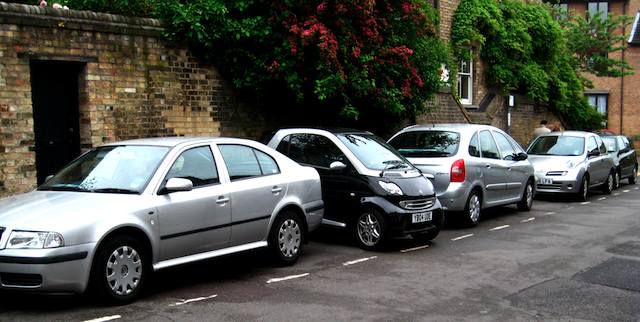
Observed on a Cambridge street the other day.

Here’s one of the first pictures from the Phoenix lander. Great stuff, of course. But gosh, doesn’t it look dull? ‘A vast featureless plain” as General Darling in Blackadder used to say, before his adjutant suggested that he turned over the map to look at the printed side.
I’ve never voted Tory in my life, but the awful prospect is beginning to look like a possibility. A key determinant of how I vote next time will be the parties’ stance on the national ID card scheme to which Gordon Brown & Co are fanatically committed. On Friday Bill Crothers, commercial director for the Identity and Passport Service, announced that five companies had won the right to bid for the billions of pounds worth of work involved under a framework agreement announced on Friday. They are CSC, EDS, IBM, Fujitsu and Thales. No surprises there, then.
But get this. These companies will have to be compensated for lost profits, in addition to their bid and other costs, if the Conservatives win a general election and carry out their pledge to scrap the scheme.
According to the Financial Times report,
The promise of loss of profit payments – standard in government IT contracts where there is a change of government policy – was, however, attacked as “improper and quite extra-ordinary” by David Davis, shadow home secretary.
Mr Davis said he had written to the IT suppliers in February giving formal notice that the Conservatives would cancel the project, and had reminded Sir Gus O’Donnell, the cabinet secretary, of the “longstanding convention that one parliament may not bind a subsequent parliament”.
“To guarantee these payments knowing that a future Conservative government has already said it will scrap ID cards is improper and quite extraordinary,” Mr Davis said. “I will be pressing ministers to explain under whose authority senior officials are making these promises.”
Stand by for the Labour argument that scrapping the ID Card would be wrong because it would cost too much in compensation.
Much is made of the fact that this kind of ‘compensation’ clause is standard for government work. Presumably, that’s because nobody would bid for the contracts without it. But doesn’t that tell you something interesting about the projects?
From today’s Telegraph
A Telegraph analysis of government figures shows how bonuses for City workers and other financial services professionals have continued to soar, exceeding previous records by more than £500 million.
The recent annual awards were mostly triggered by large profits made early in 2007, before the credit crunch hit, but will fuel a growing row over whether bankers are encouraged to take excessive risks with investors’ money.
The £12.6 billion sum would almost match the £15 billion hole that has emerged in the accounts of British banks as much of their profitability proved temporary…
Comment would be superfluous.
Hillary Clinton said something foolish the other day, and has spent the time since trying to extricate herself.
BRANDON, South Dakota (CNN) — Sen. Hillary Clinton said Friday that she regretted comments that evoked the June 1968 assassination of Robert Kennedy as part of her explanation for why she was staying in the presidential race late into the primary season.
Earlier Friday afternoon, she told the editorial board of the Sioux Falls, South Dakota, Argus Leader that “My husband did not wrap up the nomination in 1992 until he won the California primary somewhere in the middle of June, right? We all remember Bobby Kennedy was assassinated in June in California. I don’t understand it,” she said.
As devoted readers will know, the dangers to Obama in a gun-crazy culture have been on my mind too. But I’m not running for the nomination. What’s unacceptable is that Clinton appeared to be using the possibility of Obama’s assassination as a reason for staying in the Democratic race ‘just in case…’.
Dave Winer posted an MP3 of Keith Olbermann’s rant on the subject. It would have been just as effective at a quarter of the length. Olbermann hasn’t heard that brevity is the soul of wit.