
Intriguing joint venture by ASUS and Intel — a site which enables visitors to vote for the features they’d like to see in a notebook computer. A marketing stunt? Or something more profound?
Category Archives: Asides
Rip van Winklies
I’m astonished by the vox pops that journalists are doing in the US as they interview ‘undecided’ voters. Time and time again one hears people whining about Obama that they “don’t really know anything about him”. On what planet have these people been living for the past year? I know that most voters aren’t terribly interested in politics, but this is ludicrous. Does it mean that they can’t think of a respectable way of explaining why they’re not going to vote for a black candidate?
Crashed and burned
Robert Winder has a lovely essay in the Guardian about Tom Wolfe’s book, The Right Stuff. How does it read now, in the light of Bush, Iraq and thWall Street maelstrom? He concludes that
The Right Stuff is now best read as an elegy – a remembrance of vanished times. It describes a place and a mood that have crashed and burned. The seeds of this melancholy may already have been in place when the book was published – Wolfe was describing the early 60s from the vantage point of the late 70s, after all. But he was still able to work in an optimistic, fizzing spirit that has now quite dissolved: no one writes pop songs about astronauts the way that Bowie/Elton John/Pink Floyd and company once did. A book that once juddered with thoughts of the future now comes suffused with the past. Nostalgia for the 60s usually involves thoughts of free love, raw music and ditzy drugs, not the panic attacks inspired by Sputnik and the missile testing in Arizona and Florida. Wolfe was thrilled to find such subjects, and had superb, pyrotechnic fun with them. Who would have thought, only a generation later, that his eager, loop-the-loop prose would seem so sad?
He’s right. Sigh.
Recession is no time to abandon innovation
I was struck by this quote in an interesting NYTimes piece:
“In the middle of the 1970s, when we were having a big economic downturn, both Apple and Microsoft were founded. Creative people don’t care about the time or the season or the state of the economy; they just go out and do their thing.”
Palin’s energy policy
Lovely cartoon in current issue of the New Yorker. It shows a lot of glum airline passengers thronging a departure lounge. Outside on the tarmac can be seen lots of grounded planes. There’s a notice saying “Please be patient. We are drilling for fuel.”
It’s starting
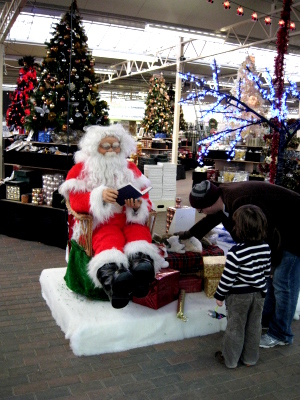
Spotted in Cambridge today. Naturally I checked to see what he was reading. The book was open at a chapter entitled “Fatness is Happiness”.
What to do on the web when a presenter leaves
James Cridland has some interesting reflections on the dilemmas facing BBC bosses following the Ross/Brand fiasco.
When a high-profile radio presenter leaves your station, it often poses a particular point of dissent between the website editor and the station management. “I want him off the website”, the edict will inevitably be. “Delete every single image of him.” And that’s understandable. But, sometimes, not the right plan.
During my time managing the content of the Virgin Radio UK website, I had a number of these events. Presenters came and went; some under a £75,000-Ofcom-fine-shaped dark cloud (hello, Jon!), some after a period of much publicised absenteeism, and some because they wanted to move to a different station…
How would Rabbit Angstrom vote?
A conversation with John Updike about the presidential race.
“A diamond-encrusted dud”…
… was Kelvin McKenzie’s pithy description of BBC Chairman, Sir John Lyons, on the (BBC) Today programme this morning, commenting on the Jonathan Ross/Russell Brand fiasco. The diamond-encrusted bit is a bit over the top, don’t you think?
Shorting Volkswagen
One shouldn’t laugh, I suppose, but you have to admit that what’s been happening to VW’s share price is a hoot. Here’s the FT report:
Volkswagen briefly became the world’s largest company by market capitalisation on Tuesday after an extraordinary surge in its share price driven by a near-panic by hedge funds and other traders to stem losses on positions betting on a fall in the stock.
The extent of the surge, which has led to sharp criticism of German capital markets, triggered intense market speculation that it could force the collapse of hedge funds and heavy losses for investment banks.
VW’s share price rose 82 per cent to €945 following Monday’s 147 per cent jump, leaving it with a market capitalisation of about €287bn ($360bn).
At the stock’s intra-day peak of €1005, its market capitalisation exceeded Exxon before the US oil company started trading yesterday.
It seems that hedge funds, reckoning that VW shares were bound to fall, borrowed them and sold them short. What they apparently didn’t realise is that Porsche and the State of Saxony between them owned or had options on 95% of VW shares. Frantic bidding for the remaining 5% resulted in crazy valuations of a car manufacturer that is — like all its peers — facing a bleak short-term future.
Heh, heh.