Twitter and Facebook

From this week’s Economist.

The services differ in two important respects. The first is the nature of the relationships that underlie them. On Facebook, users can communicate directly only if one of them has agreed to be a “friend” of the other. On Twitter, people can sign up to follow any public tweets they like. The service, which boasts Ashton Kutcher (4.3m followers) and Oprah Winfrey (3m) among its most popular users, is in essence a broadcasting system that lets users transmit short bursts of information to lots of strangers as well as to their pals. Facebook, for its part, is more of an intimate, continuing conversation between friends.

This difference is revealed in research conducted by Mikolaj Jan Piskorski, a professor at Harvard Business School, and one of his MBA students, Bill Heil. They surveyed just over 300,000 Twitter users in May 2009 and found that more than half of them tweeted less than once every 74 days. They also discovered that the most prolific 10% of twitterers accounted for 90% of all tweets. On other online social networks the most active users typically produce just 30% of all content. Another survey published in June by Sysomos, a research firm that had analysed 11.5m Twitter accounts, found that one in five people that were signed up to the service had never posted anything.

Another big difference between Twitter and Facebook is in the kind of content that gets sent over their networks. Facebook allows people to exchange videos, photos and other material, whereas Twitter is part-blog, part e-mail. “There’s a real difference here between the power of multimedia and the power of text,” says Dom Sagolla, the author of a book about the art of twittering.

I’m ashamed to confess that I’ve never heard of Ashton Kutcher. Perhaps I’m just having a Retired Colonel moment.

‘Larry and Sergey’ to offload 10m Google shares

From The Register.

Google co-founders Sergey Brin and Larry Page each plan to sell 5 million shares of their common stock in the company over the next five years.

According to an SEC filing, this is part of their respective “long-term strategies for individual asset diversification and liquidity.”

Larry and Sergey – as the filing actually refers to them – currently hold 57.7 million shares of Class B Google common stock. That represents roughly 59 per cent of the voting power of the company’s outstanding capital stock.

After selling 10 million shares, their voting power would drop to 49 per cent. But when you toss in the stock held by CEO Eric Schmidt, the Google holy trinity – who have vowed to work together until 2024 – will still control the majority of the company's voting shares.

I like that phrase “long-term strategies for individual asset diversification and liquidity”. Wonder if it’d work with my bank manager. He might, of course, ask what “assets” I possessed that might require “diversification”.

Just checked the Google share price. It’s currently $550.01. That makes 5 million shares worth, now,… let me see, $2.75 billion.

Business, Chinese style?

In a recent post I mentioned Mark Anderson’s criticisms of China which were posted on his Bright Fire blog.

Here’s an update:

I want to thank all of our posters on “What is China?” for their postings. I will note that our servers were attacked and brought down for a few minutes today, Friday, and that our tech team had the servers back up and running within minutes. Why do I mention this? Yesterday, an LA law firm which had filed a $2.2B suit against China for stealing the IP of a California company also found their servers attacked, just a day or so after the suit was filed.

Is this how we do business now?

I think it is very important, and enlightening for the rest of the world, that those who suffer cyber attacks after crticizing China, should go public IMMEDIATELY.

Like Google, and like SNS, the effect of this should be obvious: depriving China of the cyberattack tool it has recently deployed. Google claims that 34 other corporations were also hacked.

OK, CEOs of these corporations, it is time for you to step forward. We already have a human rights student from Stanford willing to stand up and say NO. Are you CEOs more afraid than she is?

How not to own up

David Pogue of the New York Times recently panned the Barnes & Noble e-Reader, the Nook. But in his review he missed something.

Barnes & Noble has been claiming that the Nook weighs less than it really does.

OK, not by much. The company says the thing weighs 11.2 ounces. In fact, it weighs 12.1 ounces. (I discovered this when my daughter set it on a home postal scale. Later, I confirmed it with a fancier scale at the actual post office.)

That’s right: Barnes & Noble conveniently shaved 7.4 percent off of the Nook’s weight, and hoped nobody would notice.

Well, OK. What’s 7.4 percent? I mean, we’re talking about an understatement of one ounce here. Who cares?

First of all, you might care if you have to hold this hard plastic slab in your hands for hours, as you must when you actually read books on it. (USA Today’s Ed Baig almost uncovered the secret when he wrote in his review: “Nook weighs 11.2 ounces compared with 10.2 ounces for the Kindle. I felt the extra ounce.” No, Ed–you actually felt the extra TWO ounces.)

The really interesting part of the saga begins when he contacts B&N for their reaction. They claimed it was all the result of an innocent mistake:

“Given the higher than anticipated demand for Nooks last year, Barnes & Noble made some minor variances in the manufacturing process to get units to customers more quickly,” says spokeswoman Mary Ellen Keating. “Those minor changes resulted in a marginal weight difference from the pre-production specs, making Nook 12.1 ounces. We are in the process of updating all references to the weight.”

Mr Pogue isn’t taken in.

No “oops,” no “we apologize for the error?” Nope; nothing but a cheesy attempt to spin this gaffe into a marketing message. The company blames the error on “the higher than anticipated demand.” …

And by the way — isn’t it funny that Barnes & Noble knew about the error, but never bothered to correct it until today, when I caught them and let them know I’d be publicizing it?

The moral he draws from the story is that if B&N faked something so simple that it could be checked with a simple postal scale, then reviewers will now have to be sceptical about all the tech specifications of devices they are given to test. For example, what about all those ludicrous claims of laptop battery life? How come no actual user ever seems to be able to get anywhere near the claimed usage time out of his/her machine?

For me, though, the more acute lesson comes from the way B&N tried to spin the story (“higher than anticipated demand”) when they were caught out. Why does nobody — well, almost nobody — ever admit a mistake any more?

Primary Apps

How about this — from Porchester Junior school.

If you’ve got an iPhone, or an iPod touch, then you need to get the Porchester App. Yes, that’s right, we have our very own App, designed and created by Mr. Widdowson, available for free from the App store that brings you the latest website articles, videos and audio from school.

We’re [sic] think it’s brilliant, and we’re not sure but…we might just be the first school to have our own App.

Eat your heart out, Eton!

The banal network

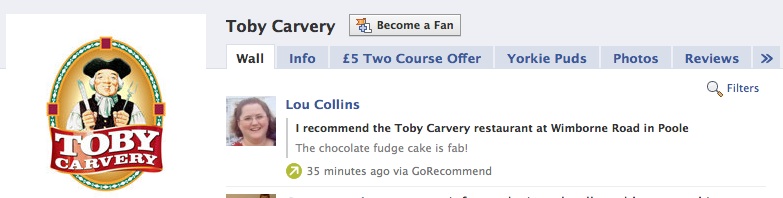
Travelling over the Christmas break, we had lunch one day in a cheap and cheerful eaterie in the midlands. It’s a good, non-nonsense, inexpensive carvery which, on the day we visited, was thronged with families having lunch. The first thing I noticed on our table was this card. To me, it signifies how far the Internet has come from being something weird and exotic to being positively mundane. When restaurant chains like this take it for granted that many of their (mainly working-class) clientele have a Facebook account, then you know that something’s happened.

I’m reminded of an observation that Andy Grove, then the CEO of Intel, made in 1999. “In five years’ time”, he said, “companies that aren’t Internet companies won’t be companies at all”. He was widely ridiculed for this prediction. Was he really suggesting that every fast-food joint and shoeshop would have to have online offerings? No: what he was trying to convey was the idea that, by 2004, the Internet would have become a utility, like electricity or the telephone or mains water. Most companies do not, for example, generate their own electricity. But if they’re not on the electricity grid (or the telephone network) then they’re at a severe disadvantage. So every company would, Grove thought, have to come to terms with the new reality of Internet-as-utility.

As it happens, he was a bit optimistic about the time it would take. But this Toby Carvery ad shows how perceptive he was.

Apple with Balsamic vinegar

We went to lunch at one of our favourite restaurants the other day and, before ordering, were given the standard board with bread plus butter and Balsamic vinegar in olive oil. This led us to wonder if the management knew we were slaves of OS X. Purists will argue that it must be coincidence — it lacks the mandatory bite out of the right-hand-side of the image. Still…

What the Google spat reveals about China

James Fallows — who recently returned to the US after a stint in China, whence he used to send very perceptive dispatches — has an interesting perspective in The Atlantic about the Google decision.

He thinks it represents a significant moment — “Significant for Google; and while only marginally significant for developments inside China potentially very significant for China’s relations with the rest of the world.”

In terms of its impact on Chinese Internet users, Fallows thinks that it’s not such a big deal.

In terms of information flow into China, this decision probably makes no real difference at all. Why? Anybody inside China who really wants to get to Google.com — or BBC or whatever site may be blocked for the moment — can still do so easily, by using a proxy server or buying (for under $1 per week) a VPN service. Details here. For the vast majority of Chinese users, it’s not worth going to that cost or bother, since so much material is still available in Chinese from authorized sites. That has been the genius, so far, of the Chinese “Great Firewall” censorship system: it allows easy loopholes for anyone who might get really upset, but it effectively keeps most Chinese Internet users away from unauthorized material.

The real significance, he argues, is that it may signify that China is entering its own “Bush-Cheney era”.

There are also reasons to think that a difficult and unpleasant stage of China-U.S. and China-world relations lies ahead. This is so on the economic front, as warned about here nearly a year ago with later evidence here. It may prove to be so on the environmental front — that is what the argument over China’s role in Copenhagen is about. It is increasingly so on the political-liberties front, as witness Vaclav Havel’s denunciation of the recent 11-year prison sentence for the man who is in many ways his Chinese counterpart, Liu Xiaobo. And if a major U.S. company — indeed, Google has been ranked the #1 brand in the world — has concluded that, in effect, it must break diplomatic relations with China because its policies are too repressive and intrusive to make peace with, that is a significant judgment.

[…]

In a strange and striking way there is an inversion of recent Chinese and U.S. roles. In the switch from George W. Bush to Barack Obama, the U.S. went from a president much of the world saw as deliberately antagonizing them to a president whose Nobel Prize reflected (perhaps desperate) gratitude at his efforts at conciliation. China, by contrast, seems to be entering its Bush-Cheney era. For Chinese readers, let me emphasize again my argument that China is not a “threat” and that its development is good news for mankind. But its government is on a path at the moment that courts resistance around the world. To me, that is what Google’s decision signifies.

This echoes something that Mark Anderson has been saying for ages — now reprinted on his blog:

Too often, today, sloppy thinkers and Western optimists assume that China is just a Big America, or a Big Vietnam, or a Fast India – or their Next Big Business Partner.

Wrong. At a time when the world thinks the communist model has been proved obsolete, China remains a communist country. In fact, under the current leader, Hu Jintao, human rights in China have recently suffered and are now in serious decline, according to Amnesty International-USA, the Committee to Protect Journalists, Human Rights Watch, and others.

China has tens of thousands, perhaps hundreds of thousands, of human censors monitoring citizen clicks and comments on the China government–controlled Internet. When my friend’s teenage daughter (a U.S. citizen) taught English there last year, police came to her apartment and grilled her about specific computer entries she had made. When one of Australia’s top mining firms, Rio Tinto, refused to allow China’s Chinalco to double its ownership interest last year (to 18%), China arrested local CEO (and Australian citizen) Stern Hu and three managers, who remain in jail today, under espionage charges. China denies any connection. In politics, thought, and business, China remains a police state.

We all refer to China as “China” now, as though it’s just One of the Gang, like “Ohio” or “Denmark”; after all, it’s a member of the G7, right? Just another market economy finding its way in the global river of events —

No, it’s not. And it isn’t in the G7. In fact, it isn’t even part of the G8, which includes Russia.

So now ask yourself: When is the last time you called Communist China, Communist China?

You’d better get used to it. There is no indication that the Chinese Communist Party has any intention of giving up any power at all, or of changing its power structure. In fact, discussion of anything political is basically off limits inside China; it is not done. Ah, you heard that there were some small moves toward shadow property rights in China? Sorry, that move has recently been reversed.

Mark goes on to itemise what he sees as the main tenets of Chinese policy. In his (bleak) view, they are:

1. Steal Intellectual Property.

2. Use Slave Labor Rates to Become the Low-Cost Producer of All Goods and Services.

3. Sell Stolen IP Back As Global Exports.

4. Industrial Policy: Subsidize Key Industries.

5. Prevent (or Restrict) Unwanted Imports.

6. Use Currency Manipulation to provide artificial aid to your export companies.

7. Price for Export, Suppress Domestic Consumption, and use domestic savings to drive the above policies.

8. Create the Appearance of Free and Fair Trade, Without the Fact.

9. Encourage Foreign Direct Investment – But Don’t Allow Controlling Ownership.

These are just the headlines — you need to read the full post to get the detail.