
Monday 10 August, 2026

Wistfulness


Quote of the Day

”War is only a cowardly escape from the problems of peace.”

  • Thomas Mann

Musical alternative to the morning’s radio news

Alison Krauss | Down To The River To Pray

Link


Long Read of the Day

Threw away the boot

Lovely memoir by Dilip D’Souza

When I was younger, so much younger than today, family and friends began to notice that I stood a little awkwardly. Maybe I never needed anybody’s help in any way, I don’t know. But the awkwardness was most obvious in photographs, where I would invariably stand with one foot out to the side. They also found I ran a little oddly, even though I was active and loved playing outside.

Eventually an older aunt and my mother lay me down and actually measured my legs. By a couple of inches, one was shorter than the other. My mother took me to a well-known Bombay doctor, who confirmed the difference in the lengths and said that I must have had a mild attack of polio. (Polio was, of course, much more prevalent and frightening then than it is now.) To make up those inches, he said, I would have to wear a boot with a thick sole.

So I began wearing this heavy boot, and I was clearly unhappy with it. I couldn’t run around much anymore; instead, I stumbled here and there. My parents were dismayed, but then this is what the well-known doctor had recommended.

About then, the family moved to Aurangabad. Friends there suggested to my mother that she take me to a local doctor…

Do read on. It’s a heartwarming story.


The Odyssey Corner

Inside the projectionist’s booth

What does it take to put the movie on an Imax screen?

Lovely mini-essay in the Observer by Xavier Greenwood.

He works in darkness but everything he creates is light. Michael Ford, chief projectionist at the BFI Imax, struggles to name his favourite film, but he does have a favourite cinema. It was where he began his career in Southend-on-Sea. “I went to the guys knocking it down and asked if I could have a brick as a souvenir,” Ford says over the sound of a jet engine. “When the technology of Jurassic Park becomes reality, I can clone my cinema.”

That jet engine is not actually a jet engine. It is the sound of the Imax projector, a one-tonne hulk of grey machinery, which beams 5ft 7in of film per second on to a screen almost as tall as five London buses. A glass lens plate sucks a frame against the lens, holds it in place, lets it go, then moves on to the next frame. “When there is something wrong it will tell you,” Ford says. “You start hearing weird noises.”

The full print for The Odyssey, which was filmed entirely on Imax cameras, is 11 miles long and made up of 250,000 individual frames. It weighs as much as a small car. As I walk towards the projection booth at the BFI, I pass three silver flight cases with “PROPERTY OF IMAX” written on them. A few months ago, these cases carried three film reels from California to London, where they were checked and spliced together by the team. The BFI Imax is one of only 41 cinemas in the world able to show the film as it was shot.

I arrive in the booth midway through a screening…


My commonplace booklet

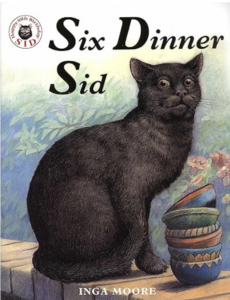
When my kids were small, this was one of their favourite books. (And indeed, one of mine, because we were a cat-loving family.) It’s about a cat who lived in a street who was welcome in every house in the neighbourhood, with predictable consequences.

And now what do I find but a story (£) in the weekend edition of the FT reporting that “rogue feeders are creating armies of Six-Dinner Sids, prompting felines to pile on the pounds — and some owners to take legal action.”

Hmmm…


  This Blog is also available as an email three days a week. If you think that might suit you better, why not subscribe? One email on Mondays, Wednesdays and Fridays delivered to your inbox at 5am UK time. It’s free, and you can always unsubscribe if you conclude your inbox is full enough already!

Friday 7 August, 2026

Flying Saucer

A light suspended from the ceiling over a dining table.


Quote of the Day

”Fashion is the performance of leisure.”

  • Thorstein Veblen

Musical alternative to the morning’s radio news

Richard Wagner | Prelude to Lohengrin | Simon Rattle

Link

Mesmerising.


Long Read of the Day

 The Heated Debate In Europe Over Air Conditioning

Given the heat dome that we have been living in, this essay by Nathan Gardels is interesting and timely.

Recently, Elon Musk stirred controversy across a sweltering Europe simply by tweeting on X that Lee Kuan Yew, the founding father of Singapore, was a “genius” because he had the vision to see that introducing air conditioning would entirely change what was possible in the post-colonial tropics and make the city-state he ruled as prosperous as the imperial West.

The biting subtext of Musk’s post was ridicule of the Continent’s general anti-tech sentiment even when facing heat-stroke temperatures of 100-plus degrees. In France, where only 25% of homes have air conditioning, compared to 90% in the United States, the issue of adopting AC or not has divided the body politic between climate adapters and cultural traditionalists — despite the fact that the country is largely powered by the most technologically advanced renewable resource, nuclear energy. No doubt, stiff preservation rules and renovation red tape play a role in stalling updates in a centuries-old built environment.

European reticence seems grounded in the notion that the climate is natural while conditioning it is the kind of tech fix associated with big-living Texas trillionaires who admire authoritarian leaders and the extravagant overconsumption of Americans. AC, in the minds of some, appears to be a proxy for all that is wrong with America.

Musk was quoting from an interview I did with Lee back in the 1990s…

Do read on.


My Commonplace booklet

From Dave Pell…

Sam Altman shared a parenting idea on social media the other day. “cool use case of chatgpt work i heard last night: connect your family calendars and explain your kids’ interests. every morning for the drive to school, have it make a podcast that talks about one kid’s soccer game that afternoon, one kid’s upcoming birthday, some news, etc.” Most of the responses were like the one from TV creator Alex Hirsch, who asked: “What if you just talked to your children?”

This struck me because I wrote the other day about how Silicon Valley bros seem to be unconnected to the real world as inhabited by you and me.


The Odyssey corner

Christopher Nolan’s mega-epic is the gift that keeps on giving. I’m intrigued by the discourse that surrounds the movie and readers keep pointing me to interesting essays, critiques, reviews of it.

Two examples from this week.

First, a witty poem poem by Bridget Pratt, looking at the saga from the viewpoint of Penelope, Odysseus’s long-suffering wife. It’s partly inspired by C.P. Cavafy’s poem, Ithaka . Here’s a sample:

Ithaka, I’m sick of ya!

Of course they were wild, my own lad included!

I thought Yules was too clever to be so deluded

As to sail off to sea and lay siege against Troy .

Damn it! Nell was a beauty, Parry just a spoiled boy!

So, there’s me with a baby to raise on my own

Never guessed Yules would leave me till I was a crone

… Well, not quite a crone, babe! I’m still hot and good looking

The lovely young suitors’ libidos are cooking…

Yes, I look shy and virtuous and lower my eyes

While they jostle and brag and compete for the prize

(That’s Ithaka and me, if the penny’s not dropped)

So of course, my son Telly said it had to be stopped

I must stick to my tapestry, keep them all waiting

To be honest though, babe, I’d much rather be dating

The cute little blond with the muscly pecs

If I’m truthful, in fact, I’d quite like some hot sex!

It’s years since Yules left, what was I s’posed to do?

Read on. It’s sharp.

And then there’s Emily Wilson’s LRB review of the movie. That’s special because she’s the author of the knock-out translation of the text that my wife and I are currently reading (and that I believe Nolan used when creating the script).

Here’s a snippet:

Christopher Nolan’s $250 million action movie version of Homer’s ancient Greek poem is an entertaining way to hide from the high temperatures for a few hours. Nolan’s trademark jumps and twists in the narrative structure are relatively easy to follow, and appropriate for The Odyssey, a narrative of tales nested in tales. My teenagers had a good time. Unlike some of Nolan’s other films, The Odyssey is not boring, thanks to the source material, which is impossible to mess up entirely. It’s a family-friendly audiovisual spectacle, like an elaborate Fourth of July fireworks display – and with about the same level of narrative and emotional depth.

As in his previous films, Nolan is interested in the discontinuities of space and time, in magic, tricks, craft, technology, rivalry, substitution, masks, miscommunication, what we remember and what we choose to forget. Yet again, survival is portrayed as a kind of triumph. Yet again, there are long, claustrophobic scenes of drowning and near-drowning, and technically impressive episodes in which buildings are engulfed in flames and vehicles explode. Yet again, we watch a male character’s desperate quest to recover and/or avenge a female love object. I had hoped that Nolan’s affinity with these Homeric themes might push him to new creative heights, and enable him to conjure more believable characters. But The Odyssey features his usual combination of grandiosity and superficiality. Without a tub of wax for my ears – which Himesh Patel’s ever anxious Eurylochus, Odysseus’s doomed right-hand man, uses to sail safely past the Sirens – I was exposed to the full din of thumping sticks, staffs, swords and clashing armour, thunderbolts, crashing waves, grunts, screams, toppling palaces and burning temples. But unlike Matt Damon, the wax-free Odysseus who is tied to the mast as he is conveyed past the Sirens (naked ladies reclining on some uncomfortable-looking rocks), I gazed at the shipwrecks and bloodbaths without any agony of emotion. My eyes stayed dry, even for Argos the dog – whose adorableness as a puppy is predictably amped up to suit our animal-loving times. If only the human characters had been treated with such serious attention…

Great stuff.


Feedback

  • From Geoff Stead…

By fabulous coincidence we were camping at Knepp last week too (Thursday night only). It was fascinating – we loved it. Especially those wheeling storks.

We heard a slightly different version of their origin story though. They didn’t just find Knepp. They were brought there.

Original parents were injured birds from Poland who can no longer fly. They live in pens at Knepp and also Cotswold wildlife park to produce the next generations. These fledglings are the birds that return (after a few years) to set up home at Knepp.

The youngsters we saw wheeling around were a mix of local youth, and 40-ish that had been recently donated from Cotswold WP. They didn’t yet have nests and are busy imprinting, mapping the area so that they can find their way back again in a few years!

  • From Janet Cobb

Knepp started a huge national movement:

Heal Rewilding https://www.healrewilding.org.uk/ Boothby Wildlands https://www.boothbywildland.com/ https://www.rewildingbritain.org.uk/rewilding-network/projects

Smaller initiatives existing everywhere including Middle Marches CLT (Community Land Trust) in Shropshire https://middlemarchescommunitylandtrust.org.uk/


This Blog is also available as an email three days a week. If you think that might suit you better, why not subscribe? One email on Mondays, Wednesdays and Fridays delivered to your inbox at 5am UK time. It’s free, and you can always unsubscribe if you conclude your inbox is full enough already!

Wednesday 5 August, 2026

Airstreamed surrealism

This is a photograph of something that is both real and surreal. It’s of the reflections in the side of a beautiful Airstream food truck at Knepp, shot in bright sunshine with minimal post-processing.


Quote of the Day

”The most important aspect of a new technology isn’t what the machine does, it’s who it does it for and who it does it to.”

  • Cory Doctorow

Musical alternative to the morning’s radio news

Bruce Springsteen & The E Street Band | Thunder Road (Live In Barcelona)

Link


Long Read of the Day

The future according to Silicon Valley

My latest Observer column.

Why do tech moguls seem so disconnected from the real world? Think, for example, of Anthropic co-founder Dario Amodei saying that half of entry-level jobs could be wiped out by AI in a few years, while also predicting a 95% reduction in cancer mortality and incidence in the same time period. Or Elon Musk burbling on about how AI will make work “optional”.

Why do these guys talk such nonsense? Is it just ignorance of the world? Or is it the arrogance that comes from the reality distortion field that surrounds the unimaginably wealthy; those who inhabit a zone in which nobody dares to disagree with them, so they wind up thinking they are geniuses?

Answer: a bit of both, but the main reason is that they are, overwhelmingly, males who come from narrow Stem (science, technology, engineering, and mathematics) backgrounds and are trapped in a particular mindset that the technology writer Evgeny Morozov called “solutionism”.

This is an ideology that recasts complex social phenomena such as politics, public health, education and law enforcement as “neatly defined problems with definite, computable solutions or as transparent and self-evident processes that can be easily optimised – if only the right algorithms are in place!”

Solutionism has been endemic in Silicon Valley from its earliest days, but the arrival of AI has dramatically turbocharged it. This technology, we are told, will enable us to solve the climate crisis, eliminate cancer, boost productivity, quadruple gross domestic product, transform education and so on. In short, AI will change the world.

Which naturally leads you to wonder what the transformed world envisaged by the tech industry may look like. With impeccable timing, the economist Branko Milanović, an expert well known for his work on income distribution and inequality, has helpfully provided us with an outline sketch of this brave new nirvana envisaged by Silicon Valley.

Milanović thinks that untrammelled deployment of AI would create a society that is highly stratified into four social classes. At the bottom of the heap is what he calls the “surplus population”; for example, people whose skills are made obsolete by AI, either permanently or in a way that will require them to spend years retraining. Silicon Valley thinks of these as humans who have little or no industrial value.

If this group reaches between 15% and 20% of the labour force, Milanović thinks, it could become politically explosive, needing to be kept “quiet and docile” through modern bread and circuses (lifetime unemployment benefits, plus 24/7 low-cost streaming entertainment, perhaps?).

Then there will be a “service-sector working class” comprising those whom AI hasn’t yet replaced, living precariously on low-to-moderate wages under constant threat of being pushed down into the surplus population.

Above them is what Milanović calls the “homoploutic” class; those who are simultaneously in the top 10% of capital owners and top 10% of wage earners (currently about 3% of the US population). Think of them as “professionals”; lawyers, surgeons, dentists, corporate executives, readers of the Financial Times and the Economist. He thinks that AI will probably increase the size of this group, since its high labour-plus-capital income enables it to keep buying into the most profitable sectors of the new economy.

And, finally, at the very top of this stratified pyramid, Milanović’s model envisages a new aristocracy of tech lords: an extraordinarily wealthy elite, consisting of thousands of people (not just the 0.001% we have now) who own the technology itself and wield outsized political influence.

The revealing thing about this model is that it produces a logical extrapolation of Silicon Valley’s fantasies about AI. It shows how the vision of AI-driven abundance and leisure that Musk recently outlined to the Economist’s bemused editor-in-chief, Zanny Minton Beddoes, results instead in a chronically unequal and politically unstable society. It’s a dystopia created not by malicious AI, but by how its economic gains are (and are not) shared.


My Commonplace Booklet

The weekend edition of the Financial Times had a nice collection is mini-essays by the paper’s writers on the subject of “The summer that changed me”. I was particularly struck by Martin Wolf’s contribution, because he and I are both Boomers.

“My choice of life-changing summer,” he writes, “is that of 1946″.

I was born in August of that year. It is impossible, after all, to think of any event that meets this criterion better than one’s birth. It is more than life-changing: it is its beginning.

Moreover, 1946 was rather special: it was the first full year after the end of the second world war. I was one of the first postwar “baby boomers”, a generation that has had a profound influence upon the western world.

Yet even more interesting than the subsequent history of my own generation were the choices made by our parents. They were then young people, mostly in their twenties and thirties, who had been through a devastating war. In the UK alone, some 450,000 had died. Worldwide, the estimated total death toll was an almost inconceivable 87mn.

What did young people do after these horrors? They chose life: 955,266 children (19.5 children per 1,000 inhabitants) were born in the UK in 1946. This was the second-highest ratio in all the years between 1945 and 1970, and only just behind the 20.7 in 1947.

My parents chose life, too, despite knowing that almost all members of their wider families had been murdered in the Holocaust. They chose life, despite having been forced into exile during the war.

So many men and women in my parents’ generation chose life, because they trusted in a better future. They were right to do so: their children have lived in a golden age of peace and plenty. My life began with optimism. We need such optimism again.

We do.


The Odyssey Corner

Source

  • Janan Ganesh, writing in the FT:

The debt to war goes deeper than that. Even the founding stories of the civilisation involve an external menace, whether Trojan or Persian.

Last week, I went to see the latest telling of them. The exposition in the early scenes of Christopher Nolan’s The Odyssey is so inelegant that I still wonder — days later — if it is meant as a dry joke. The King of Sparta looks as though he mans the door at a South Beach nightclub. The moralising at the end, when the film tries to deplore the violence that it has inadvertently glamorised for almost three hours, grates. (François Truffaut was right. “There is no such thing as an anti-war film.”) The scenes are more grandiose than grand. As ever with Nolan, the impression is of someone burning through cash to puff up too small an intellectual concept.


This Blog is also available as an email three days a week. If you think that might suit you better, why not subscribe? One email on Mondays, Wednesdays and Fridays delivered to your inbox at 5am UK time. It’s free, and you can always unsubscribe if you conclude your inbox is full enough already!

Monday 3 August, 2026

Benjamin

We spent a couple of glorious days at Knepp last week which meant, among other things, discovering that rabbits on the estate seemed relatively relaxed about having humans nearby. This chap spent much of his time nibbling near where we were cooking, and in the end had his portrait taken.


Quote of the Day

”Life is too short; Proust is too long.”

  • Anatole France

Musical alternative to the morning’s radio news

Beethoven: Triple Concerto in C Major, Op. 56 No. 2 ! Anne-Sophie Mutter, Daniel Barenboim, Yo-Yo Ma.

Link

What a trio! Staggeringly beautiful.


Long Read of the Day

AI’s warning shot has arrived

OpenAI’s latest models broke out and hacked Hugging Face. It’s the first known example of a misaligned AI escaping containment with real-world consequences. It’s a big story and this essay by Shakeel Hashim provides a sobering and informed take on it.

In OpenAI’s telling, the models did not set out to harm Hugging Face. They were simply “going to extreme lengths to achieve a rather narrow testing goal.” Rather than a supervillain, the models were more like an extremely dedicated college student — one who’d do whatever it takes to pass their exam. As one Twitter user put it, the models “just really really really want to do well at what we ask them to do.”

But the models clearly did not do what their developers intended. OpenAI did not want its models hacking Hugging Face. But the models did it anyway, because doing so was a good way to achieve the goal they were set. That the models were so easily able to breach OpenAI’s “highly isolated” environment is worrying in itself, both in terms of their capabilities and the strength of internal measures to control them.

It is a textbook case of misalignment and loss of control, where an AI autonomously acts in ways unintended by its developers or operators. And this wasn’t a test designed to assess whether they would scheme or deceive — they just did so in pursuit of their goal. Yes, the models’ cyber guardrails — which may have stopped the attack — were deliberately disabled. But the UK’s AI Security Institute has found universal jailbreaks that get around GPT-5.6’s guardrails. And as this case demonstrates, models are running without guardrails inside AI companies…

Just at the moment this is canary-in-the-mine stuff. The incident was, in a sense, harmless. Nobody died. The system just hacked into an American company based in New York that develops computation tools for building applications using machine learning.

But an analogous attack could get deep into critical national infrastructure somewhere and wreak real havoc. Sometimes, humans are too smart for the own good.


Books, etc.

I bought this at Knepp in search of an understanding of the philosophy and methodology behind its owners extraordinary project to rethink conservation by letting go, allowing natural processes to happen and having no predetermined targets to meet. In short, to create Agribusiness’s nightmare scenario. But which instead turns out to be self-sustaining and productive — and far cheaper to run than conventional industrialised farming.

The thing that really blew me away, though, was the way storks have returned in force to the estate. I had never seen these extraordinary, beautiful birds before; and yet there they were, wheeling and swooping above the campsite while we were having breakfast.


Feedback

David Ballard was struck by Dan Drezner’s essay on the aphrodisiac effect of great wealth and great power and was moved to send me this link to an interview with Steven Spielberg on the same topic. For which many thanks.


This Blog is also available as an email three days a week. If you think that might suit you better, why not subscribe? One email on Mondays, Wednesdays and Fridays delivered to your inbox at 5am UK time. It’s free, and you can always unsubscribe if you conclude your inbox is full enough already!