
The real threat to national security

One of the most infuriating things aspects of the Blair hooey about the ’45 minute’ threat to Britain posed by Saddam Hussein was the way it diverted attention from real and substantive threats to the country’s national security. Like the stranglehold that Putin’s Russia now exerts on our energy supplies.

This week’s Economist has a sobering piece about it.

RUSSIA’S president, Vladimir Putin, must be feeling smug. His strategy of using the country’s vast natural resources to restore the greatness lost after the break-up of the Soviet Union seems to be paying off. If power is measured by the fear instilled in others—as many Russians believe—he is certainly winning.

The Soviet Union relied on its military machine for geopolitical power: its oil and gas were just a way to pay for it. In today’s Russia, energy is itself the tool of influence. To use it the Kremlin needs three things: control over Russian energy reserves and production, control over the pipelines snaking across its territory and that of its neighbours, and long-term contracts with European customers that are hard to break. All three are in place. For all the talk of a common strategy towards Russia, the EU is divided and stuck for an answer.

Gazprom, Russia’s energy giant, cherished by Mr Putin as a “powerful lever of economic and political influence in the world”, has long-term supply contracts with most European countries, including France, Germany, Italy and Austria. It also has direct access to these countries’ domestic markets. The EU reckons that half its gas imports now come from Russia. Newer EU members, such as Hungary and the Czech Republic, are almost entirely dependent on Russian gas. Moreover, a pipeline network that it inherited from the Soviet Union gives Russia control over gas imported from Central Asia.

The EU has few ideas for how to deal with its chief energy supplier. “We know we should do something about Russia, but we don’t know what,” one Brussels official says. “In the EU we negotiate on the rules, whereas Russia wants to do deals.” The deals are coming thick and fast. Last month, Russia secured one to build an oil pipeline from Bulgaria to Greece that will bypass the Bosporus. Symbolically, it will be the first Russian-controlled pipeline on EU territory. The pipeline will carry Russian and Central Asian oil straight to the EU, avoiding Turkey.

Oil can at least be bought from elsewhere. The bigger worry is about the EU’s dependence on Russian gas. The flow of natural gas depends on the routes and control of pipelines, as European consumers were reminded when Russia switched off the gas supply to Ukraine just over a year ago and Ukraine started to steal Russian gas that was destined for the EU. Russia’s pipeline routes encircle the EU from the north and south…
No-Fly lists and false positives

What I love about the blogosphere is its collective intelligence — notwithstanding all the fuss about incivility etc. I’ve been fuming quietly ever since I read about the experience of Professor Walter Murphy, a decorated former marine who found himself on Homeland Security’s No-Fly list.

But now Ed Felten casts a calmer (and more informed) eye on the matter, and comes to a different conclusion:

There are two aspects to the no-fly list, one that puts names on the list and another that checks airline reservations against the list. The two parts are almost entirely separate.

Names are put on the list through a secret process; about all we know is that names are added by intelligence and/or law enforcement agencies. We know the official standard for adding a name requires that the person be a sufficiently serious threat to aviation security, but we don’t know what processes, if any, are used to ensure that this standard is followed. In short, nobody outside the intelligence community knows much about how names get on the list.

The airlines check their customers’ reservations against the list, and they deal with customers who are “hits”. Most hits are false positives (innocent people who trigger mistaken hits), who are allowed to fly after talking to an airline customer service agent. The airlines aren’t told why any particular name is on the list, nor do they have special knowledge about how names are added. An airline employee, such as the one who told Prof. Murphy that he might be on the list for political reasons, would have no special knowledge about how names get on the list. In short, the employee must have been speculating about why Prof. Murphy’s name triggered a hit.

It’s well known by now that the no-fly list has many false positives. Senator Ted Kennedy and Congressman John Lewis, among others, seem to trigger false positives. I know a man living in Princeton who triggers false positives every time he flies. Having many false positives is inevitable given that (1) the list is large, and (2) the matching algorithm requires only an approximate match (because flight reservations often have misspelled names). An ordinary false positive is by far the most likely explanation for Prof. Murphy’s experience.

Note, too, that Walter Murphy is a relatively common name, making it more likely that Prof. Murphy was being confused with somebody else. Lycos PeopleSearch finds 181 matches for Walter Murphy and 307 matches for W. Murphy in the U.S. And of course the name on the list could be somebody’s alias. Many false positive stories involve people with relatively common names.

Given all of this, the most likely story by far is that Prof. Murphy triggered an ordinary false positive in the no-fly system. These are very annoying to the affected person, and they happen much too often, but they aren’t targeted at particular people. We can’t entirely rule out the possibility that the name “Walter Murphy” was added to the no-fly list for political reasons, but it seems unlikely.

Double think

There’s a very interesting item on Andrew Sullivan’s blog. It’s about the British service personnel who were held by the Iranians and the prevailing double-think about confessions obtained under duress.

Here’s the problem: the Royal Navy folks were captured and subjected to some forms of duress, as a result of which they said all kinds of foolish things on Iranian TV — such as the admission that they had trespassed on Iran’s sovereign territory. Nobody believes this: the Brits knew exactly where they were. They’ve been using TomToms (as it were) for aeons. So when they arrive home, all kinds of accommodating noises are made; the poor kids had to say these idiotic things simply to get their tormentors off their backs, etc. etc. But it didn’t mean anything really.

One of Sullivan’s readers made an astute comment about this:

Meanwhile, the U.S. position is that torture (or torture-like) techniques garner valuable information as opposed to false statements engineered to end discomfort. Anybody else see a disconnect here?

Sullivan responds:

Count me in – but the public doesn’t seem to grasp this. It’s especially telling since we dismiss the statements of the captive British soldiers as the fruit of coercion even though their treatment was like a bed and breakfast compared to what has taken place at Abu Graib, Camp Cropper, Bagram or Gitmo. Why are we unable to make the same assumptions about other coerced testimony?

One possible answer is simply that as long as the victims of torture are not white or Western, they are not seen as fully human victims of torture – and therefore none of the rules we apply to full human beings count. Since any information from sub-humans is sketchy anyway, why not torture it out of them? It’s as legit as anything we’re likely to get out of them by conventional techniques. “Treat them like dogs” was General Miller’s express instructions at Abu Ghraib. And he saw the prisoners as dogs. In fact, if animal shelter workers in the West treated its dogs as some US forces have treated some detainees, they’d be fired for cruelty.

The scenario changes instantly when the victim of coercion is white or an allied soldier. It’s striking, isn’t it, that the only cases of torture in Gitmo and elsewhere that have had any traction in the wider culture have been people who do not fit the ethnic profile of Arabs. Jose Padilla is Latino; David Hicks is Australian. When they’re tortured, we worry about the reliability of the evidence. But when we torture “information” out of men called al-Qhatani or Khaled Sheikh Mohammed, the information we get is allegedly saving “thousands of lives.” How do we know this? Because the torturers, i.e. the Bush administration, tell us so. And so the circle of cognitive dissonance tightens until it becomes airtight.

Spot on. This is not a criticism of the Royal Naval hostages btw. They did what most of us would have done in the circs. There are strong moral arguments against torture. But there is also a very good pragmatic argument against it, namely that people will say anything — anything — to stop the torture. Ergo, you cannot believe anything they tell you under such circumstances.

Yo Blair!

Hmmm… New Labour has decided that it must “use” the “YouTube channel”. Somehow, I don’t think it’ll catch on. Especially when it’s up against stuff like this.

Homeland security

Here’s a sobering account of what happened recently to a distinguished US academic lawyer, Professor Walter Murphy of Princeton.

“On 1 March 07, I was scheduled to fly on American Airlines to Newark, NJ, to attend an academic conference at Princeton University, designed to focus on my latest scholarly book, Constitutional Democracy, published by Johns Hopkins University Press this past Thanksgiving.”

“When I tried to use the curb-side check in at the Sunport, I was denied a boarding pass because I was on the Terrorist Watch list. I was instructed to go inside and talk to a clerk. At this point, I should note that I am not only the McCormick Professor of Jurisprudence (emeritus) but also a retired Marine colonel. I fought in the Korean War as a young lieutenant, was wounded, and decorated for heroism. I remained a professional soldier for more than five years and then accepted a commission as a reserve office, serving for an additional 19 years.”

“I presented my credentials from the Marine Corps to a very polite clerk for American Airlines. One of the two people to whom I talked asked a question and offered a frightening comment: “Have you been in any peace marches? We ban a lot of people from flying because of that.” I explained that I had not so marched but had, in September, 2006, given a lecture at Princeton, televised and put on the Web, highly critical of George Bush for his many violations of the Constitution. “That’ll do it,” the man said. ”

“After carefully examining my credentials, the clerk asked if he could take them to TSA officials. I agreed. He returned about ten minutes later and said I could have a boarding pass, but added: “I must warn you, they’re going to ransack your luggage.” On my return flight, I had no problem with obtaining a boarding pass, but my luggage was “lost.” Airlines do lose a lot of luggage and this “loss” could have been a mere coincidence. In light of previous events, however, I’m a tad skeptical.”

“I confess to having been furious that any American citizen would be singled out for governmental harassment because he or she criticized any elected official, Democrat or Republican. That harassment is, in and of itself, a flagrant violation not only of the First Amendment but also of our entire scheme of constitutional government. This effort to punish a critic states my lecture’s argument far more eloquently and forcefully than I ever could. Further, that an administration headed by two men who had “had other priorities” than to risk their own lives when their turn to fight for their country came up, should brand as a threat to the United States a person who did not run away but stood up and fought for his country and was wounded in battle, goes beyond the outrageous. Although less lethal, it is of the same evil ilk as punishing Ambassador Joseph Wilson for criticizing Bush’s false claims by “outing” his wife, Valerie Plaime, thereby putting at risk her life as well as the lives of many people with whom she had had contact as an agent of the CIA. …”

Bin Laden has won, hands down. My boycott of the US stands.

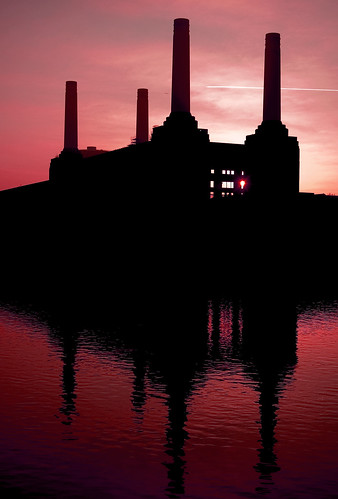
Battersea Power Station

It’s one of London’s iconic buildings, and a magnet for photographers (like my son, Brian, whose photograph this is), but there are rumours of a new attempt to replace it with a glass-walled monstrosity. Brian writes:

Yesterday, the Guardian reported that the new owners of the £400m prime 36+ acre riverside site, Treasury Holdings, had scrapped development plans approved by Wandsworth Council in November last year and speculated whether London might be about to lose the four iconic chimneys altogether to yet another bland, luxury, residential development if the Power Station is allowed to further deteriorate beyond the realms of renovation.

Wandsworth Council and previous owners, Parkview, refused to even consider an alternative report by a team of three companies of concrete experts brought together by the World Monuments Fund & Twentieth Century Society, who have revealed that the chimneys can be repaired for half the cost of demolition and rebuilding.

The independent report also revealed there is no sign of structural distress in the chimneys. When Parkview bought the site thirteen years ago, they promised to restore it, but instead sat on it and did nothing, merely hanging onto it as property speculators. They pushed through planning permission to demolish the chimneys, full of promises to restore the building, but instead immediately flogged it for a £240m profit, since the value of the site had increased hugely as a result of planning permission to demolish the chimneys. Profit not renovation was evidently their aim.’

There is a Number 10 e-petition that UK citizens can sign to put pressure on the developers to honour their agreement.

I’ve signed the petition. It reads:

‘We the undersigned petition the Prime Minister to prevent the proposed demolition of the chimneys of Battersea Power Station and to legally oblige the current owners to renovate the site, rather than sit on it and speculate as the previous owners did.’

Toffwatch

I enjoyed Toff At The Top — Peter Hitchens’s Dispatches documentary about Dave ‘Vote Blue to Get Green’ Cameron. I don’t much care for Hitchens, but this time I suspect he was on the money. His basic argument was that Cameron is a shameless opportunist who doesn’t believe in anything, and certainly doesn’t believe in the Conservative values that Hitchens worships.

One interesting snippet from the film came when Hitch was retracing Cameron’s days as an undergraduate at Oxford, where he was a member of the Bullingdon Club, a rowdy upper-class dining club famous for the sound of breaking glass and immortalised as the Bollinger Club in Evelyn Waugh’s Decline and Fall. The Bullingdons dress up in Regency evening wear and Hitchens had the brilliant idea of going to Ede and Ravenscroft, the expensive Savile Row tailor which maintains an establishment in Oxford (and indeed in Cambridge also) to cater for the sartorial needs of wealthy toffs like Cameron. He inspected the Bullingdon uniform and inquired about its cost. About £3,000.

Another interesting snippet. There’s an Oxford photography firm which regularly takes photographs of the Young Bullingdons in their finery. They have a particularly fine picture of young Cameron togged out for a night’s drinking and trashing. But it turns out that the firm has withdrawn the publication rights to all its Bullingdon pics of Cameron’s era — so that they are no longer published anywhere. Can’t even find them on Google Images. I wonder how much the Tories paid for that particular favour.

Hitchens also maintained that Cameron has thirteen Old Etonians in his Shadow Cabinet. Wow! Can this be true? Talk about a vast system of out-relief for the upper classes. It’s almost enough to make one look fondly on Gordon Brown. I said almost.

Update… David Mackinder found the key photograph — it was published by the Daily Telegraph with a helpful index to the main poseurs. Nice caption too: “Cameron as leader of the Slightly Silly Party”.

The absurdity of consistency

Quentin pointed me to this post in The Dilbert Blog. It reads, in part:

One of the most potent forms of persuasion has to do with people’s innate need to be consistent. Studies show that people will ignore logic and information to be consistent. (In other words, we are moist robots.) According to the research, humans are hardwired for consistency over reason. You already knew that: People don’t switch political parties or religions easily. What you didn’t know is how quickly and easily a manipulator can lock someone into a position.

For example, researchers asked people to write essays in support of a random point of view they did not hold. Months later, when surveyed, the majority held the opinion they wrote about, regardless of the topic. Once a person commits an opinion to writing – even an opinion he does not hold – it soon becomes his actual opinion. Not every time, but MOST of the time. The people in these experiments weren’t exposed to new information before writing their contrived opinions. All they did was sit down and write an opinion they didn’t actually have, and months later it became their actual opinion. The experiment worked whether the volunteers were writing the pro or the con position on the random topic.

Most of the truly stupid things done in this world have to do with this consistency principle. For example, once you define yourself as a loyal citizen of Elbonia, you do whatever the King of Elbonia tells you to do, no matter how stupid that is. And your mind invents reasons as to why dying is a perfectly good life strategy.

Right on. I’ve always thought that consistency is a peurile obsession. Oscar Wilde described it as “the last refuge of the unimaginative”. When Maynard Keynes was once accused (I think by a journalist) of changing his mind, he replied, “When the facts change, I change my mind. What do you do, sir?”

And one of the most nauseating aspects of modern British political journalism is the triumphant cry of “U Turn!” that goes up whenever a politician changes his or her mind. It seems to me that U-turns are a sure sign of a sentient, thinking being.

The Dilbert post attracted many idiotic comments, but one stood out from the crowd. It quoted this paragraph from Ralph Waldo Emerson’s essay on Self reliance:

A foolish consistency is the hobgoblin of little minds, adored by little statesmen and philosophers and divines. With consistency a great soul has simply nothing to do. He may as well concern himself with his shadow on the wall. Speak what you think now in hard words, and to-morrow speak what to-morrow thinks in hard words again, though it contradict every thing you said to-day. — ‘Ah, so you shall be sure to be misunderstood.’ — Is it so bad, then, to be misunderstood? Pythagoras was misunderstood, and Socrates, and Jesus, and Luther, and Copernicus, and Galileo, and Newton, and every pure and wise spirit that ever took flesh. To be great is to be misunderstood.